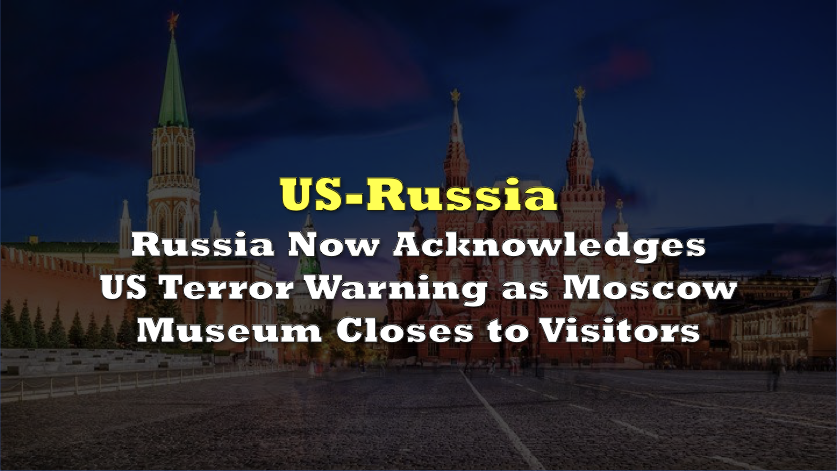

A crowded concert was interrupted and police sealed off a Moscow museum complex on Saturday after the US warned of a possible mass-casualty attack.
The US Embassy identified the Tsaritsyno Museum Reserve in southern Moscow as the location of a credible threat on Saturday, advising Americans to avoid the property and said Washington was coordinating with Russian authorities.
The alert did not identify suspects, a planned method of attack, or the intelligence behind its assessment.
 Sponsored · Silver47 Exploration Inc.
Russia’s Federal Security Service confirmed receiving information about preparations for an attack through established channels. Its public relations office told RBC that work was underway, while TASS, citing emergency services, reported that the reserve had closed for security operations.
Organist Lilia Pechenkina said an evacuation announcement interrupted her concert with roughly 10 minutes remaining, according to Russian outlet Fontanka, citing her account to Ostorozhno Media.
Reporting by Baza, carried by URA.RU, said some audience members initially failed to hear the warning over the music before museum employees escorted them out. Another scheduled concert was canceled.
The museum had advertised Pechenkina’s performance for 5 p.m. and a second musical event for 6 p.m. Police subsequently restricted access to the park, according to Russian media.
 Sponsored · PTX Metals Inc.
Fontanka also reported that when a reporter called the museum after initial warnings, a person answering the telephone said operations were normal and made a dismissive remark about alarmists. The caller’s identity and authority were not established. The sequence raises an unresolved operational question about when venue staff received actionable instructions.
The recent Russia’s response to American intelligence comes more than two years after the Crocus City Hall massacre that killed more than a hundred people.
On March 19, 2024, Putin told FSB leaders, “All these actions resemble outright blackmail and the intention to intimidate and destabilise our society,” referring to Western terrorism warnings. Three days later, attackers opened fire at Crocus City Hall near Moscow and set the venue ablaze.
The toll subsequently reached 149 dead and more than 600 wounded, according to figures cited when a Russian military court convicted 19 defendants in March 2026. Fifteen received life sentences.
Washington had publicly warned on March 7, 2024, that extremists might target large gatherings. The Washington Post later reported, citing unnamed US officials, that American intelligence had privately identified Crocus City Hall as a possible target.
Russian foreign intelligence chief Sergei Naryshkin maintained that the information Moscow received was too general to identify the attackers.
The Islamic State’s Afghan affiliate claimed responsibility for the 2024 massacre. Russia also alleged Ukrainian involvement without publicly substantiating that claim but Ukraine denied it.