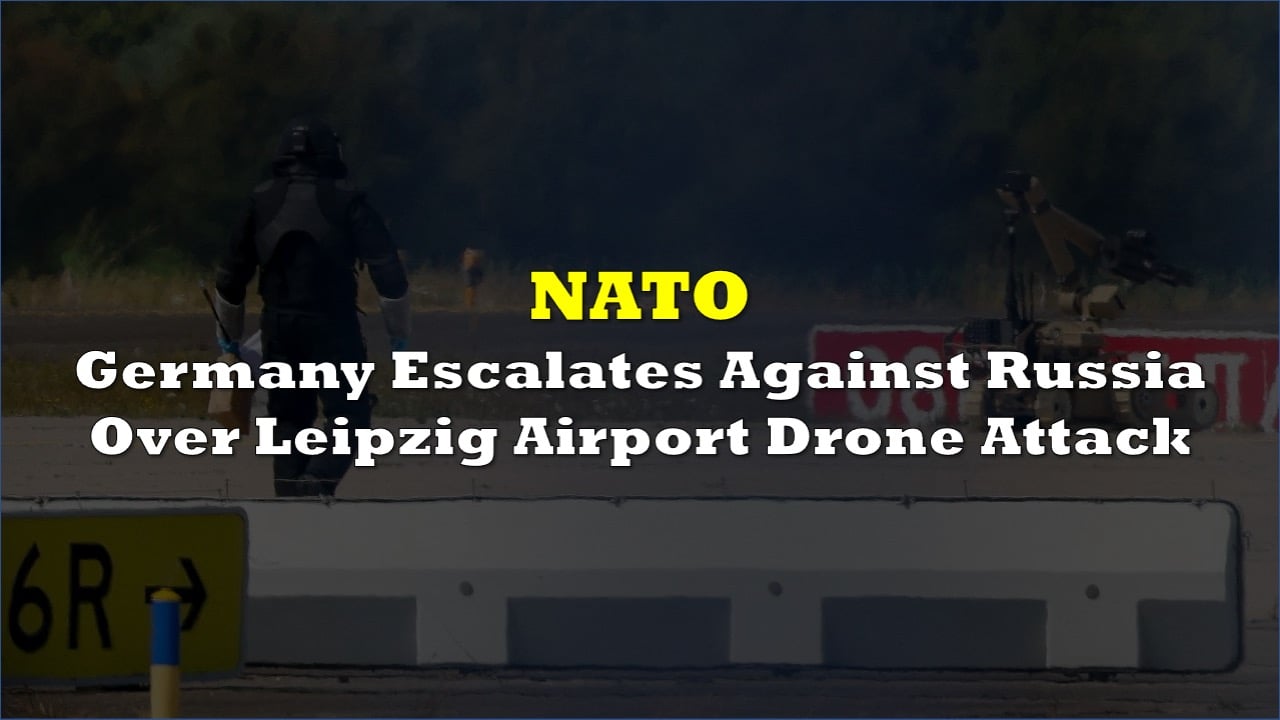

Germany’s government took a harder line Tuesday, formally declaring Russia responsible for last month’s attempted drone attack on Leipzig/Halle Airport rather than treating it as suspected foreign sabotage. The conclusion moves well beyond the US intelligence assessment reported previously.
Read: Leipzig Airport Drone Bore “Typical” Hallmarks of Russia’s GRU, US Says
Interior Minister Alexander Dobrindt said police investigations, the pattern of the attack, and intelligence findings together “prove a Russian responsibility” for the plot. He pointed to specific technical markers linking the device to Moscow, including a detonator and explosive charge consistent with patterns “known to us from other Russian hybrid operations,” describing a device whose construction showed real technical sophistication, even though low-level operatives likely carried it out.
Foreign Minister Johann Wadephul said Russia’s leadership had “decided deliberately to do significant damage” to an already strained relationship, announcing Germany will tighten entry rules for Russian nationals, push the EU to sanction more Russian individuals, increase pressure on the tanker fleet Russia uses to evade oil sanctions, close Russia’s consulate in Bonn effective September 18, and end the operating agreement for Berlin’s Russian House cultural center.
The response drew quick international backing, with NATO’s Mark Rutte pledging “full solidarity” and the European Commission’s Ursula von der Leyen promising a “clear response” that would include additional sanctions from EU foreign ministers meeting in Ireland this week. Russia’s foreign ministry said Moscow would respond to what it called Germany’s “anti-Russian action,” without saying how.
 Sponsored · Selkirk Copper Mines
EU foreign policy chief Kaja Kallas said Tuesday that Russia is hitting Europe with “a wave of increasingly kinetic hybrid attacks,” telling reporters the bloc is preparing its “most far-reaching sanctions against Russia yet.”
That same day, authorities discovered several improvised explosive devices at a substation near the Jänschwalde coal plant in Brandenburg, damaging power lines and briefly interrupting service before crews defused the remaining devices. Nobody was hurt, and the region’s premier called it a “trial attack.”
No one has claimed responsibility, and investigators haven’t attributed it to Russia. Brandenburg has also seen a string of arson attacks in recent years that a domestic far-left group claimed, including one that knocked out power to tens of thousands of homes for nearly a week.
Early on Wednesday, an unidentified object exploded in a passageway at Augsburg’s main train station, injuring two people and shattering windows before police shut down part of the station. Investigators haven’t established what the device was or what caused it to detonate, and nothing so far ties it to Russia or to the other incidents. It may well turn out to be unrelated.