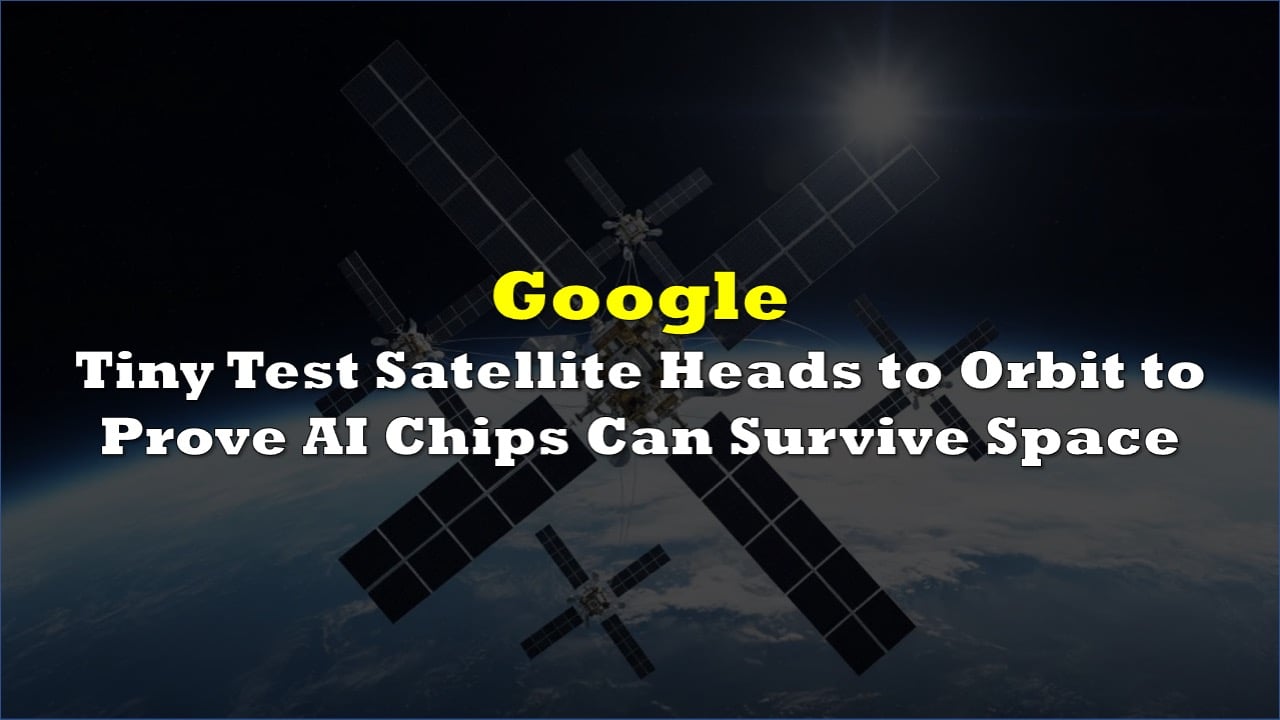

Google (Nasdaq: GOOG) is preparing to launch its first prototype satellite to test whether AI hardware can survive in orbit, with liftoff expected next week aboard SpaceX‘s Transporter-18 rideshare mission.
The satellite carries Google’s Trillium-generation Tensor Processing Units and was developed in partnership with Planet, the company said. The company says the chips have already survived vibration testing simulating a rocket launch — a spacecraft can pull up to 10 g during the climb to orbit, and individual components, including the chips themselves, can see spikes of 50 to 100 g — and radiation testing at UC Davis’s Crocker Nuclear Laboratory, where the TPUs held up against a dose greater than what they’d absorb over a five-year mission in space.
Read: Google and SpaceX Team Up to Put AI Data Centers in Orbit
 Sponsored · Selkirk Copper Mines
Google says satellites in low Earth orbit can access up to eight times more solar power than equivalent panels on the ground, since there’s no atmosphere or weather blocking the light. Google isn’t alone chasing that math — Musk’s SpaceX has floated deploying up to a million orbital data centers of its own under a project called Starmind, targeting a 2027 start, while Starcloud has already put an Nvidia GPU into orbit and Blue Origin is pursuing similar plans.
When the company first unveiled Project Suncatcher, Musk commented “Great idea lol” on the announcement — to which Google CEO Sundar Pichai replied, “Only possible because of SpaceX’s massive advances in launch technology!”
Google is treating this launch as a first, deliberately small step rather than a finished product — the next milestone comes in 2027, when the company plans to put two satellites in orbit to test high-bandwidth laser links between them, a technology it says will be needed to eventually coordinate entire clusters of orbiting chips.
Travis Beals, the Google Research director leading the project, wrote that the mission “is about seeing what works, identifying points of failure, and applying those findings to future missions.”