
A viral question out of Venezuela turned a disaster into a technology explainer: how did Google know an earthquake was coming before many people felt it?
Two powerful earthquakes struck Venezuela on Wednesday, with the first quake registering magnitude 7.2 about 160 kilometers west of Caracas, followed less than a minute later by a magnitude 7.5 tremor, according to the US Geological Survey. At least 32 people were initially reported dead and 700 injured, while officials warned the toll did not yet capture the worst-hit areas.
By Thursday, other reports citing interim President Delcy Rodríguez put the toll at least 164 dead and 971 injured, with major damage around Caracas and La Guaira. The government has already declared a state of emergency.
 Sponsored · Cambria Gold Mines
The USGS described the second as Venezuela’s most powerful since 1900.
The technology story surfaced because users shared screenshots of an Android alert that read “Sismo cercano,” warning that shaking was possible and showing an initial estimated magnitude of 6.2 at about 221.8 miles away. One post asked how Google knew “seconds before” the tremor began.
The answer is less mystical and more consequential. Google did not predict the earthquake. Its Android Earthquake Alerts System detected the earliest seishttps://x.com/enriqdev/status/2069915288921915397?s=20mic motion, processed signals from phones near the source, and pushed warnings to users farther away before the stronger shaking arrived.
Google says Android phones contain accelerometers that can sense vibration. Outside California, Oregon, and Washington, where Android distributes alerts from the ShakeAlert network, Google uses a crowdsourced model: phones that detect possible earthquake motion send a signal and coarse location to Google’s earthquake detection server, which combines data from many devices to determine whether an earthquake is happening.
The physics gives the system its opening. Earthquakes produce faster P-waves and slower, more damaging S-waves. The fast wave can trip sensors first, while alerts can travel electronically faster than the ground shaking moves. USGS explains that early warning systems work because messages can be transmitted almost instantly, while seismic waves move through the Earth at only a few kilometers per second.
 Sponsored · Nord Precious Metals
California’s earthquake warning program states the limitation bluntly: early warning is not earthquake prediction, and an alert cannot arrive before the quake starts. The goal is narrower but useful: reach people before they feel the strongest shaking.
That is why distance matters. People close to the epicenter may get little or no warning. People farther away may get a few seconds or more because the phone network and server pipeline can outrun the damaging waves. In Reuters’ Venezuela reporting, one office worker said she received a phone alert just before the shaking intensified, then felt light shaking before stronger movement followed.
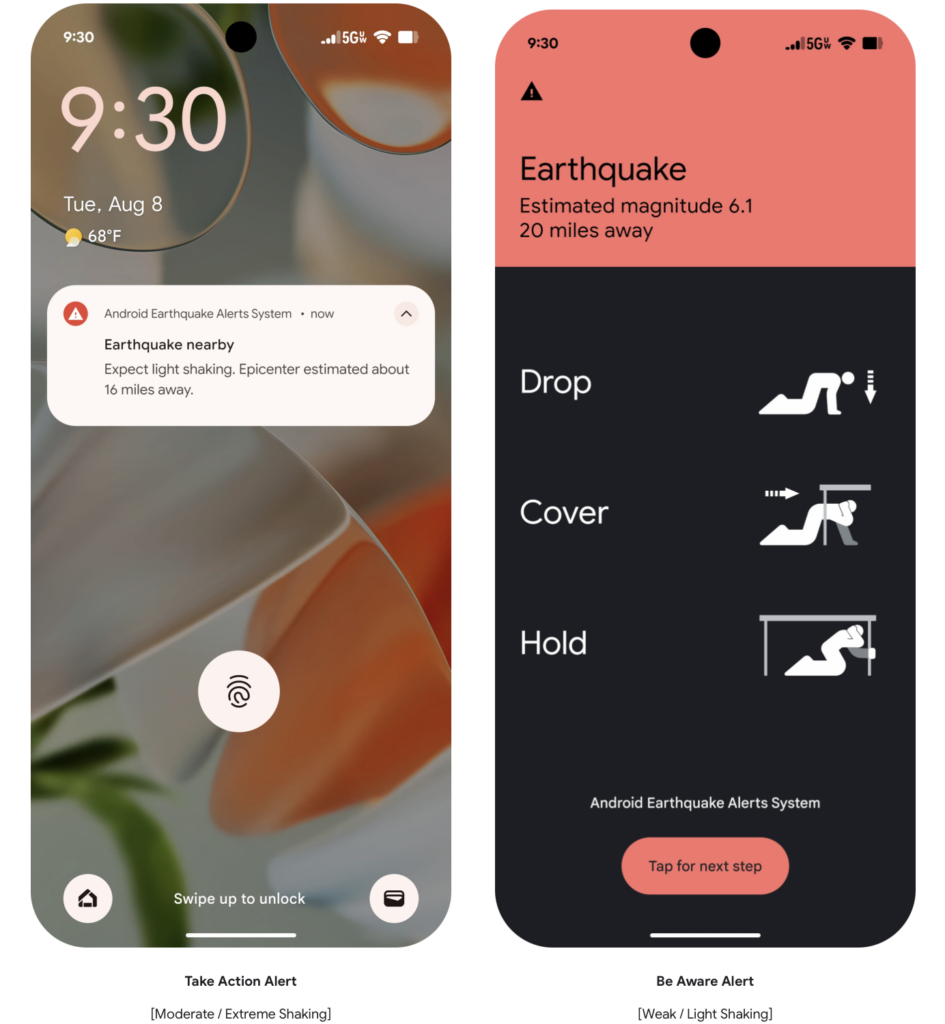
Google’s scale is the strategic edge. The company says the Android system uses more than 2 billion phones as “mini-seismometers,” making it the world’s largest earthquake detection network. Android sends two alert types for earthquakes of magnitude 4.5 or greater: Be Aware for weaker shaking and Take Action for stronger shaking, with the latter designed to override Do Not Disturb, turn on the screen, and play a loud sound.
In a 2025 Google Research post tied to a science paper, the company said the system was active in 98 countries by the end of 2023. Google also said its first magnitude estimate error had improved over three years, with median absolute error falling from 0.50 to 0.25.
The same post cited major real-world examples: nearly 2.5 million alerts during a magnitude 6.7 earthquake in the Philippines in November 2023, more than 10 million alerts during a magnitude 5.7 earthquake in Nepal, and more than 11 million alerts during a magnitude 6.2 earthquake in Turkey in April 2025.