

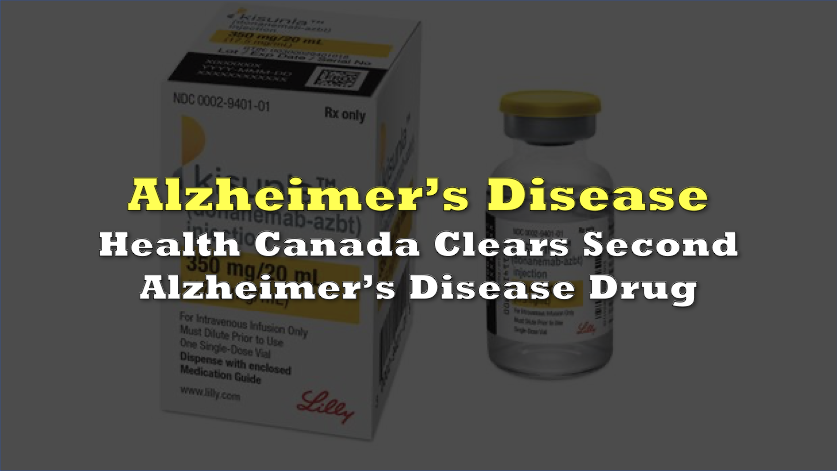

Health Canada has approved Eli Lilly’s once-monthly Alzheimer’s drug donanemab, giving Canada a second therapy that targets amyloid plaques tied to the disease.
Eli Lilly Canada, part of Eli Lilly, said Health Canada authorized Kisunla, the brand name for donanemab, for adults with mild cognitive impairment or mild dementia due to Alzheimer’s disease who are ApoE ε4 heterozygotes or non-carriers and have confirmed amyloid pathology. The product monograph lists the same restricted early-stage indication, excluding broader use in later-stage dementia.
The approval comes more than two years after Health Canada accepted donanemab for review in February 2024, and follows the October 2025 approval of lecanemab, sold as Leqembi, which became Canada’s first approved drug designed to slow Alzheimer’s progression by clearing amyloid rather than only managing symptoms.
 Sponsored · Cambria Gold Mines
Donanemab enters Canada with a sticker price of $47,250 per year, according to Eli Lilly Canada, above the nearly $30,000 average annual price cited for Eisai’s lecanemab. Public plans typically negotiate confidential discounts before listing drugs, but the visible gap still matters because Canada’s drug-review system is already skeptical of the class.
In February, Canada’s Drug Agency’s expert committee issued a draft recommendation against public reimbursement for lecanemab for early Alzheimer’s disease, saying the evidence did not clearly show clinically meaningful benefit and flagging the need for MRI monitoring for amyloid-related imaging abnormalities, including swelling and microbleeds in the brain.
That leaves lecanemab, at least for now, mainly available to Canadians who can pay out of pocket or rely on private insurance. Donanemab’s approval therefore creates a two-drug regulatory market before Canada has resolved whether public plans should fund even the first entrant.
Lilly said Kisunla is approved in 48 markets globally, but public funding remains limited, including in the US, China, and Japan. In the UK, NICE rejected routine funding for lecanemab and donanemab after concluding the benefits were too modest relative to cost and rollout demands.
Alzheimer’s is the most common cause of dementia, a condition thought to affect about 770,000 Canadians. The new drugs do not reverse the disease, and they are not indicated for patients beyond early stages, but clinicians and patient advocates argue they mark a meaningful break from purely symptomatic treatment.
Information for this briefing was found via The Globe And Mail and the sources and the companies mentioned. The author has no securities or affiliations related to this organization. Not a recommendation to buy or sell. Always do additional research and consult a professional before purchasing a security. The author holds no licenses.








One Response
When will they stop looking at the plaques and look for other causes and cures. This has not been working for years. Find out what causes the plaques in the first place perhaps. Always treating symptoms….never truly looking for cause.