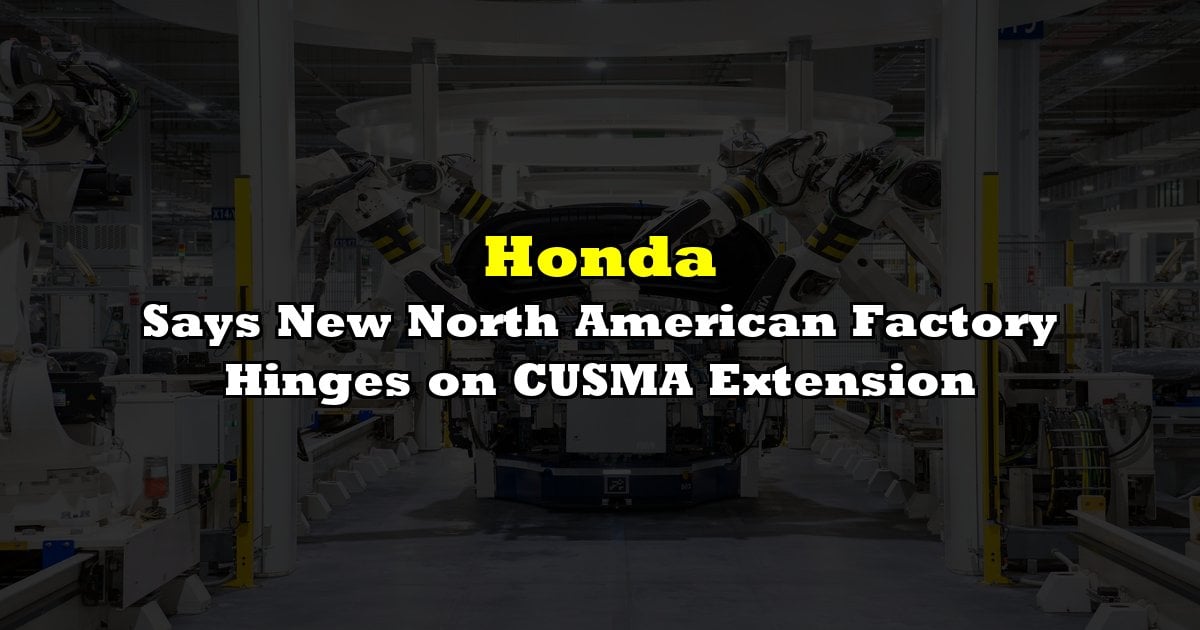

Billions of dollars in potential investment across the continent are suddenly in question, as Honda Motor Co. signals that its future manufacturing footprint in North America could stall entirely if the region’s trade framework is not preserved.
The automaker indicated it may forgo building any new plants in North America unless the Canada-United States-Mexico Agreement is extended, tying long-term expansion plans directly to the fate of the trilateral pact.
That threat carries weight given how central the region is to Honda’s operations. The company runs an extensive network of assembly and component facilities across the United States, Canada and Mexico, and cross-border supply chains have long allowed automakers to move parts and vehicles between the three countries with minimal friction.
 Sponsored · Selkirk Copper Mines
CUSMA, which replaced NAFTA, is due for a formal review, and the uncertainty around whether it survives in its current form has left manufacturers reluctant to commit capital to major new projects. For an industry that plans production years in advance, ambiguity over tariffs and rules of origin makes it difficult to justify greenfield spending.
Honda’s position reflects a broader anxiety in the auto sector, where tariff risk has become a recurring theme. Without the predictability the agreement provides, the economics of adding capacity in the region grow harder to defend, and the company appears prepared to hold off rather than gamble on a favourable outcome.
The comments also underscore how trade policy has moved from the background to the centre of corporate decision-making. What was once a routine matter of logistics now shapes whether new factories, and the jobs that come with them, materialize at all.
Canada faces a pointed message here. The country’s auto manufacturing base depends heavily on integrated North American trade, and any pullback in fresh investment would ripple through suppliers and workers tied to the sector.
Honda has not committed to a specific new facility, but its warning makes clear that the path forward depends on what happens to the agreement.