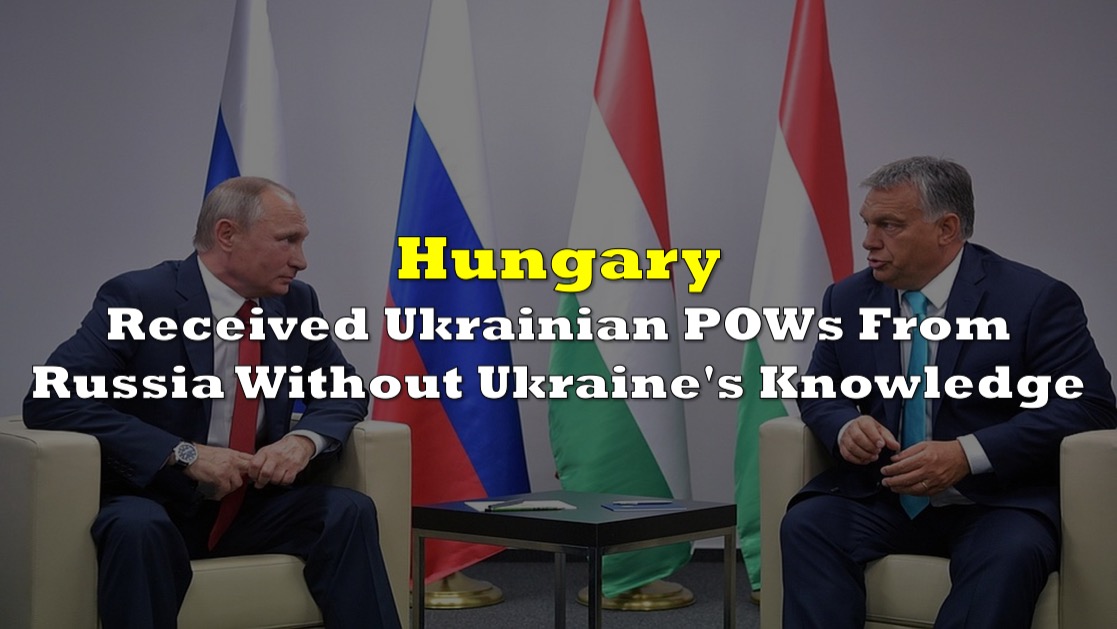

Hungary made a surprising announcement on Friday, revealing that it had successfully received a group of Ukrainian prisoners of war from Russia. This unexpected release was met with mixed reactions, as Ukraine expressed its concern over not being informed about the operation.
The prisoners of war hailed from the western region of Ukraine, which shares a border with Hungary, according to the Russian Orthodox Church, which played a role in the release, and Hungarian Deputy Prime Minister Zsolt Semjen.
“This is my human and patriotic duty… we have brought back from Moscow 11 prisoners of war from Transcarpathia,” a post on Semjen’s official Facebook page said.
 Sponsored · Selkirk Copper Mines
In Hungary, Prime Minister Viktor Orban’s government has long shown support for the Russian Orthodox Church. It has even gone as far as blocking proposals from other European Union (EU) members for imposing sanctions on the Church’s overall leader, Patriarch Kirill.
A statement published on the website of the Russian Orthodox Church’s Moscow Patriarchate late Thursday clarified that the transfer of the Ukrainian prisoners of war to Hungary had been carried out at the request of the Hungarian side. The statement, however, was labeled as “fake news” by a Hungarian government spokesman early on Friday, although he later became unreachable for further comment.
The reason behind this apparent confusion within the Hungarian government remains unclear at this time.
Meanwhile, Ukraine, which has managed to secure prisoner exchanges with Russia through international mediation during the ongoing 15-month-long invasion, expressed its surprise at not being informed about the release of its prisoners. The country’s foreign ministry promptly reached out to Hungary’s representative in Ukraine, urging immediate access to the released individuals.
 Sponsored · Altamira Gold Corp.
Foreign ministry spokesperson Oleg Nikolenko, acknowledging the positive aspect of the prisoners’ release, wrote on Facebook, “The release of Ukrainian prisoners of war is always good news.” He also emphasized the importance of coordinating cooperation on such sensitive matters.
It is worth noting that Hungary, unlike its fellow EU and NATO members, has refrained from providing military assistance to Ukraine. Additionally, it has repeatedly voiced its disapproval of EU sanctions against Russia. Nonetheless, Hungary has ultimately supported all the agreed-upon measures thus far.
Recently, the United States has imposed sanctions on more than 120 targets in response to Moscow’s invasion of Ukraine, including entities and companies like majority Russian-owned International Investment Bank (IIB) in Hungary, as well as its current and former executives.
While many feared that bringing the Hungarian-based, Russian-owned bank within the sanctionsphere will muddle further the tense relations between the two countries, Orban sought to bring down the temperature between his government and the United States following the sanctions.
Orban agreed that IIB “could have played a serious role in developing Central European economies,” adding that the already limited effectiveness of the bank has been effectively “ruined” following the sanctions.
The sanctions and Orban’s pronouncements come alongside Hungarian Foreign Minister Peter Szijjártó’s diplomatic moves within the same week. He travelled to Russia to finalize new energy accords then returned to receive the Moscow-allied Belarusian foreign minister in Budapest, Sergei Aleynikov, President Alexander Lukashenko’s self-proclaimed main diplomat, on the following day.
Following Szijjártó’s travel to Moscow to sign a series of energy accords, Politico reported that Oleg Ustenko, Ukraine’s president’s economic adviser, stated that Budapest’s new energy deals with Russia would simply prolong the conflict in Ukraine.
“If you’ve seen the video where Russians cut the head off a Ukrainian soldier, the Hungarians are paying for the knife,” Ustenko said.
While Hungary and Ukraine have been engaged in a longstanding dispute over the treatment of the ethnic Hungarian minority in Ukraine, it is essential to recognize Hungary’s assistance to hundreds of thousands of Ukrainian refugees who have sought shelter in the country.
In conclusion, Hungary’s recent operation to receive Ukrainian prisoners of war from Russia has sent shockwaves through the region. With Ukraine caught off guard by this unexpected development, questions arise regarding Hungary’s motivations and the coordination between the two nations. As tensions persist, the fate of the Ukrainian prisoners and the future of Hungarian-Ukrainian relations remain uncertain.
Information for this briefing was found via Reuters and the sources mentioned. The author has no securities or affiliations related to this organization. Not a recommendation to buy or sell. Always do additional research and consult a professional before purchasing a security. The author holds no licenses.