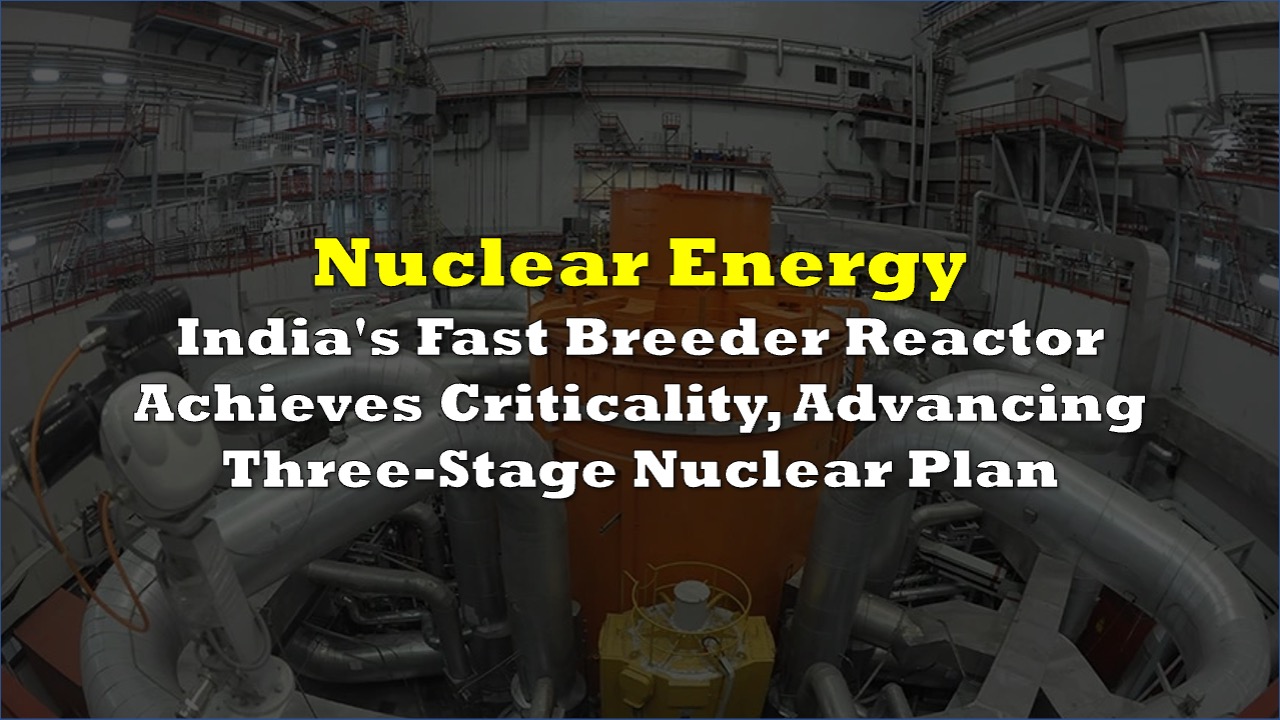

India’s Prototype Fast Breeder Reactor achieved criticality on April 6, advancing the country’s long-delayed push to harness its vast thorium reserves for nuclear power.
The 500-megawatt electric sodium-cooled reactor at Kalpakkam, Tamil Nadu — designed by the Indira Gandhi Centre for Atomic Research and built by state-owned Bharatiya Nabhikiya Vidyut Nigam Ltd. (BHAVINI) — now sustains a controlled nuclear fission chain reaction without external neutron input. Commercial operations are expected by September 2026, pending staged power increases and regulatory sign-offs.
Prime Minister Narendra Modi called the achievement “a decisive step towards harnessing our vast thorium reserves” in an April 6 post on X, congratulating the scientists and engineers involved.
Today, India takes a defining step in its civil nuclear journey, advancing the second stage of its nuclear programme.
— Narendra Modi (@narendramodi) April 6, 2026
The indigenously designed and built Prototype Fast Breeder Reactor at Kalpakkam has attained criticality.
This advanced reactor, capable of producing more fuel…
The PFBR burns uranium-plutonium mixed oxide fuel, surrounding its core with a uranium-238 blanket that transmutes during operation to produce more fissile material than the reactor consumes. A thorium-232 blanket is also planned, breeding uranium-233 for the third stage of India’s nuclear programme.
India’s three-stage nuclear strategy, conceived by physicist Homi Bhabha in the 1950s, was built around a stark resource imbalance: the country holds roughly 25% of the world’s known thorium reserves but only 1–2% of global uranium. Bhabha’s plan uses second-stage fast breeder reactors to build the fissile stockpile needed to sustain a thorium fuel cycle in the third.
The project took far longer than planned. Construction began in 2004 with a 2010 completion target, but fuel handling failures, coolant issues, and procurement delays drove costs to approximately ₹6,840 crore by 2021 — nearly double the original estimate. India’s Atomic Energy Regulatory Board cleared BHAVINI for final fuel loading in October 2025, with more than 200 domestic industries contributing to the build.
At full power, India joins only Russia in operating a fast breeder reactor commercially. China’s CFR-600 has entered early operation, while France, the US, and Japan have largely shuttered their own breeder programs over high costs and technical complexity.
The Department of Atomic Energy has proposed two additional 600-MWe fast breeder reactors at Kalpakkam, along with five small modular reactors by 2033 — both part of the government’s Nuclear Energy Mission, which targets 100 GW of nuclear capacity by 2047.
Information for this story was found via the sources and companies mentioned. The author has no securities or affiliations related to the organizations discussed. Not a recommendation to buy or sell. Always do additional research and consult a professional before purchasing a security. The author holds no licenses.