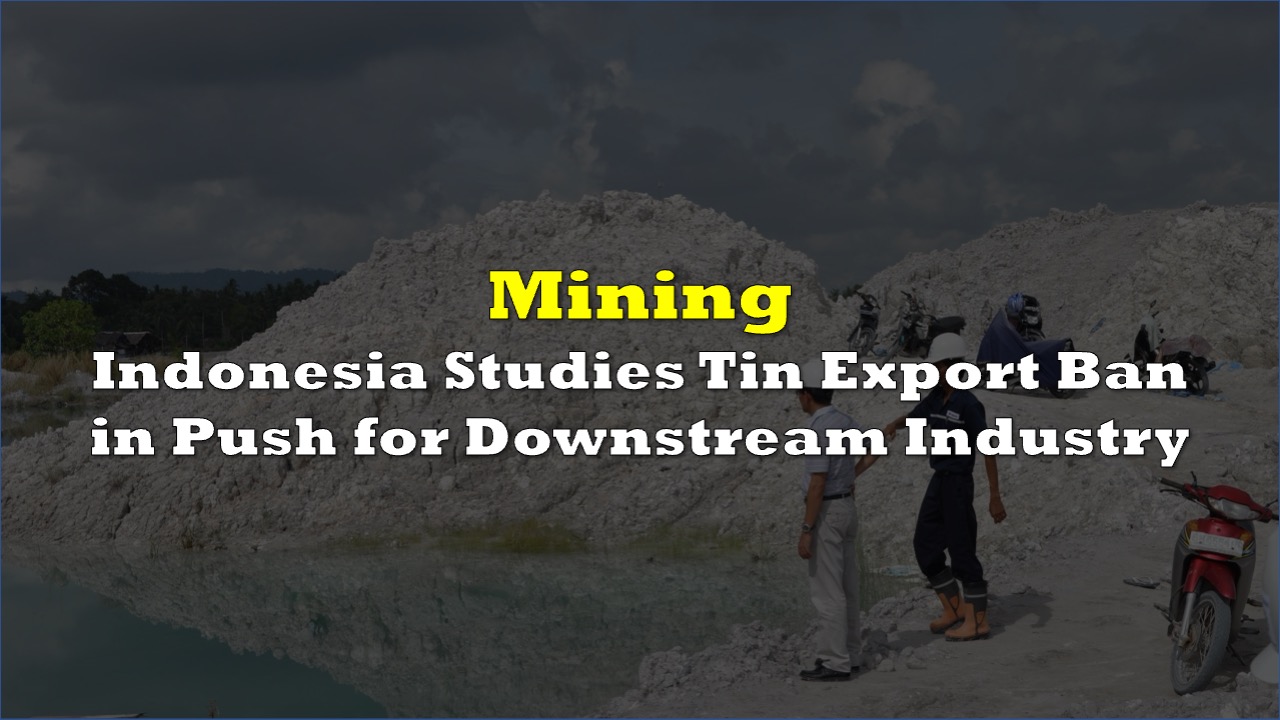

Indonesia is studying a plan to ban tin exports as President Prabowo Subianto’s administration extends a resource nationalism strategy that has already transformed the country’s nickel sector.
Energy and Mineral Resources Minister Bahlil Lahadalia announced the move Friday at the Indonesia Economic Outlook 2026 forum in Jakarta, telling an audience that included international agency representatives that the government intends to stop shipping raw materials abroad at low margins.
“Last year we have banned bauxite exports and in the coming years, we are studying to ban a number of other commodities including tin,” Bahlil said. “We should no longer export raw materials.”
Indonesia wants to ban exports on more raw materials, including tin.
— Brandon Beylo (@marketplunger1) February 17, 2026
You're seeing a lot more of this lately with raw material dominant exporters.
They're not satisfied with the lower margin/revenue sales.
They want higher-margin refined/finished goods. pic.twitter.com/wWtAWgteGk
No timeline has been set. Bahlil pointed to the nickel export ban — fully imposed in 2020 — as the model. Processed nickel exports climbed from $3.3 billion in 2017 to $33.9 billion by 2024, a tenfold rise he cited as justification for applying the same playbook to tin and other minerals.
Related: Indonesia orders largest nickel mine to slash ore output
Indonesia is the world’s largest exporter of refined tin and ships roughly 95% of its domestic refined tin production overseas. The metal is a critical component in semiconductor soldering, electric vehicle battery connectors, and solar panel photovoltaic cells — placing it at the center of global energy transition supply chains.
Supply pressures were already building before Friday’s announcement. Indonesia launched a crackdown on illegal tin mining across Bangka and Belitung islands in late 2025, targeting roughly 1,000 unlicensed operations. Myanmar’s Man Maw mine, one of the world’s largest tin producers, has remained largely offline since late 2023.
Indonesia’s export bans have drawn repeated international fire. The World Trade Organization ruled its nickel restrictions violated the 1994 General Agreement on Tariffs and Trade, but the absence of a functioning WTO appellate body left the decision unenforceable — a precedent Jakarta appears willing to repeat.
Bahlil said six of 18 priority downstream projects submitted to state asset manager Danantara entered the construction phase this month.
Information for this story was found via the sources and companies mentioned. The author has no securities or affiliations related to the organizations discussed. Not a recommendation to buy or sell. Always do additional research and consult a professional before purchasing a security. The author holds no licenses.