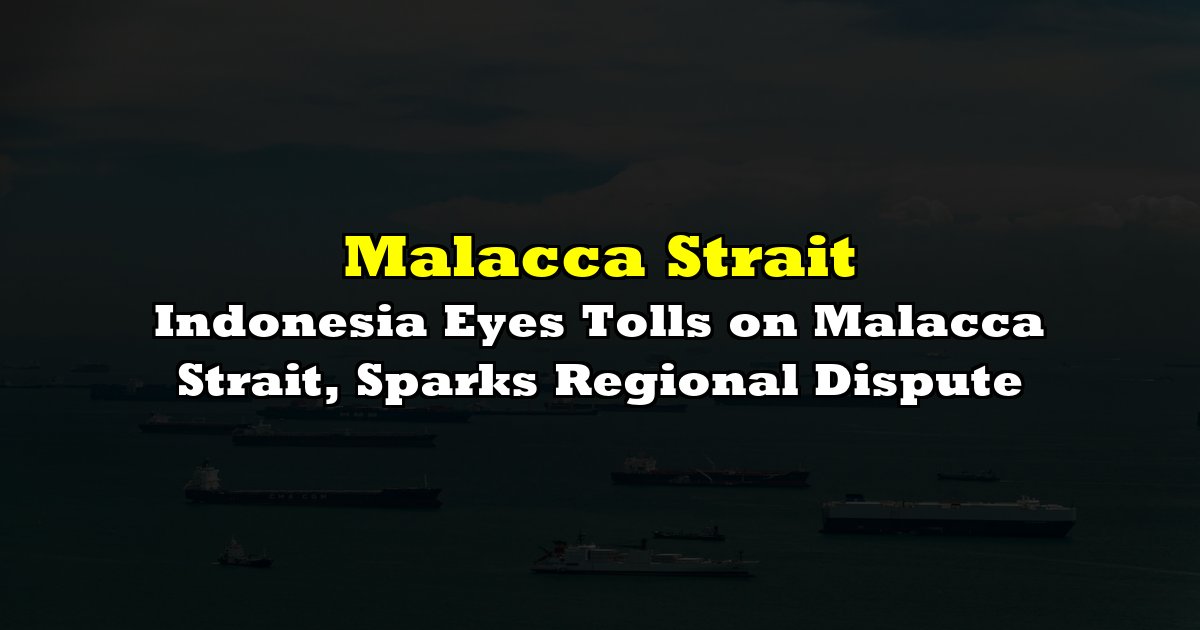

Singapore and Indonesia have staked out opposing positions on the potential imposition of tolls in the Malacca Strait, a vital artery for global trade and energy shipments, as geopolitical tensions over maritime routes intensify. Singapore’s Foreign Minister Vivian Balakrishnan declared on April 22, that passage through the strait must remain free, rejecting any moves to restrict or monetize transit.
In stark contrast, Indonesian Finance Minister Purbaya Yudhi Sadewa suggested on the same day that charging levies on ships passing through the Malacca Strait could yield significant economic benefits. Speaking at a symposium in Jakarta, he pointed to Iran’s recent plan to impose fees in the Strait of Hormuz as inspiration, noting that a three-way split between Indonesia, Malaysia, and Singapore could generate substantial revenue.
“Our stretch is the largest and the longest,” Purbaya emphasized, while acknowledging that any policy would require regional agreement.
The Malacca Strait, bordered by Singapore, Malaysia, and Indonesia, links the Indian and Pacific Oceans and serves as a critical conduit for 70% of East Asia’s energy and trade, according to Indonesian President Prabowo Subianto. Speaking earlier in April 2026, Prabowo underscored Indonesia’s strategic position, calling for the nation to assert itself as a global economic player. Purbaya echoed this sentiment, aligning the toll proposal with a broader push to reposition Indonesia on the world stage.
 Sponsored · Granada Gold Mine Inc.
Balakrishnan, however, doubled down on the importance of free navigation during an interview at a CNBC event in Singapore. “The right of transit passage is guaranteed for everyone,” he said. “We will not participate in any attempts to close or interdict or to impose tolls in our neighborhood.” He stressed that all three littoral states share a strategic interest in maintaining open access, a stance he has communicated to both Washington and Beijing.
Geopolitical undercurrents add urgency to the debate. Balakrishnan warned of the risks posed by fracturing US-China relations, describing current tensions in the Strait of Hormuz—where Iran has restricted passage since February 28, 2026—as a potential “dry run” for larger conflicts in the Pacific. China, long concerned about its vulnerability in the Malacca Strait, has sought to reduce reliance on the route through alternative energy pipelines and renewable initiatives.
Indonesia’s proposal remains in early stages, with Purbaya cautioning that regional coordination and the impact on global trade flows must be carefully weighed. Despite controlling the largest portion of the strait’s waters, Indonesia cannot act unilaterally, he admitted.
The divergence in policy could ripple through markets dependent on the strait, which handles trillions in annual trade. As of the time of reporting no concrete steps toward a levy have been taken, but the mere suggestion has already highlighted fractures among the region’s key players.
Information for this story was found via the sources and companies mentioned. The author has no securities or affiliations related to the organizations discussed. Not a recommendation to buy or sell. Always do additional research and consult a professional before purchasing a security. The author holds no licenses.