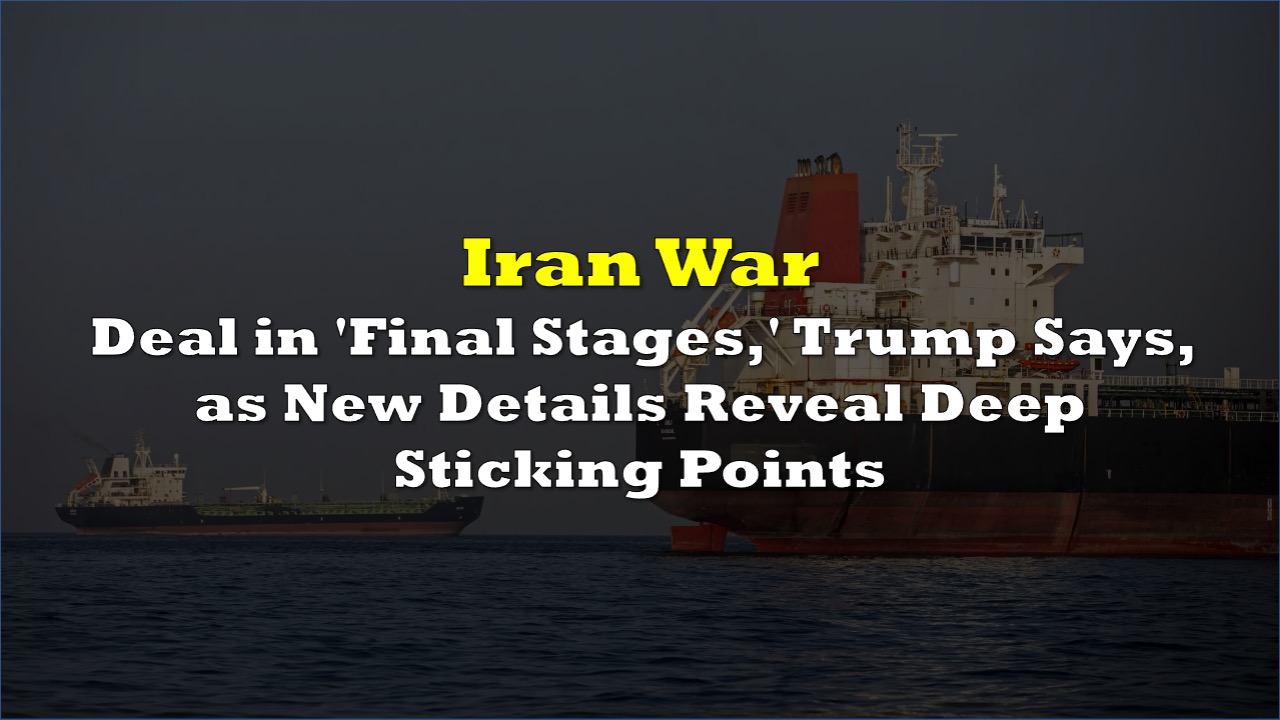

President Donald Trump declared Wednesday that US negotiations with Iran are in the “final stages,” sending oil prices tumbling and Treasuries rallying — even as newly surfaced details from Iranian sources outline a framework still divided on its most critical terms.
“We’re in the final stages of Iran,” Trump told reporters. “We’ll see what happens. Either have a deal or we’re going to do some things that are a little bit nasty, but hopefully that won’t happen.” He added: “We’re going to give this one shot. I’m in no hurry.”
A day earlier, Vice President JD Vance told reporters the administration has made “a lot of progress” and framed renewed military action as “option B” if talks collapse.
 Sponsored · Selkirk Copper Mines
Markets moved on Trump’s remarks. West Texas Intermediate futures fell more than 5% to close at $98.26 a barrel, while Brent settled at $105.02. US benchmark 10-year Treasury yields dropped 10 basis points to 4.57%. Gasoline at the pump has climbed more than 43% over the past year as the Hormuz disruption keeps fuel costs elevated, making a resolution one of the most consequential near-term variables in the global economy.
Trump has declared the talks at their endpoint at least four times since March, each time without a deal.
What Iranian sources say is on the table
Iranian journalist Ali Gholhaki, posting in Persian and widely circulated by regional analysts, described the current US proposal as including: an end to the war across all fronts; lifting of the US naval blockade; Iran reopening the Strait of Hormuz on terms it prefers; release of 25% of Iran’s frozen assets — approximately $25 billion out of an estimated $100 billion total — and a 30-day oil sales exemption.
The main-phase asks would require Iran to remove 400 kilograms of highly enriched uranium, accept its right to enrich only to the civilian 3.67% level after a moratorium, and close nuclear facilities with a carve-out for the Tehran reactor.
 Sponsored · Altamira Gold Corp.
Foundation for Defense of Democracies senior advisor Saeed Ghasseminejad flagged a similar set of terms on Wednesday, framing them skeptically. Iran policy analyst Gregory Brew responded to Gholhaki’s thread directly: “If accurate, the deal being negotiated right now is very favorable to Iran.”
Where it breaks down
The 400 kilograms of 60%-enriched uranium is the hardest sticking point. Iran refuses to transfer the stockpile to a third country, such as China or Russia; the US wants to take possession itself. Israel has drawn a hard line on the issue, and Trump reportedly had a tense call with Prime Minister Benjamin Netanyahu this week in which Netanyahu pushed back sharply against the emerging terms. Trump’s response, relayed to reporters: Netanyahu will do “whatever I want him to do.”
A second fracture: the US wants Iran to sign the full agreement at once. Iran insists on a 30-day phased verification period — sell oil, confirm US follow-through, then commit to nuclear terms. The two positions are structurally incompatible without a bridging mechanism that neither side has publicly proposed.
On sanctions, Gholhaki’s account suggests the US will not fully lift them, offering only a time-limited suspension — a materially weaker concession than full removal and one Iran has previously rejected as insufficient. Iran also frames the nuclear file, Hormuz reopening, and war termination as three separate dossiers. The US is pushing for a single integrated agreement.
Signs of movement
South Korea’s foreign minister confirmed Wednesday that a supertanker carrying 2 million barrels of crude completed a Hormuz transit under arrangements made with Iranian authorities — the first South Korean vessel to do so since the war began. Iran’s Revolutionary Guard separately claimed 26 commercial vessels transited the strait in the preceding 24 hours under IRGC coordination.
Trump is also reportedly drafting a letter of intent that would formally declare an end to the war and open a 30-day negotiation period covering Hormuz governance and Iran’s nuclear program. Whether that letter constitutes a deal or merely a precondition for one remains the central ambiguity in talks that, by multiple accounts, remain as close to collapse as to resolution.
Information for this story was found via the sources and companies mentioned. The author has no securities or affiliations related to the organizations discussed. Not a recommendation to buy or sell. Always do additional research and consult a professional before purchasing a security. The author holds no licenses.