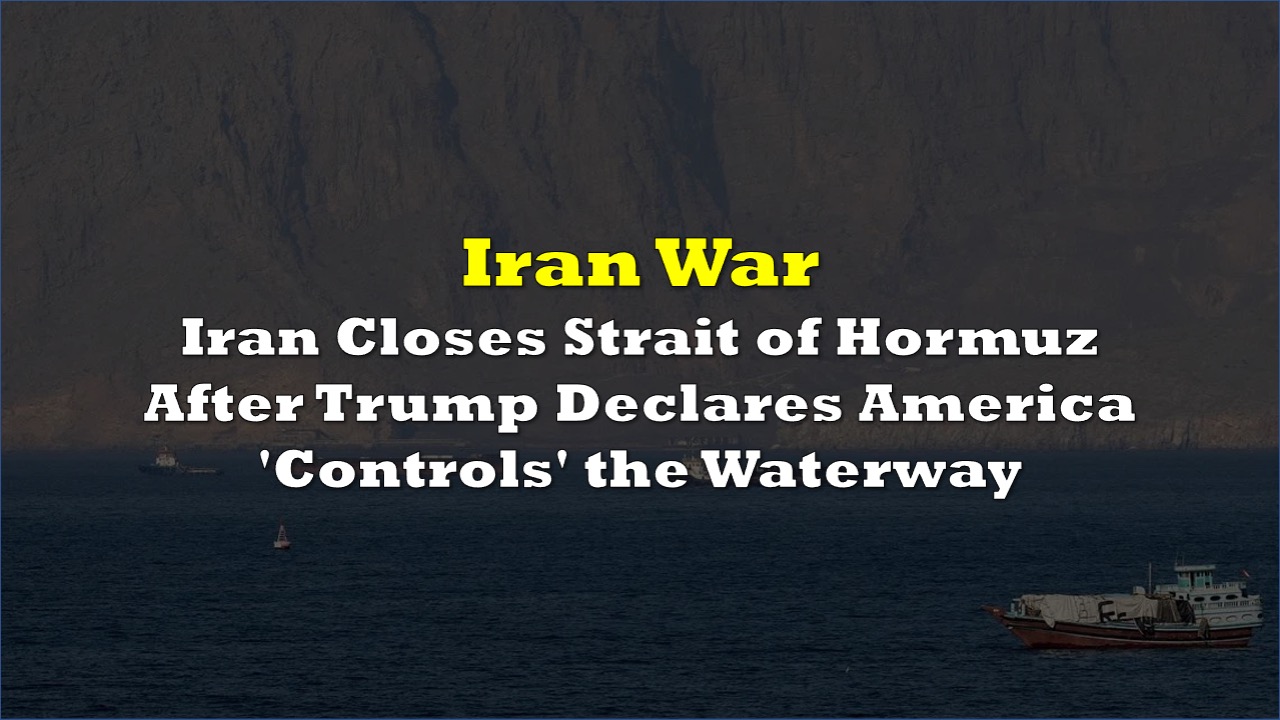

Iran’s Islamic Revolutionary Guard Corps declared the Strait of Hormuz “closed to all vessels, including oil tankers and commercial ships” on Thursday and launched multiple ballistic missiles at US military bases in Kuwait and Jordan — a sweeping escalation that came hours after President Trump posted on Truth Social that the United States controls the waterway and that Iran’s military is “defeated.”
In a post the White House reposted to its official X account, Trump said he had directed a secret military mission last month to escort oil tankers and commercial ships through the strait, claiming more than 100 million barrels of oil and 200 commercial ships had passed safely.
“The UNITED STATES of AMERICA CONTROLS the Strait of Hormuz — NOT Iran,” he wrote. He added that Iran’s economy was “lost” and declared: “It’s over for Iran!”
Trump separately told reporters the US had been secretly moving “millions of barrels” of Iranian oil through the strait at night and that Iran had “just found out” — remarks the Energy Department said it had no knowledge of, and which the White House did not clarify.
Within hours, Iran’s IRGC closed the strait and fired ballistic missiles toward US bases in Kuwait and Jordan. Explosions rang out at multiple locations across both countries.
 Sponsored · Altamira Gold Corp.
Al Jazeera reported heavy clashes between US forces and IRGC naval units in the strait as the closure took effect. Iranian officials said the shutdown came in direct response to new US strikes, warned any vessel attempting passage would be targeted, and said US actions had pushed “the prospect of diplomacy further out of reach.”
The day before, Iran launched long-range missiles at Jordan, Bahrain, and Kuwait — the IRGC claiming it “targeted and destroyed four major targets” in Jordan, including F-35 nests and the US command centre at Al-Azraq. Jordan said it intercepted the incoming missiles. Euronews reported the June 10 strikes came after the downing of a US Army Apache helicopter near the strait on June 9 — an incident CENTCOM attributed to the broader exchange of fire in the area, but whose specific cause it has not publicly confirmed.
Thursday’s closure marks the third time Iran has moved to block the waterway since the war began on February 28. The IRGC first closed the strait March 2, forcing Maersk, MSC, CMA CGM, and Hapag-Lloyd to suspend transits and leaving more than 150 tankers anchored outside the Persian Gulf.
The April 8 ceasefire brokered by Pakistan — with Iran’s opening of the strait as a key condition — briefly stabilised the situation before the IRGC re-closed the waterway on April 18, citing the US naval blockade on Iranian vessels. US strikes near Bandar Abbas on May 7 and May 26 fractured the agreement further, as did US strikes on Iranian radar sites on June 6.
The Strait of Hormuz carries approximately 21 million barrels of oil per day — roughly 21% of global consumption — along with 20% of the world’s LNG, supplying energy from Saudi Arabia, Kuwait, Iraq, Qatar, Bahrain, and the UAE predominantly to Asian markets. Analysts have warned that a sustained closure would push crude prices well into triple digits.
No casualty figures from the Kuwait and Jordan strikes have been confirmed. The story is developing.
Information for this story was found via the sources and companies mentioned. The author has no securities or affiliations related to the organizations discussed. Not a recommendation to buy or sell. Always do additional research and consult a professional before purchasing a security. The author holds no licenses.