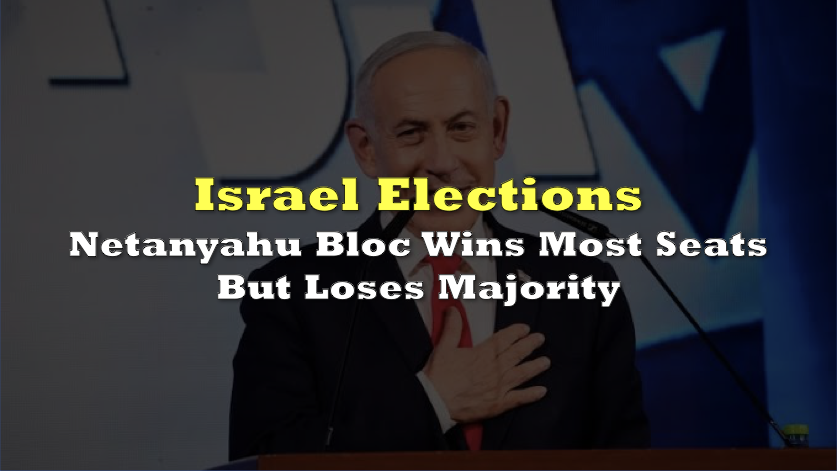

Israel’s new parliament contains a potential 67-seat majority outside Prime Minister Benjamin Netanyahu’s alliance, but the refusal of some opposition leaders to work with the Arab-led parties needed to reach that majority.
The Central Elections Committee’s completed count from the October 27 election, gives Netanyahu’s five-party bloc 53 seats in the 120-member Knesset, eight short of a majority.
Gadi Eisenkot’s four-party opposition bloc has 48, while the Joint List and Ra’am secured a record 19 seats together. That leaves an arithmetic route to 67 seats for parties outside Netanyahu’s camp, but no agreement to govern together.
 Sponsored · Selkirk Copper Mines
Netanyahu’s existing alliance held 68 seats in the outgoing Knesset, meaning it lost 15, even though his Likud remains the largest individual party with 27 seats.
Avigdor Liberman, whose Yisrael Beytenu won seven seats within Eisenkot’s bloc, reiterated Thursday that he would not join a government with Netanyahu or one relying directly or indirectly on Arab parties. Without those seven seats, the remaining opposition parties and both Arab-led lists would total only 60 seats, one short of a parliamentary majority.
Even that calculation assumes cooperation that has not been agreed. Former prime minister Naftali Bennett, whose joint list with Yair Lapid won 12 seats, has also rejected a government dependent on Arab-party support. Eisenkot has resisted such an arrangement.
The record Arab-party representation therefore creates a parliamentary opening without automatically providing a governing coalition. The Joint List won 11 seats, and Ra’am took eight. Together, they nearly doubled their representation from the outgoing parliament’s 10 seats.
Likud’s 27 seats put Netanyahu ahead of Eisenkot’s Yashar, which won 21, but Israel’s system does not automatically give the largest party the premiership. President Isaac Herzog will consult parliamentary factions after the results are submitted on November 4, then assign a lawmaker the task of trying to form a government.
Netanyahu remains prime minister during those negotiations. The new Knesset is scheduled to convene November 10.
The committee reported turnout of 77.9%, with 5,716,665 ballots cast, the highest in decades. The count is complete, although final checks and possible minor corrections remain before formal certification.