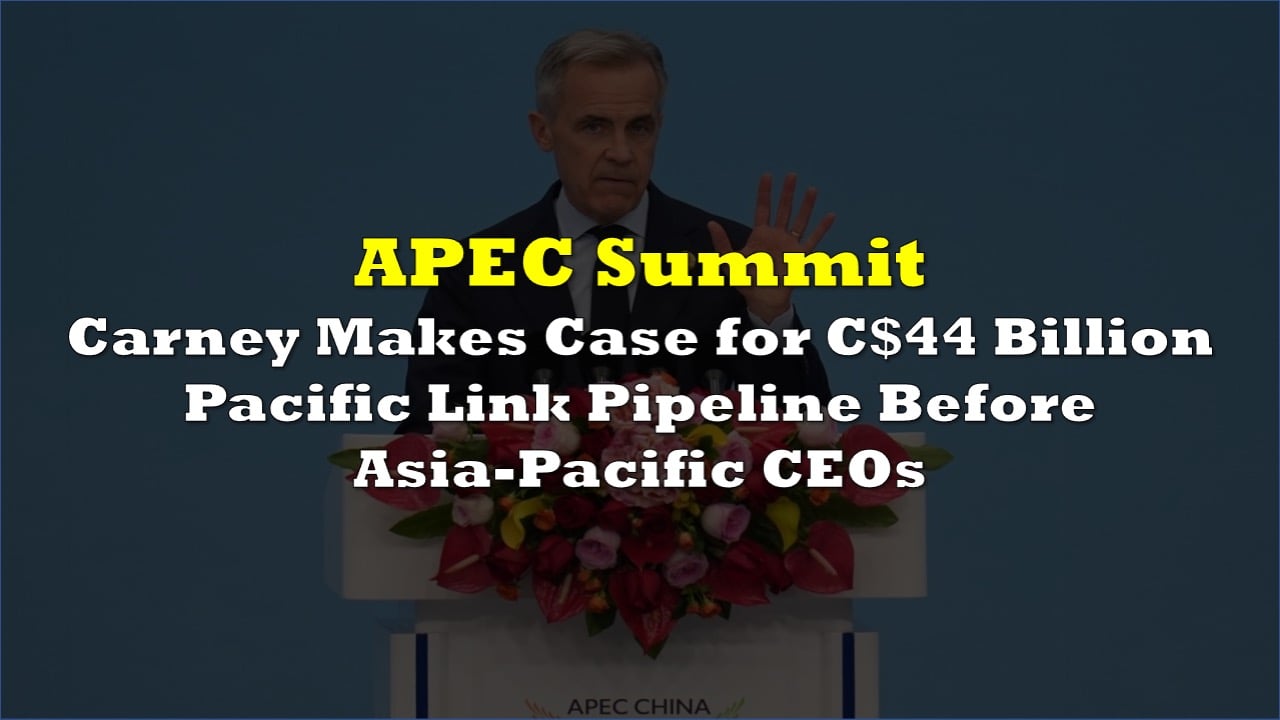

Prime Minister Mark Carney made the case for a proposed oil pipeline to the British Columbia coast at an Asia-Pacific business summit Wednesday, telling executives it would carry an extra one million barrels of crude a day to Asian markets.
“We are advancing Pacific Link, a new pipeline to the Pacific,” Carney said in a speech to the Asia-Pacific Economic Cooperation CEO summit, held alongside the leaders’ meeting in Shenzhen.
Related: China Cuts Duties on C$400 Million in Canadian Pork and Seafood in Swap for Steel Relief
 Sponsored · Cambria Gold Mines
He cast Canada as a dependable provider of energy and food, and said his government has launched sweeping regulatory reforms to speed reviews of major projects. Canada has shipped more than 11 million tonnes of LNG since LNG Canada’s first cargo in June 2025, he said, and will quadruple that by the end of the decade.
Ottawa says the project would reduce Canada’s reliance on the United States, which buys more than 90% of its crude exports. The Trans Mountain expansion, finished in 2024, is running at or near capacity, while Chinese demand is growing. The University of Alberta’s China Institute counts C$3.5 billion in third-quarter crude sales to China, up almost 159% from a year earlier, at roughly 327,000 barrels a day, nearly double last year’s pace.
Pacific Link would span about 1,250 kilometres, linking Bruderheim, near Edmonton, with a deepwater port near Delta, British Columbia. Estimates put its cost at C$35.2 billion to C$43.7 billion, and its final route and financing have not been settled. Ottawa and Alberta would share ownership, with Indigenous communities offered at least 10%.
Carney’s government made Pacific Link the first project designated a national-interest project under the Building Canada Act on October 1, a step meant to speed its federal permits. The designation does not give final approval to build, and Ottawa is aiming to finish the project’s conditions by September 1, 2027.
Read: Canada Fast-Tracks Pacific Link Oil Pipeline While Financing Remains Open
At least 10 First Nations have gone to Federal Court seeking to quash the designation, arguing Ottawa did not consult them properly. Some Indigenous leaders support the project.