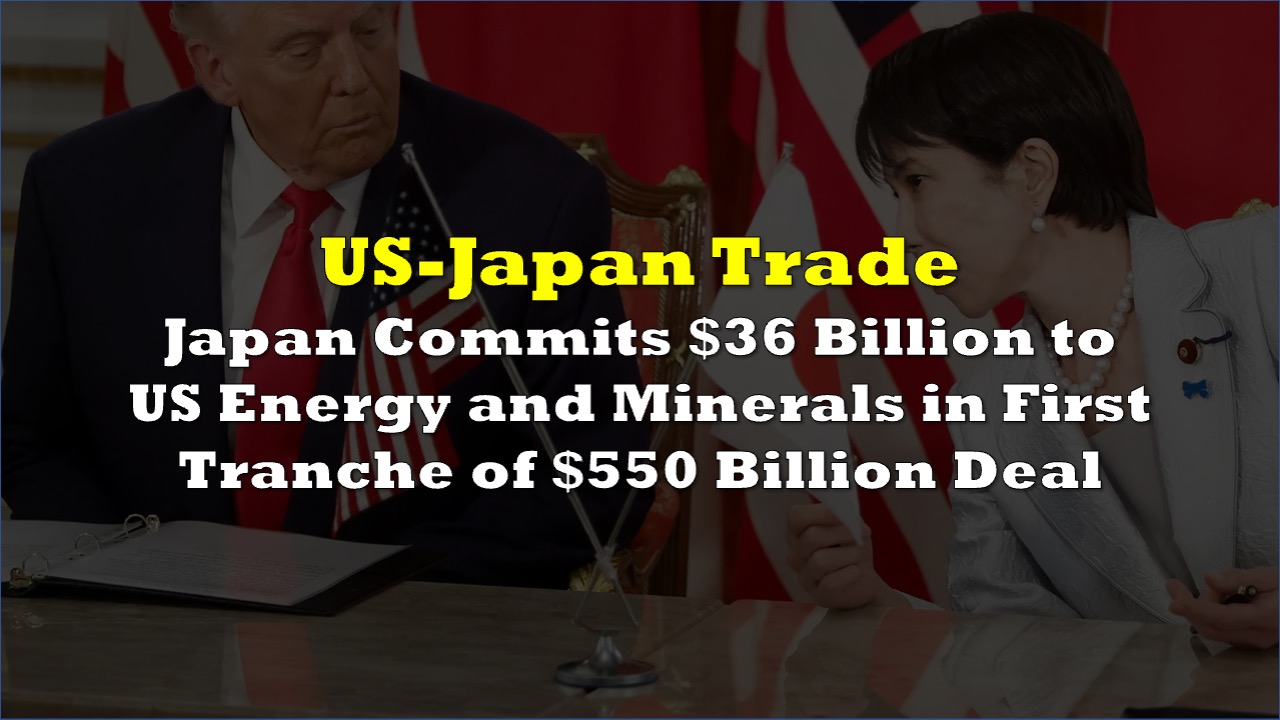

Japan announced a $36 billion commitment to US oil, gas, and critical mineral projects on February 18, 2026, marking the first installment of a sweeping $550 billion investment framework the two countries established under a trade deal that set tariffs on Japanese imports at 15%.
The package spans three states and three sectors — natural gas in Ohio, crude oil exports in Texas, and industrial diamonds in Georgia — and represents the opening move in what both governments describe as a long-term economic partnership.
Japan plans to invest $36 billion in US oil, gas and critical mineral projects
— Stephen Stapczynski (@SStapczynski) February 18, 2026
🇯🇵 🤝 🇺🇸
The most significant piece is a 9.2GW gas-fired power plant in Ohio. The investment will be led by SoftBankhttps://t.co/5io8koo0jd
Ohio: The Centerpiece
The largest component is a $33 billion natural gas-fired power plant in Portsmouth, Ohio, set to generate 9.2 gigawatts of electricity. SB Energy, a subsidiary of Japan’s SoftBank Group, will lead the project.
US Commerce Secretary Howard Lutnick called the Portsmouth Powered Land Project “the largest natural gas generation facility in history.”
Japanese manufacturers Toshiba and Hitachi have expressed interest in joining the effort, according to Japan’s trade minister Ryosei Akazawa.
To put the scale in perspective: PJM Interconnection, the grid operator serving the eastern US, estimates that 7.4 million households draw roughly that much power. Nine nuclear reactors would be needed to match the facility’s projected output.
Texas and Georgia
Japan also agreed to back a $2.1 billion deepwater crude oil export terminal off the Texas coast. Dallas-based Sentinel Midstream is developing the Texas GulfLink project, which the White House says could generate up to $30 billion in annual crude exports at peak capacity.
In Georgia, $600 million will fund a synthetic industrial diamond plant — a strategic push to rebuild a supply chain the US has long ceded to China. Diamond abrasives are a critical input in semiconductor fabrication and high-precision manufacturing, and currently, no domestic production capacity exists at scale.
Structure of the Deal
Not all of the $36 billion will arrive as direct cash investment. Trade Minister Akazawa said previously that only 1–2% of the broader $550 billion mechanism would consist of cash, with the remainder structured as loans and loan guarantees. The government-owned Japan Bank for International Cooperation and Nippon Export and Investment Insurance will play central financing roles.
The agreement builds in an enforcement mechanism: once a project is selected, Japan must move on funding within 45 business days. Failure to do so gives the US the right to recoup revenues or reinstate tariffs.
Profits split 90% to the US and 10% to Japan based on contribution levels — a structure some analysts say resembles a lending arrangement more than equity investment, with projections suggesting Japan could incur net losses in present value terms.
The two governments plan to address implementation details during a summit between President Donald Trump and Japanese Prime Minister Sanae Takaichi expected in Washington on March 19.
Information for this story was found via Bloomberg, and the sources and companies mentioned. The author has no securities or affiliations related to the organizations discussed. Not a recommendation to buy or sell. Always do additional research and consult a professional before purchasing a security. The author holds no licenses.