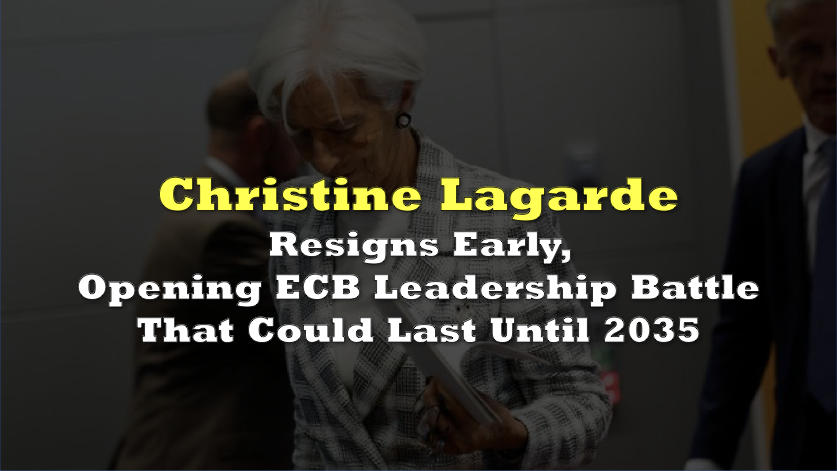

European Central Bank President Christine Lagarde’s early resignation has accelerated a leadership overhaul that could determine who directs eurozone monetary policy until 2035, while allowing Europe’s current political leaders to begin selecting her successor before France’s presidential election.
The announcement comes as three of the ECB’s six executive-board positions face turnover within five months, creating an unusually concentrated round of appointments during renewed inflation pressures and rising government borrowing costs.
Lagarde, 70, will leave on February 7, 2027, nearly nine months before her eight-year mandate was scheduled to expire on October 31.
 Sponsored · Selkirk Copper Mines
Her departure gives French President Emmanuel Macron an opportunity to participate in choosing the next ECB president before France votes on April 18 and May 2, 2027.
Under EU rules, the next president receives a non-renewable eight-year mandate. An appointment beginning in February 2027 would therefore extend into February 2035.
The reshuffle extends beyond the presidency. Executive-board member Isabel Schnabel will leave on January 3, 2027, to become the International Monetary Fund’s financial counsellor. Chief economist Philip Lane’s mandate expires on May 31.
Together with Lagarde’s resignation, the departures create vacancies covering half the ECB’s six-member executive board.
 Sponsored · Cambria Gold Mines
European Council President António Costa said the selection process would begin immediately.
Macron cannot independently choose Lagarde’s successor. The appointment requires support from at least 16 of the eurozone’s 21 governments, representing at least 65% of its population.
Former Dutch central bank governor Klaas Knot and Bank for International Settlements chief Pablo Hernández de Cos are among the potential candidates identified by Reuters and the AP News.
European governments are also expected to negotiate the vacancies together, balancing national representation and competing preferences over monetary policy.
Lagarde did not confirm whether the French election influenced her departure date. Speaking after the ECB’s October 29 policy meeting, she said the institution’s political neutrality requirements constrained her ability to address issues outside monetary policy.
“I don’t think that I can remain neutral,” she told reporters.
The far-right National Rally is seen as a major contender in the upcoming France’s presidential election. Lagarde had already expressed interest in entering the national debate, telling Les Échos in July that “a European voice needs to be heard in the French presidential debate,” according to Reuters.
A former French finance minister and vocal supporter of European integration, Lagarde has argued that France’s economic future depends on its ties to the EU.
The succession comes as the ECB faces conflicting economic pressures. Eurozone inflation reached 3.8% in September, compared with 3.2% in August, according to Eurostat. That remains substantially above the ECB’s 2% target.
On October 29, the central bank left its deposit rate unchanged at 2.50%, following a 25-basis-point increase in September.
The ECB warned that higher energy prices could push inflation upward while weakening economic growth. It also acknowledged that financing conditions had tightened since its previous meeting.
The institution continues reducing its bond portfolios, while maintaining tools designed to prevent disorderly sovereign-debt market movements from disrupting monetary policy.
The next president will inherit those decisions alongside an executive board undergoing substantial renewal.