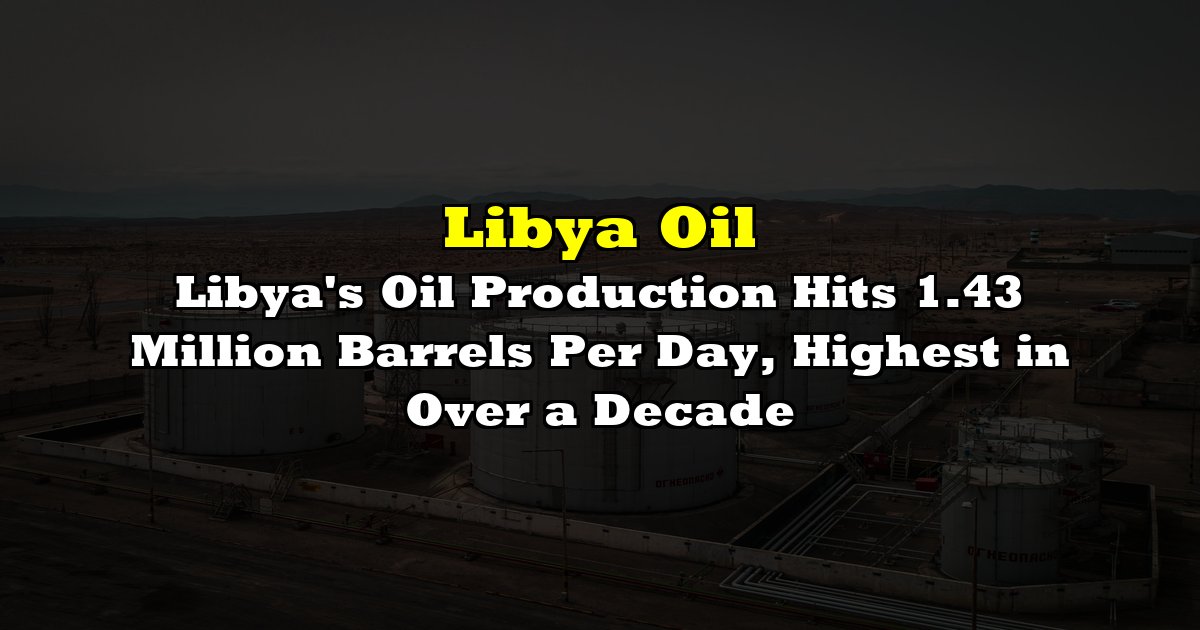

Libya’s oil production has climbed to 1.43 million barrels per day, marking the highest output level in more than a decade, as announced by the head of the National Oil Corporation. This milestone signals a robust recovery for the OPEC member’s energy sector amid a complex regional landscape.
The surge in production comes at a critical juncture for North Africa and the broader Middle East, where energy supply chains are under strain. Libya’s increased output is already reshaping regional dynamics, with Egypt stepping in to secure at least 1 million barrels of Libyan crude per month to offset a halt in Kuwaiti oil supplies due to the effective closure of the Strait of Hormuz.
This follows a force majeure declaration by Kuwait Petroleum Corporation, which has disrupted Egypt’s imports of between 1 and 2 million barrels monthly from Kuwait, alongside another 1 million barrels from Saudi Aramco.
Libya's oil production has reached 1.43 million barrels per day, marking the highest output in over 10 years, according to the National Oil Corporation.
— The Dive Feed (@TheDeepDiveFeed) April 5, 2026
Under a memorandum of understanding signed at the Libya Energy and Economy Summit in Tripoli on January 24, Egypt and Libya are launching a new phase of cooperation in petroleum, natural gas, and mining. The agreement, attended by Libyan Prime Minister Abdul Hamid Dbeibeh, Egyptian Minister of Petroleum Karim Badawi, and Libyan Minister of Oil and Gas Khalifa Abdel Sadiq, includes provisions for exploration, refining, and the transportation of crude and gas. Egypt will receive two cargoes totaling 1.2 million barrels each month via tankers from the port of Sirte, as part of its broader strategy to import 3.5 to 4 million barrels monthly from Arab and European markets to meet domestic demand.
Egypt’s move to tap Libyan oil reflects mounting pressures on its energy market, compounded by regional instability. With domestic production at around 500,000 barrels per day and refinery capacity between 620,000 and 650,000 barrels daily, Cairo faces a persistent supply gap. Libyan crude, described as a light waxy type similar to Egypt’s Western Desert oil, poses handling challenges due to the need for heating during storage, but blending with other crudes could make it viable for Egyptian refineries.
Geopolitical risks loom large over these developments. Egyptian President Abdel Fattah el-Sisi warned at the Egypt International Energy Conference in February 2026 that ongoing conflict in Iran could drive oil prices to $200 per barrel, citing dual shocks of supply shortages and price spikes. Additional threats in the Bab al-Mandab region further complicate energy transit routes.
Libya’s output milestone also carries economic implications for its own recovery. After years of instability that strained ties with neighboring countries, the current production level of 1.43 million barrels per day offers a foundation for stronger regional partnerships, particularly with Egypt, which consumes 12 million tons of diesel and 6.7 million tons of gasoline annually. As both nations navigate these turbulent waters, Libya’s oil sector stands as a key pillar for stability, with exports to Egypt expected to play a growing role in meeting the region’s energy needs through at least the second quarter of 2026.
Information for this story was found via the sources and companies mentioned. The author has no securities or affiliations related to the organizations discussed. Not a recommendation to buy or sell. Always do additional research and consult a professional before purchasing a security. The author holds no licenses.