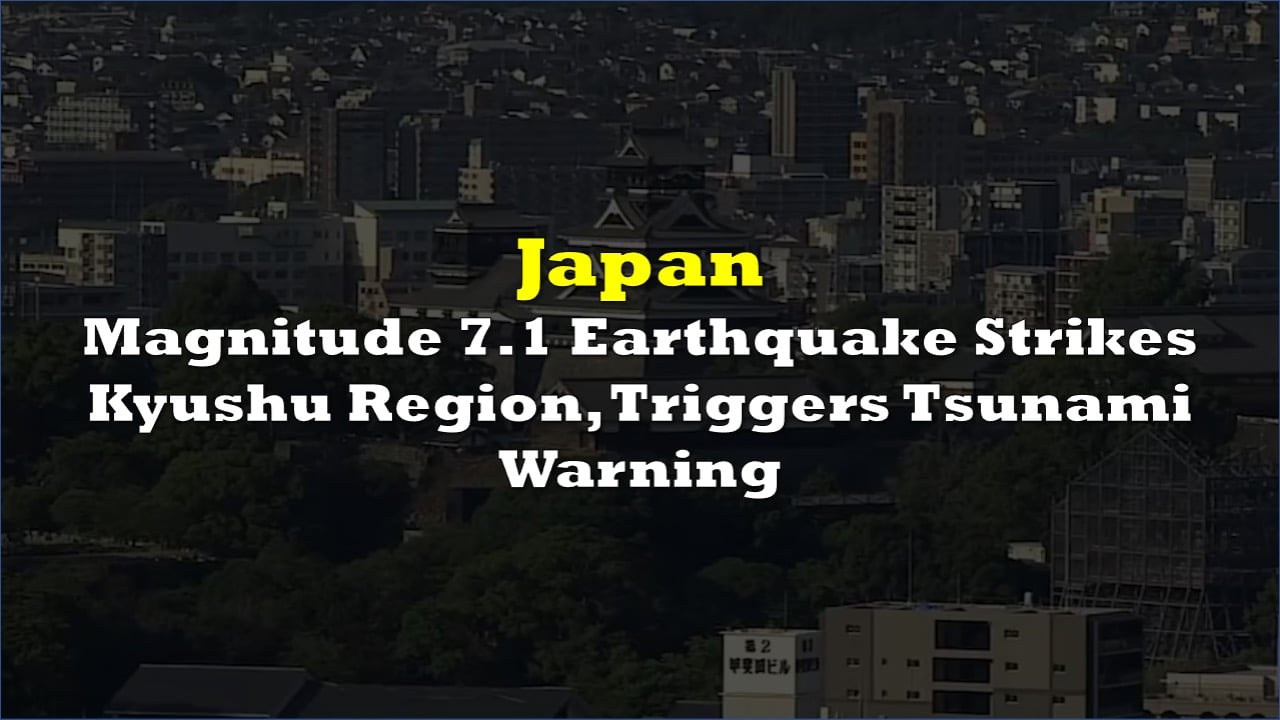

A magnitude 7.1 earthquake struck Kumamoto Prefecture on Japan’s southern Kyushu island on Tuesday afternoon, triggering tsunami warnings, cutting power to tens of thousands of households and suspending bullet train service across the region.
The quake hit at 4:27 p.m. local time near the city of Uki, just south of Kumamoto city, at a depth of 10 kilometers, the Japan Meteorological Agency said. The agency measured the shaking at shindo 7, the highest level on Japan’s seismic intensity scale, in Uki and the town of Hikawa. The US Geological Survey recorded the quake at magnitude 6.8. An aftershock of roughly magnitude 5 followed about 30 minutes later.
The Meteorological Agency issued a tsunami advisory for the Ariake and Yatsushiro seas, warning of waves up to 1 meter. The government issued emergency earthquake warnings for Kumamoto, Nagasaki, Kagoshima, Fukuoka, Saga, Oita and Miyazaki prefectures, covering all of Kyushu.
NHK broadcast footage of collapsed buildings near the epicenter, and fire crews in Uki said they had fielded numerous emergency calls as blazes broke out across the city. Kyushu Electric Power said about 48,300 households in Kumamoto Prefecture lost electricity, while operator JR Kyushu suspended rail service across the region, including its Shinkansen bullet trains.
 Sponsored · Altamira Gold Corp.
Chief Cabinet Secretary Minoru Kihara said authorities had detected no abnormalities at nuclear plants in the region, including the Sendai facility, and Kyushu Electric said its reactors continued normal operations. Prime Minister Sanae Takaichi posted on X urging residents in the affected areas “to remain vigilant for the possibility of another earthquake of similar magnitude,” adding that the government was working to assess the damage as quickly as possible.
Sony Group Corp (TYO: 6758) and Taiwan Semiconductor Manufacturing Co (TSMC, NYSE: TSM) both operate plants in the affected region. A Sony spokesperson said the company was checking on its facilities, while TSMC had not responded to requests for comment as of Tuesday evening.
Kumamoto has been here before. Back-to-back earthquakes in April 2016, a magnitude 6.5 foreshock followed two days later by a magnitude 7.3 mainshock, left 278 people dead and roughly 2,800 injured across the region.
Japan sits along the Pacific “Ring of Fire” and records roughly 20% of the world’s earthquakes of magnitude 6.0 or greater. No casualties had been confirmed from Tuesday’s quake as of this writing, though authorities continued assessing damage across the region.