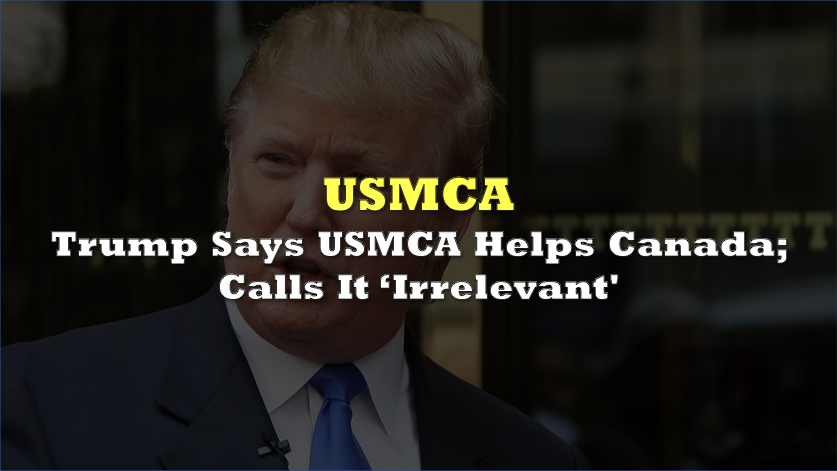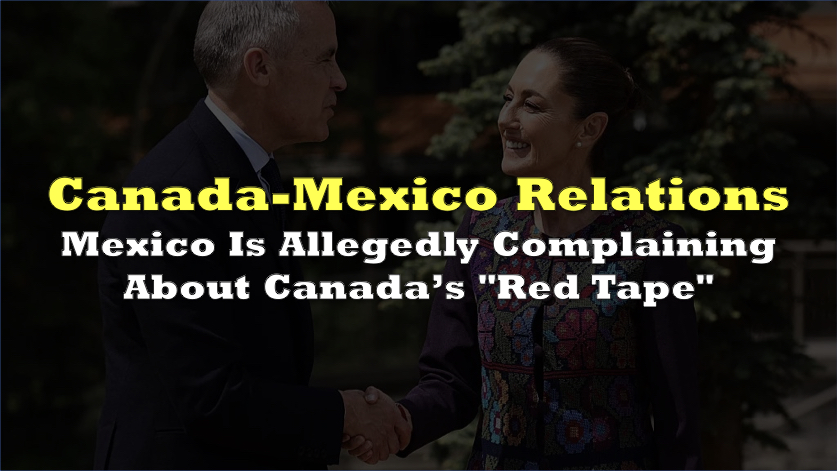

Mexico’-linked’s alleged criticism of Canada’s “excessive requirements, cost or red tape” is emerging just as the July 2026 CUSMA joint review becomes an explicit leverage point, with Washington signaling the agreement’s next extension is conditional on fixing “specific and structural issues,” starting with Canadian dairy access.
The spark in the notes comes from a partisan X account framing Mexico as saying Canada is a “pain in the ass,” attributed only to a Mexican embassy-in-Canada report saying Mexican firms looking to expand to Canada were turned off by bureaucracy.
This comes months after Carney’s office announced a “new partnership with Mexico to elevate ties across trade, energy, and security.”
#REPORT: The government of Mexico says that dealing with the Carney Liberal government involves too much "excessive requirements, cost or red tape." The complaint comes just months after Carney claimed he was forging a "new partnership with Mexico to elevate ties across trade." pic.twitter.com/lgoiD3ltMT
— Canada Proud (@WeAreCanProud) December 24, 2025
This also floats following USTR’s report of the three-day public hearing in preparation for the first six-year joint CUSMA review scheduled for July 1, 2026.
Mechanically, the highest-friction file in the notes is Canada’s dairy market access, routed through tariff-rate quotas. Canada’s negotiating flexibility is described as tighter than a typical stance because Bill C-202 became law in 2025, restricting the federal government from making trade commitments that would increase TRQs or reduce over-quota tariffs for supply-managed goods.
The political constraint is reinforced as Prime Minister Mark Carney publicly ruled supply management “off the table,” while polling shows a split public baseline: 29% favor eliminating supply management and 23% support maintaining it.
The USTR “non-exhaustive” agenda in the notes extends beyond dairy into digital rules, citing Canada’s Online Streaming Act and Online News Act as discriminatory to US tech and media firms, plus provincial alcohol distribution barriers, procurement measures in Ontario, Quebec, and BC, and “complicated” customs registration for Canadian recipients of US exports.
Information for this story was found via the sources and companies mentioned. The author has no securities or affiliations related to the organizations discussed. Not a recommendation to buy or sell. Always do additional research and consult a professional before purchasing a security. The author holds no licenses.