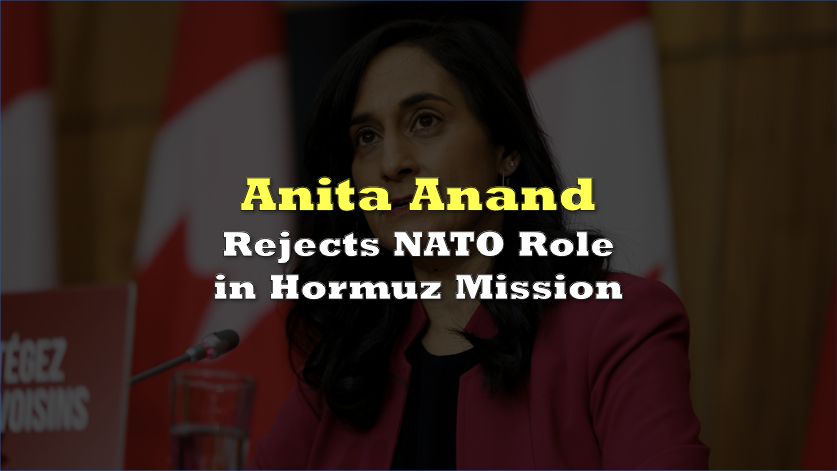

Canada says NATO is not formally discussing any alliance role in reopening the Strait of Hormuz, even as Foreign Affairs Minister Anita Anand called Iran’s blockade a violation of the UNCLOS and warned that the disruption is choking global flows of energy, fertilizer and food-linked goods.
Anand said there has been no conversation within NATO to answer President Donald Trump’s call for allied help in reopening the shipping lane. According to her, NATO’s core principles of collective defence and deterrence are triggered by the alliance as a whole, not by a unilateral demand from one member state.
“To our knowledge a request has not been made to NATO for the type of assistance that is being requested,” Anand said.
Canada stands with NATO allies on the triggering mechanism, she clarified, and “at this point, it’s important to remember that those conversations among NATO allies have not occurred.”
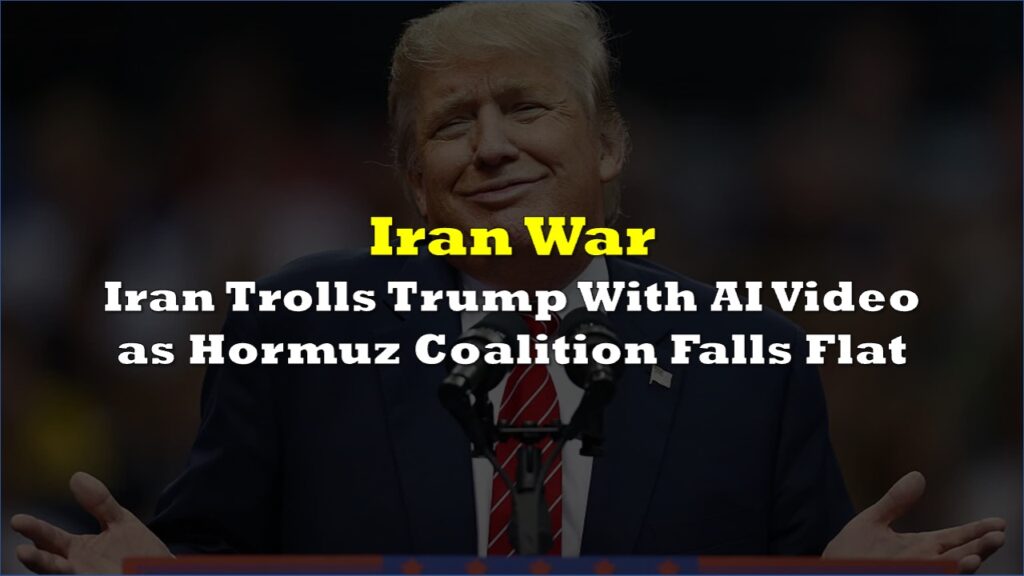
Earlier, Trump said NATO members should back the US in patrolling the narrow strait and warned on Sunday that “If there’s no response or if it’s a negative response, I think it will be very bad for the future of NATO.
Anand, however, said she has not discussed the issue with Secretary of State Marco Rubio. She expects to see him next week in Paris at a G7 foreign ministers meeting.
The practical impact of Iran’s effective closure, she added, is that countries globally are unable to receive energy exports, fertilizer and other goods moving through food supply chains.
“Ships from all countries have the right to pass through,” she said. She also said that she is working with Gulf-region countries and others to build support around that principle of international law.
The foreign minister made the remarks from Turkey, where she is meeting officials partly to discuss the regional conflict.
Britain is sketching a different operational lane from Trump’s NATO framing. Prime Minister Keir Starmer said Monday he was working with allies on a viable plan to reopen the strait, but no decisions have been made. He acknowledged the difficulty of safeguarding maritime traffic and set a firm boundary around the institutional vehicle. Any action, he said, must be credible and involve as many countries as possible.
“Let me be clear, that won’t be, and it’s never been envisioned to be, a NATO mission,” he said. Instead, he described a prospective “alliance of partners” spanning Europe, the Gulf and the US.
Information for this story was found via The Globe And Mail and the sources and companies mentioned. The author has no securities or affiliations related to the organizations discussed. Not a recommendation to buy or sell. Always do additional research and consult a professional before purchasing a security. The author holds no licenses.