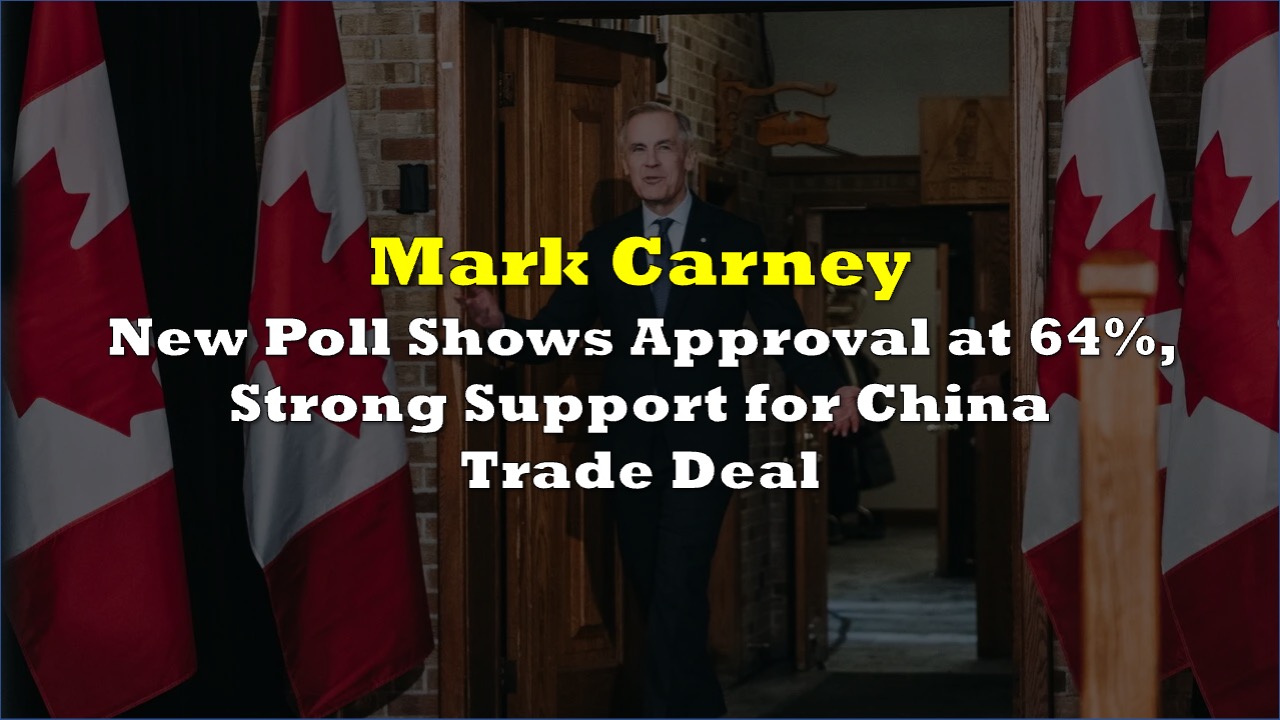

Prime Minister Mark Carney’s approval rating stands at 64% while 78% of Canadians believe the recent China trade agreement was the right decision, according to new polling from Spark Insights released on January 25.
The survey of 4,000 Canadians, conducted January 18-21, shows approval exceeds 66% in every region except Alberta, where it reaches 57%. The polling period overlapped with Carney’s World Economic Forum speech in Davos on January 20, where he declared the US-led international order was experiencing “a rupture” and called on middle powers to unite against economic coercion. Bob Rae, Canada’s former ambassador to the United Nations, stated he had “never seen a global reaction to a speech” like Carney’s.
Read: Carney Declares End of Rules-Based Order in Davos Speech, Calls for Middle Power Coalition
Bruce Anderson, founding partner of Spark Advocacy, reported that 28% of Conservative voters from the 2025 election approve of Carney’s government, along with 69% of New Democratic Party voters and 68% of Bloc Québécois voters. Anderson disclosed in previous Policy Magazine articles that he actively supported Carney during the Liberal leadership campaign and federal election.
Approval of Carney government rises to 64%; 78% believe arrangement with China on canola and cars was the right thing to do. Latest @spark_advocacy polling https://t.co/SjmryaScbt pic.twitter.com/JakQFbUbvd
— Bruce Anderson (@bruceanderson) January 25, 2026
The poll measured public reaction to Canada’s January 16 agreement with China, which allows 49,000 Chinese electric vehicles into Canada annually at a 6.1% tariff rate, down from 100%, in exchange for China reducing tariffs on Canadian canola from 84% to approximately 15% by March 1.
Respondents were asked whether the agreement “to reduce tariffs, which will result in some increased canola sales to China and some Chinese electric vehicles being sold in Canada” was the right or wrong thing to do for Canada. Support reached 77% in prairie provinces, 75% in Ontario, and 56% among Conservative voters.
Other polling firms show lower approval. Liaison Strategies measured Carney at 57% in a January 19 release based on surveys conducted January 5-17, before the China deal and Davos speech. The Angus Reid Institute found 52% approval in November 2025.
The variance reflects different methodologies, sample sizes, and timing. Spark Insights surveyed 4,000 Canadians after both major events, while Liaison Strategies polled 1,000 using interactive voice recording before either occurred. Angus Reid surveyed 2,038 adults in early November.
The Spark Insights survey found Carney’s government receives majority approval on all 23 measured policy areas, with strongest ratings for finding new trading partners, improving Canada’s image, diversifying trade relations and attracting investment. Weakest ratings came for cost of living and housing affordability.
The poll shows 63% of Canadians would prefer Carney to win if an election were held now, compared to 37% preferring Conservative leader Pierre Poilievre. More than half of Alberta voters, 55%, would prefer a Carney victory.
Two-thirds of Canadians believe the Conservative Party should replace Poilievre, including 27% of Conservative voters. The survey found 61% hold a positive view of Carney personally, compared to 39% for Poilievre.
The China trade deal has produced mixed reactions from provincial leaders. Saskatchewan Premier Scott Moe called the agreement “very good news” for canola producers, while Ontario Premier Doug Ford warned it would harm the auto sector without securing manufacturing investments.
The survey revealed high stress levels among Canadians, with 79% saying they feel “overwhelmed by the world as it is today.” The poll found 78% fear “things will never again feel settled in the world” and 80% believe “America can no longer be trusted.”
Liaison Strategies shows the Liberal Party at 40% support in vote intention, compared to the Conservative Party at 35%, with the NDP at 11% and Bloc Québécois at 8%.
Information for this story was found via the sources and companies mentioned. The author has no securities or affiliations related to the organizations discussed. Not a recommendation to buy or sell. Always do additional research and consult a professional before purchasing a security. The author holds no licenses.