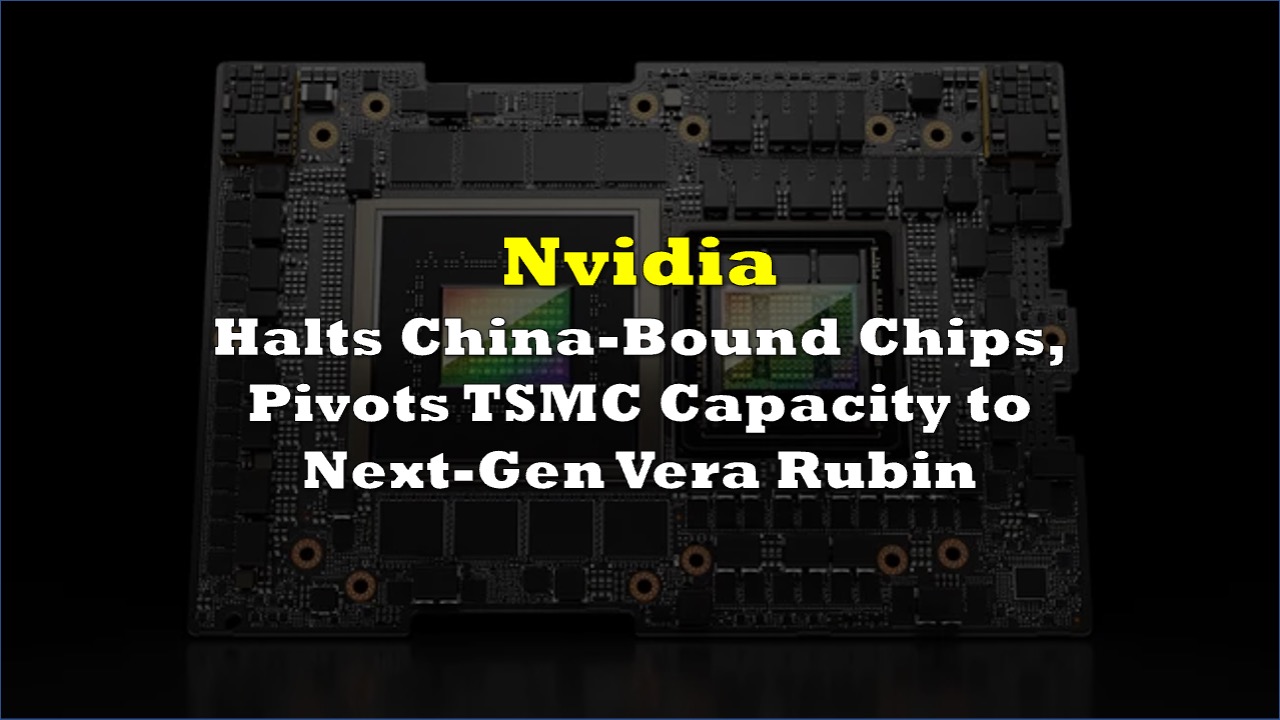

Nvidia (Nasdaq: NVDA) has pulled back from manufacturing H200 chips for the Chinese market, reassigning that production capacity at TSMC to its next-generation Vera Rubin platform, the Financial Times reported Thursday, citing two people with knowledge of the matter.
The decision reflects a judgment that regulatory gridlock — on both sides of the Pacific — will keep the Chinese market closed long enough to make further H200 production there uneconomical. Vera Rubin is expected to reach mass production in the second half of 2026.
FT reports Nvidia has stopped producing China-bound H200 chips and shifted TSMC capacity from H200 to $NVDA's next-gen Vera Rubin platform. pic.twitter.com/e0Jx85LvEM
— Wall St Engine (@wallstengine) March 5, 2026
The pivot comes as the US government confirmed no H200 units have reached any Chinese buyer. The Trump administration granted formal export clearance in January, but Beijing’s customs authorities rejected arriving shipments, leaving the market effectively shut despite Washington’s green light.
A Commerce Department official confirmed last month that the sales count remains at zero. The Trump administration is now separately considering a cap of 75,000 H200 units per Chinese customer, Bloomberg reported Monday — a ceiling that would also apply to AMD’s MI325 chips. Given the production halt, the cap may be moot for now.
The financial stakes are significant. Chinese firms, including Alibaba, ByteDance, and Tencent, had collectively requested more than 400,000 chips, and Nvidia had logged total Chinese demand exceeding two million units — nearly three times its current inventory of roughly 700,000. At $27,000 per unit, Jensen Huang had projected China sales could eventually reach $50 billion annually.
Washington’s China chip policy remains deeply divided. White House AI Czar David Sacks and Huang have argued that cutting off Chinese access to Nvidia hardware only strengthens Huawei’s push to build domestic alternatives.
Hawks counter that sales enable Beijing’s military AI programs — a position reinforced last month when a congressional lawmaker alleged that Nvidia engineers had helped DeepSeek achieve major AI training breakthroughs, with the resulting models later tied to Chinese military use.
The dispute intensified when a Trump administration official separately alleged DeepSeek trained its newest model on Nvidia’s banned Blackwell chips, sourced through undisclosed channels.
Nvidia denied that its chips meaningfully serve Chinese military purposes, saying it was “nonsensical” to suggest Beijing’s military would depend on American technology.
Information for this story was found via the sources and companies mentioned. The author has no securities or affiliations related to the organizations discussed. Not a recommendation to buy or sell. Always do additional research and consult a professional before purchasing a security. The author holds no licenses.