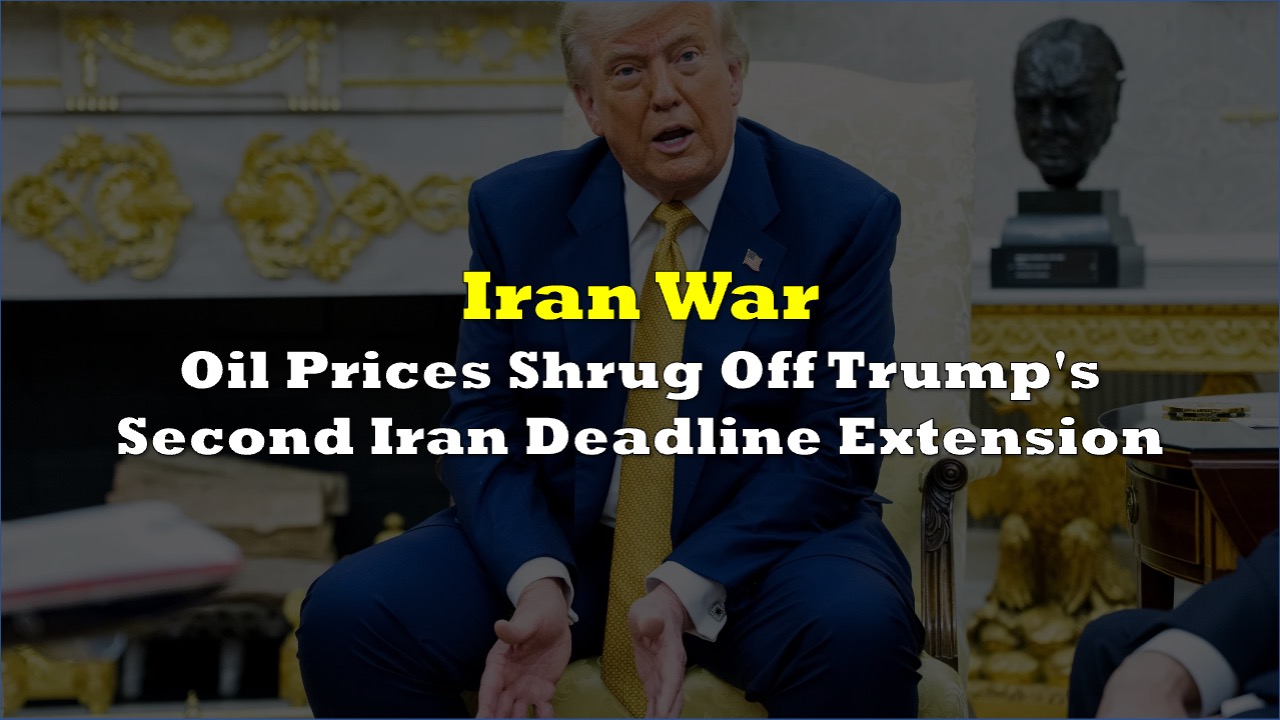

President Donald Trump extended his pause on US strikes against Iranian power plants for a second time Thursday, pushing the deadline to April 6 — but oil markets barely flinched before reversing course entirely, a stark contrast to the dramatic selloff that followed his first extension just four days earlier.
At 4:11 PM ET, Trump posted on Truth Social: “As per Iranian Government request, please let this statement serve to represent that I am pausing the period of Energy Plant destruction by 10 Days to Monday, April 6, 2026, at 8 PM, Eastern Time. Talks are ongoing and, despite erroneous statements to the contrary by the Fake News Media, and others, they are going very well.”
U.S. President Donald Trump:
— OSINT Digest (@Indowatchosint) March 26, 2026
"As per Iranian Government request, please let this statement serve to represent that I am pausing the period of Energy Plant destruction by 10 Days to Monday, April 6, 2026, at 8 P.M., Eastern Time. Talks are ongoing and, despite erroneous… https://t.co/ORYH7cYQ7w pic.twitter.com/i33mWt7quo
Oil prices dipped briefly on the announcement — then climbed back. Brent crude futures ended the day up 5.66% at $108.01 per barrel, while West Texas Intermediate rose 4.61% to $94.48. The S&P 500 fell 1.74%, its steepest single-day loss since the war began.
At 4:11 PM ET, President Trump extended his “pause” of US strikes on Iranian power plants and oil prices fell -6%.
— The Kobeissi Letter (@KobeissiLetter) March 26, 2026
40 minutes later, that entire decline was erased.
Markets are becoming numb to the headlines. pic.twitter.com/3PFPnQfvhk
The contrast with March 23 is stark. When Trump announced the first five-day pause that day — citing “productive conversations” with Tehran — Brent collapsed nearly 11% and WTI shed more than 10% as traders priced in the possibility of an imminent ceasefire. Thursday’s muted response signals that markets have stopped believing the deadlines mean anything.
The warning signs were visible before Thursday’s session. Deutsche Bank’s “Pressure Index” — an equally weighted composite of 20-day changes in the S&P 500, 10-year US Treasury yields, Trump’s approval rating, and 1-year inflation expectations — had already climbed to its highest reading since the start of Trump’s second term by March 23, surpassing spikes seen during the Liberation Day tariff delay and the Greenland escalation.
The index signaled that economic and political pressure on the administration to pursue de-escalation was building faster than at any previous point in 2025 or 2026.
Apparently, Deutsche Bank has a 'Pressure Index' that is flagging a de-escalation with Iran is warranted, and fast: pic.twitter.com/pU8uZl88oL
— Brian Sozzi (@BrianSozzi) March 23, 2026
Iranian Foreign Minister Abbas Araghchi told state media that exchanges through Pakistani mediators do not constitute negotiations with the US, and Tehran rejected the US ceasefire proposal, countering with its own five conditions — including war reparations and formal recognition of Iranian sovereignty over the Strait of Hormuz.
Trump, for his part, said he granted the 10-day extension because “they gave me ships,” a reference to his claim that Iran allowed eight to 10 tankers to transit the strait as a goodwill gesture — one Bloomberg‘s tracking data has not corroborated.
JUST IN: 🇮🇷🇺🇸 Iran says it did not request a 10-day pause from President Trump on strikes targeting its energy infrastructure, WSJ reports.
— BRICS News (@BRICSinfo) March 26, 2026
Read: Did Trump Lie About Iran ‘Gifting’ the US 8 (or 10?) ‘Boats of Oil’?
The Strait of Hormuz remains effectively closed to most commercial traffic. The International Energy Agency has called the current supply disruption the worst in the history of the oil market, exceeding both the oil shocks of the 1970s and the fallout from the Russia-Ukraine war.
Information for this story was found via the sources and companies mentioned. The author has no securities or affiliations related to the organizations discussed. Not a recommendation to buy or sell. Always do additional research and consult a professional before purchasing a security. The author holds no licenses.