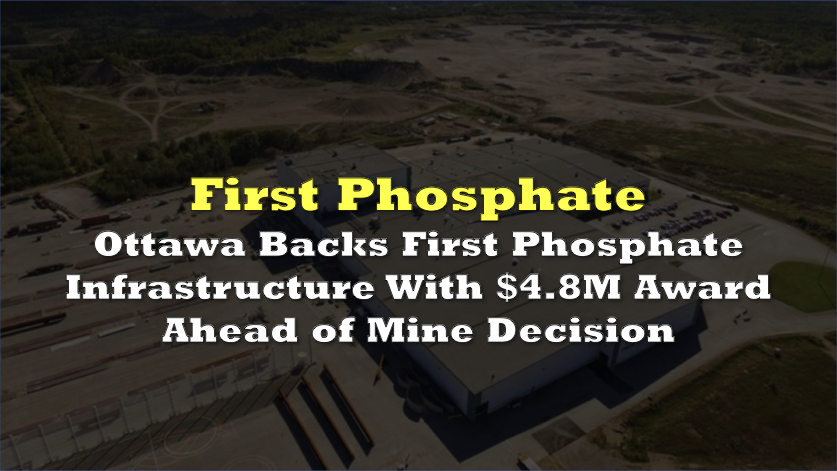

First Phosphate (CSE: PHOS) has secured $4.84 million in non-repayable federal funding for road and power infrastructure studies at its Bégin-Lamarche phosphate project in Quebec’s Saguenay–Lac-Saint-Jean region.
Natural Resources Canada awarded $3.07 million for studies and design work related to a proposed 161-kilovolt transmission line, substations, connection corridors, environmental reviews, and public and Indigenous consultation.
A separate $1.77 million contribution will support road pre-feasibility and feasibility studies, traffic analysis, environmental work, and planning for transportation links to regional rail infrastructure and the Port of Saguenay.
 Sponsored · Selkirk Copper Mines
First Phosphate must match the federal contributions, bringing total planned spending under the two agreements to approximately $9.69 million. Eligible activities are expected to continue through 2030, according to Natural Resources Canada.
The agreements raise disclosed federal support for Bégin-Lamarche to approximately $21.54 million. Ottawa previously committed $16.70 million through the Global Partnerships Initiative for pilot work, engineering, environmental studies, and feasibility-related activities.
The funding is intended to advance the technical and environmental work needed to connect the proposed operation to Quebec’s power and transportation networks.
First Phosphate’s 2024 preliminary economic assessment estimated initial capital costs of $675.00 million. The study outlined a 23-year operation producing an average of 900,000 tonnes of phosphate concentrate and 380,000 tonnes of magnetite annually.
It estimated an after-tax net present value of $1.59 billion using an 8% discount rate, a 33% after-tax internal rate of return, and a 2.9-year payback period. Those figures remain preliminary and were based partly on inferred mineral resources.
Earlier in July, First Phosphate has been selected for accelerated support under Filon, a Quebec government initiative designed to speed up mining projects tied to critical and strategic minerals. The status applies to Bégin-Lamarche, which aims to develop a high purity deposit destined for the lithium iron phosphate battery sector.
The company updated the Bégin-Lamarche resource in May 2026 to 204.7 million tonnes of measured and indicated resources grading 6.05% phosphorus pentoxide, plus 89.5 million inferred tonnes grading 6.16%.