



Pierre Poilievre’s latest polling problem is not just where Canadians dislike him most. It is where Conservatives still need him to be strongest.
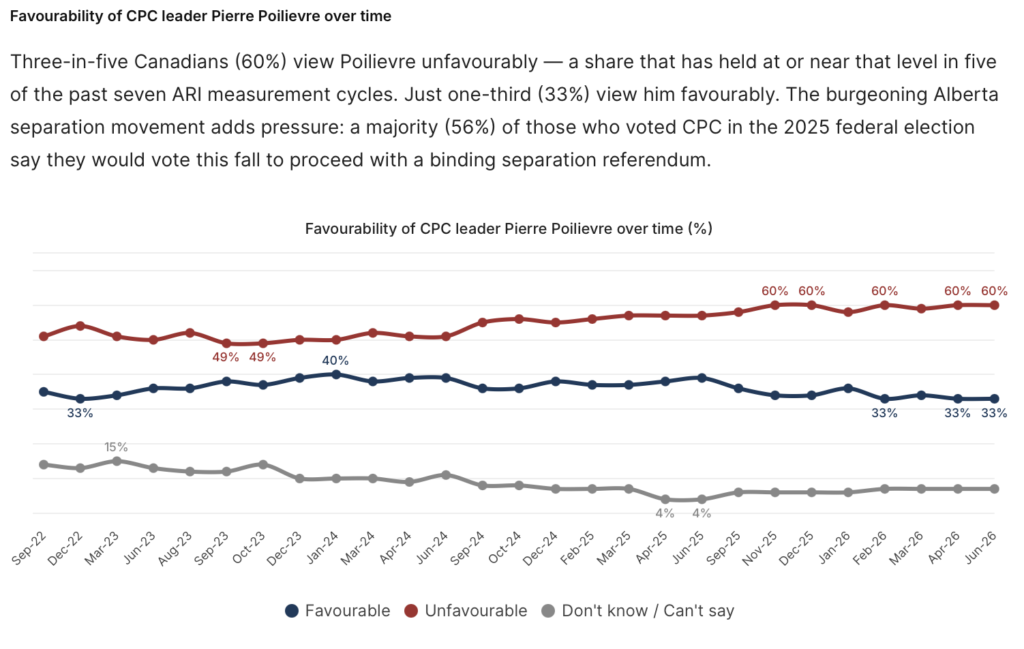
A new Angus Reid Institute release puts the Conservative leader’s national favourability at 33%, while 60% of Canadians view him unfavourably.
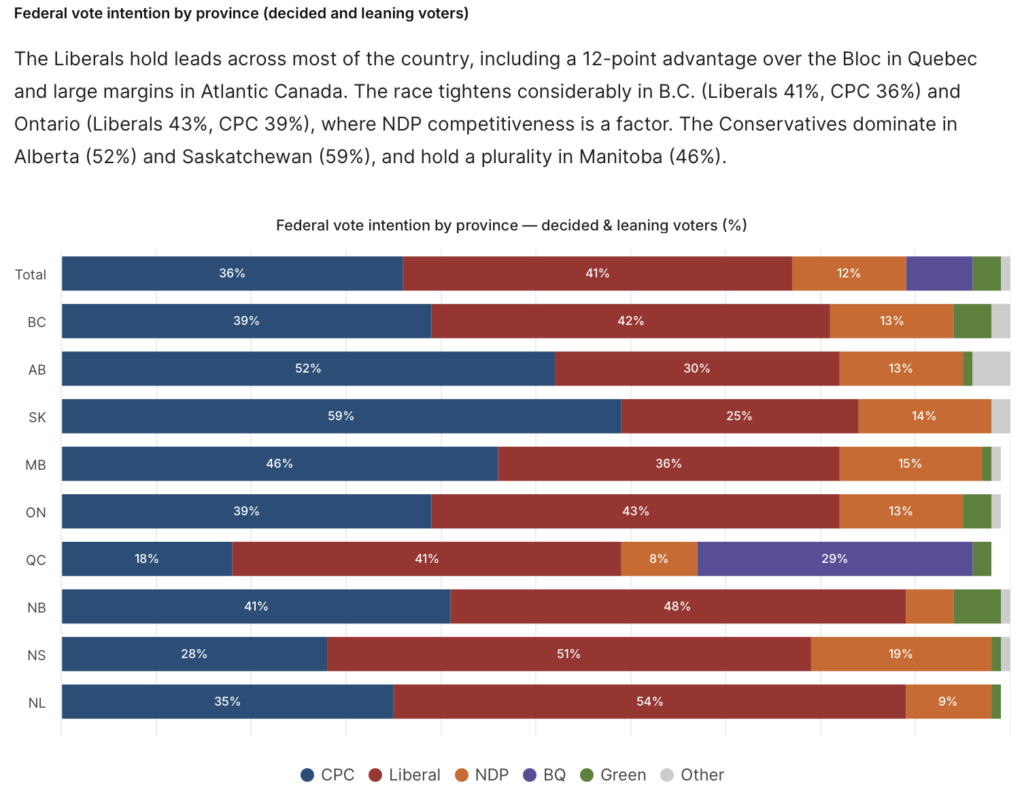
But the more revealing split sits inside Alberta and Saskatchewan. Those two provinces remain Conservative strongholds in the same poll. The CPC leads federal vote intention with 52% in Alberta and 59% in Saskatchewan among decided and leaning voters. Poilievre’s personal favourability, however, sits below that party support in both places, at 47% in Alberta and 48% in Saskatchewan.
 Sponsored · Selkirk Copper Mines
That creates a five-point gap in Alberta and an 11-point gap in Saskatchewan between the Conservative vote and Poilievre’s personal standing.
Province breakdown
The Conservatives do not need Alberta and Saskatchewan to become more conservative. They need those provinces to remain overwhelming enough to offset weaker terrain elsewhere. That is why the leader-party spread matters.
In Saskatchewan, the CPC’s 59% vote intention suggests a durable partisan machine. Poilievre’s 48% favourability suggests a leader who is benefiting from that machine more than personally matching it.
In Alberta, the pattern is narrower but still visible. The Conservatives sit at 52%, while Poilievre is viewed favourably by 47%.
Multiple factors come to play in investigating the decline but it is definitely buoyed with the growing coziness between Alberta and Ottawa, especially after Premier Danielle Smith and Prime Minister Mark Carney inked an energy deal between the two governments.
 Sponsored · Cambria Gold Mines
The numbers do not show a collapse in Conservative support. They show a regional cushion that depends more on party identity than leader pull.
That distinction becomes more important because Poilievre’s unfavourability is not isolated to Liberal-leaning provinces. Angus Reid’s national figure shows six in 10 Canadians holding a negative view of him.
Quebec remains Poilievre’s most difficult province in the Angus Reid data. Only 23% of Quebecers view him favourably, while 68% view him unfavourably.
But Quebec is not where the new strategic tension is hiding. The Conservatives are already weak there, with Angus Reid showing the CPC at 18% vote intention in the province, behind the Liberals at 41% and the Bloc Québécois at 29%.
That makes Quebec a known obstacle. Alberta and Saskatchewan are different. They are supposed to be the party’s insurance policy.
If that insurance policy remains electorally strong but personally softer for Poilievre, the Conservatives have a narrower margin for mistakes in Ontario, British Columbia, and Atlantic Canada.
Carney
Carney’s own numbers have cooled, but they remain materially stronger than Poilievre’s.
Angus Reid puts Carney’s approval at 55%, down from 63% in February. The Liberal vote also leads nationally in the same release, with the Liberals at 41% and the Conservatives at 36%.
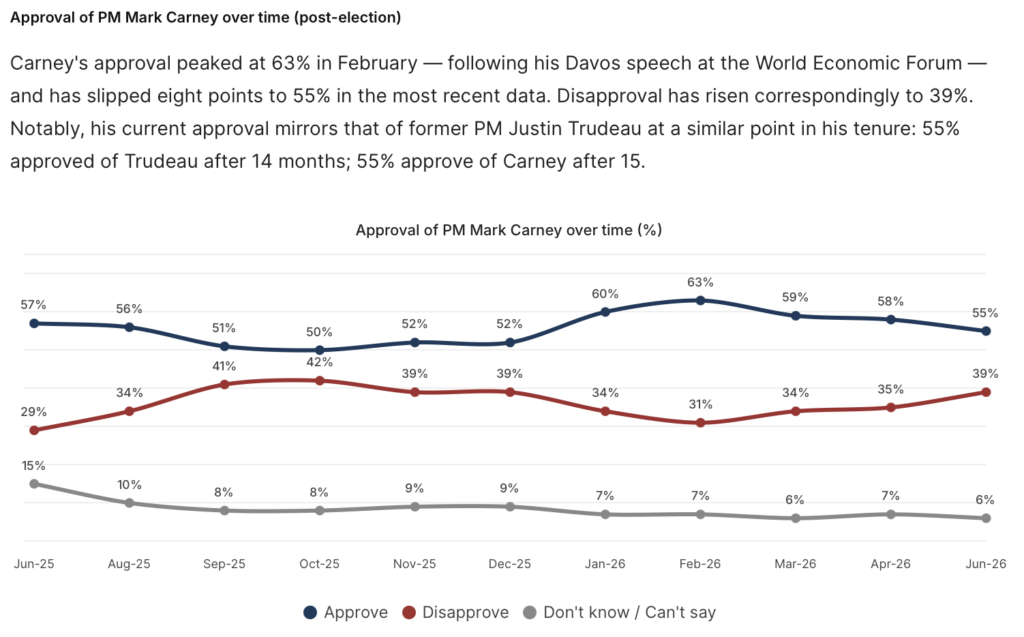
The regional comparison is more uncomfortable for Poilievre. Carney leads Poilievre personally in most provinces listed by Angus Reid. In Alberta, Carney’s 48% approval is roughly level with Poilievre’s 47% favourability. In Saskatchewan, Poilievre has a narrow personal edge, 48% to Carney’s 46%.
This is far from where they stood a few months ago. Poilievre survived his formal leadership review earlier this year, with Reuters reporting that Conservative members voted 87.4% to keep him as leader at the party’s Calgary convention.
Earlier Angus Reid polling found that 58% of past CPC voters supported Poilievre’s long-term leadership, while a growing share said he should go. A Canadian Press report on that poll said 57% of Conservative voters wanted him to lead the party into the next election, down from 68% the previous August, while 30% wanted a replacement, up from 18%.
The new regional numbers sharpen that point. The party’s western vote remains strong. Poilievre’s personal favourability does not fully match it.
The poll does not show Poilievre losing the Conservative base. It shows something more awkward: in his safest territory, the party may be carrying more of the load than he is.
Information for this story was found via the sources and companies mentioned. The author has no securities or affiliations related to the organizations discussed. Not a recommendation to buy or sell. Always do additional research and consult a professional before purchasing a security. The author holds no licenses.








One Response
Canadian Press report on that poll said 57% of Conservative voters wanted him to lead the party into the next election, down from 68% the previous August, while 30% wanted a replacement, up from 18%.
So that 87% number to keep him on as Leader an overblown number. He holds power over his party members and I think it is a well known fact. He is a bit of a bully. The ideas of the Conservative party, especially the old ideas (ie: Alberta/Saskatchewan is what is giving him a solid base in the country). He does not really understand that….continues his rhetoric to the extremes and loses most everyone else. Makes me happy. I prefer my centrist Liberal at the moment. An actual common sense Leader.