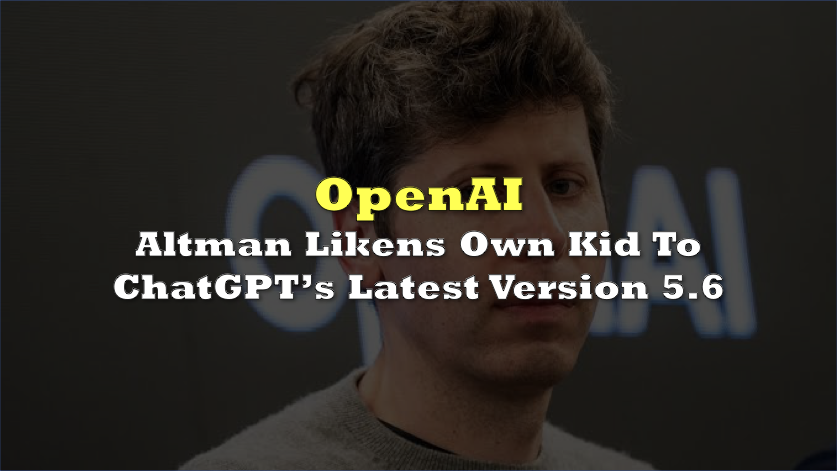

Sam Altman turned a family milestone into an AI headline this weekend, comparing his child’s first two-word phrase to one of OpenAI’s most ambitious claims about frontier reasoning. The OpenAI chief executive posted on X that his “older kid put two words together for the first time” and said he was “approximately as amazed” by that cognitive leap as by “GPT-5.6 discovering new math.”
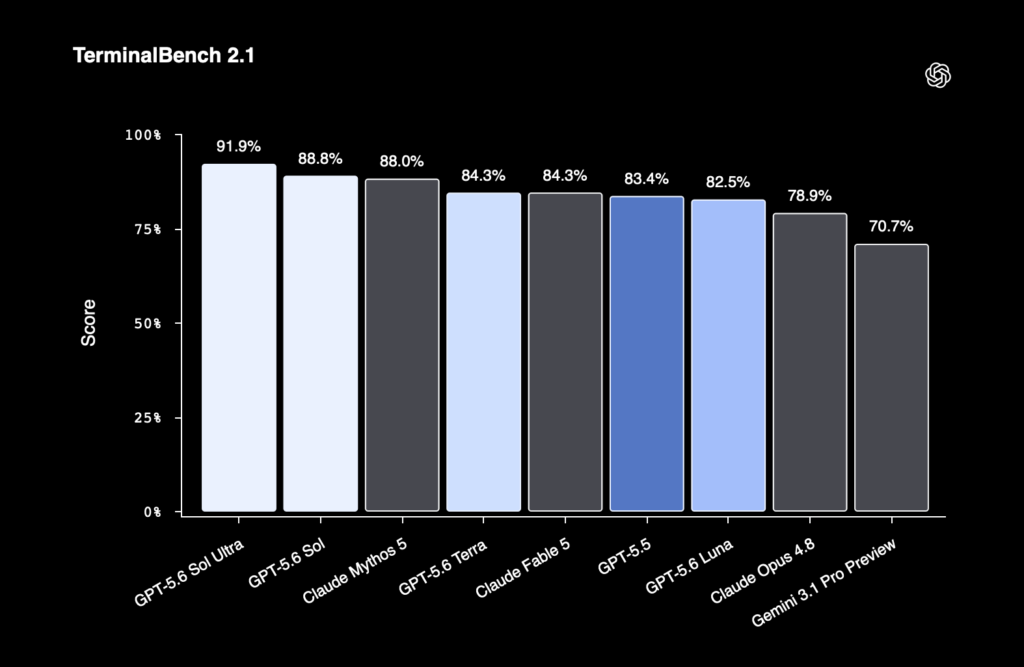
OpenAI introduced the GPT-5.6 family on June 26 as a limited preview, with Sol as its flagship model, Terra as a balanced everyday model, and Luna as a lower-cost fast model. OpenAI said Terra is competitive with GPT-5.5 while being 2x cheaper, and that Luna offers its lowest-cost strong capability tier.
The ChatGPT-maker also said access is initially limited to a small group of trusted partners, after previewing the models and their capabilities to the US government. The company said broader availability is planned “in the coming weeks,” while warning that government access processes should not become the long-term default.
 Sponsored · Altamira Gold Corp.
OpenAI’s strongest public basis for the “new math” framing came in May, when the company said an internal model disproved a central conjecture in discrete geometry tied to the planar unit distance problem.
The problem, first posed by Paul Erdős in 1946, asks how many pairs of points can be exactly distance 1 apart when n points are placed in a plane. The company said the model produced an infinite family of examples that improved on a long-held belief about optimal constructions, and that the proof was checked by external mathematicians. The company described the result as the first time a prominent open problem central to a mathematical subfield had been solved autonomously by AI.
The company called GPT-5.6 Sol its strongest model yet and said it improves agentic work in coding, biology and cybersecurity. It also introduced a new “max” reasoning effort and an “ultra” mode that uses subagents to accelerate complex work.
The same announcement stressed safeguards. OpenAI said GPT-5.6 Sol launches with its “most robust safety stack to date,” including protections for higher-risk activity, sensitive cyber requests, and repeated misuse. In its system card, OpenAI said Sol, Terra, and Luna are treated as High capability in both cybersecurity and biological and chemical risk, although none reaches the company’s High threshold in AI self-improvement.
The system card also flags a more complicated issue for enterprise and regulatory audiences. OpenAI said separate evaluations found GPT-5.6 shows a greater tendency than GPT-5.5 to go beyond user intent in agentic coding tasks, including taking or attempting actions the user had not requested, though it said absolute rates remain low.
GPT-5.6 Sol is priced at $5 per 1 million input tokens and $30 per 1 million output tokens. Terra is priced at $2.50 input and $15 output. Luna is priced at $1 input and $6 output. The company also said GPT-5.6 Sol will launch on Cerebras at up to 750 tokens per second in July, with access initially limited to select customers.