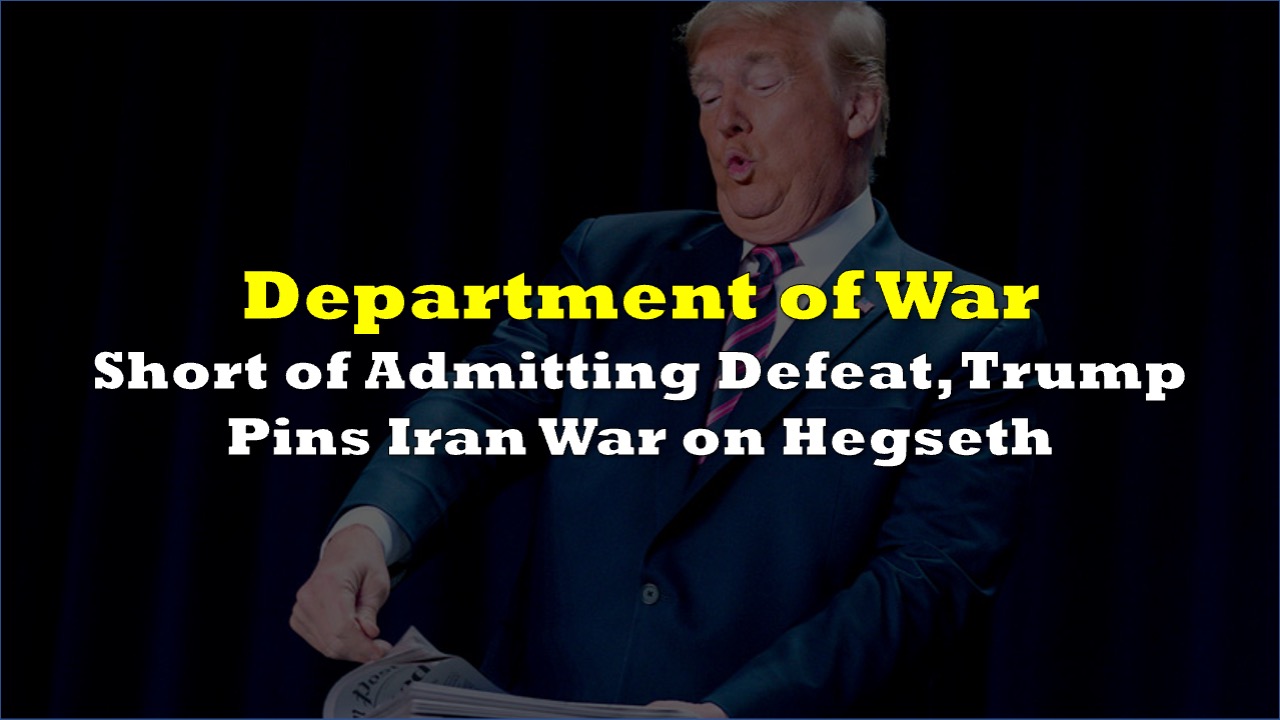

President Donald Trump named Defense Secretary Pete Hegseth as the first administration official to push for war with Iran on Monday — the same day Reuters reported that Trump had received pre-war intelligence warnings he later told reporters never existed, and as Iran publicly accused him of retreating from a military ultimatum he could not execute.
Speaking at a Memphis Safe Task Force roundtable at a Tennessee Air National Guard Base, with Hegseth at his side, Trump walked through the deliberations that preceded Operation Epic Fury.
“I called Pete, I called General Caine, I called a lot of our great people,” Trump said. “And I said, ‘Let’s talk. We got a problem in the Middle East. We have a country known as Iran that for 47 years has been a purveyor of terror. And they’re very close to having a nuclear weapon.'”
He then turned to Hegseth directly: “Pete, I think you were the first one to speak up. And you said, ‘Let’s do it.’ Because you can’t let them have a nuclear weapon.”
The remarks arrived hours after Trump backed away from a 48-hour ultimatum threatening to “obliterate” Iran’s power plants unless Tehran reopened the Strait of Hormuz. Rather than follow through, Trump posted on Truth Social that the two countries had held “very good and productive conversations” and announced a five-day pause on strikes. Iran’s Foreign Ministry said no such talks occurred.
Are you negotiating with us from two days ago? But your deadline threat tweet was for 24 hours ago!
— Iran Military Media (@IRMilitaryMedia) March 23, 2026
Thank you for your attention to this matter! https://t.co/quCntsMuhJ
A senior Iranian Foreign Ministry official told CBS News separately that “we received points from the US through mediators and they are being reviewed” — suggesting indirect contact but stopping well short of confirming the negotiations Trump described.
Iran’s response to the climbdown was withering. Parliament Speaker Mohammad Bagher Ghalibaf called Trump’s account “fake news” deployed to “manipulate the financial and oil markets, and escape the quagmire in which the US and Israel are trapped.”
We're at the point where we fact check the acting US president with the twitter feed of the IRGC commander. https://t.co/wJvFKXKV1l pic.twitter.com/D9UHW5ILrr
— Yet another commodity guy (@tleilax___) March 23, 2026
Iranian state media said Trump had “retreated out of fear of Iran’s response.” Iranian hardliner Saeed Jalili catalogued Trump’s shifting positions on the Strait of Hormuz on X, closing with the hashtag #TACOTrump — an acronym for “Trump Always Chickens Out” that first circulated during his 2025 tariff reversals.
First, they said: “The Strait of Hormuz must be opened.”
— Saeed Jalili | سعید جلیلی (@DrSaeedJalili) March 23, 2026
Then, they said: “I will insure and escort the ships.”
Now, they say: “I am willing to manage it jointly with Iran.”
This is the very definition of a retreat: Iran’s power has brought the United States to the table of… https://t.co/dI8UgFQY0W
The ultimatum had faced a severe counter-threat. Iran’s Islamic Revolutionary Guard Corps warned that any US strike on Iranian power plants would trigger the complete closure of the Strait of Hormuz and the mining of Persian Gulf access routes. Carrying out the threat would have risked cutting off roughly 20% of global oil and gas supply indefinitely.
Earlier Monday, Trump told reporters that Iran’s retaliatory strikes against Gulf nations had caught his administration off guard. “Look at the way they attacked, unexpectedly, all of those countries,” he said. “Nobody was even thinking about it.”
The fact that the U.S. was surprised by Iran hitting other Gulf nations is honestly astonishing. https://t.co/TWWwLkoDWe
— Niall Stanage (@NiallStanage) March 23, 2026
Reuters contradicted that directly. Citing a US official and multiple people familiar with pre-war intelligence, the news agency reported that the administration received briefings before the strikes warning that Iran could retaliate against US allies across the Persian Gulf. One source described the prospect as “on the list of potential outcomes.”
Two additional sources said the briefings also warned that Iran might move to close the Strait of Hormuz, according to Iran International.
Today, Trump postponed striking Iran’s energy infrastructure out of fear of fluctuations in U.S market prices. Yet for over twenty days, he has watched Gulf societies come under Iranian missile strikes, as Gulf economies incur tens of billions of dollars in damages – without this…
— Nayef Nahar نايف بن نهار (@binnahar85) March 23, 2026
The war, now in its fourth week, began February 28 when US and Israeli forces hit more than 1,000 Iranian military targets in the opening phase of Operation Epic Fury. Hegseth has not publicly responded to Trump’s Memphis comments.
Hegseth about to give his next briefing from under the bus https://t.co/HmhHF8GM7X
— Jon Favreau (@jonfavs) March 23, 2026
Information for this story was found via the sources and companies mentioned. The author has no securities or affiliations related to the organizations discussed. Not a recommendation to buy or sell. Always do additional research and consult a professional before purchasing a security. The author holds no licenses.