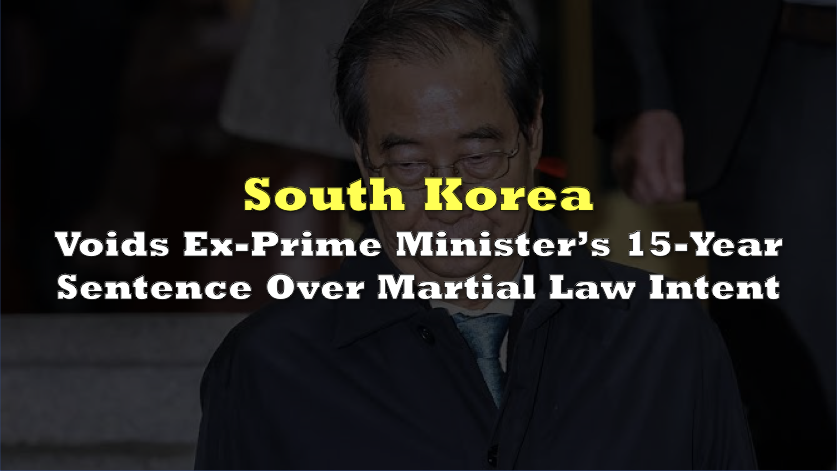

A Cabinet meeting intended to constrain presidential power has become the point on which a former South Korean prime minister’s 15-year prison sentence collapsed. The Supreme Court ruled Thursday that prosecutors failed to prove Han Duck-soo intended to support an insurrection when he helped convene ministers before martial law was declared, even as it left intact findings about his conduct afterward.
The decision, reached by a 9–3 majority, sends the case back to the Seoul High Court. However, it does not acquit Han, 77, or invalidate the court’s conclusion that former President Yoon Suk Yeol’s December 3, 2024, martial-law operation was unconstitutional and amounted to an insurrection.
The disagreement concerned the legal significance of getting ministers into a room. Prosecutors alleged that Han proposed a Cabinet meeting and tracked attendance to create the appearance of required deliberations before Yoon issued his decree. Lower courts treated that conduct as participation in the attempted seizure of power.
 Sponsored · Cambria Gold Mines
The Supreme Court majority found another interpretation remained plausible. A prime minister asking a president to follow the Cabinet-review procedure could be performing a constitutional duty, the justices reasoned. The prosecution had not sufficiently shown that Han shared the purpose of subverting the constitutional order before the declaration or knew the details of plans to deploy forces against major institutions.
The court drew a different conclusion about events after the decree. It found no legal error in rulings that Han pressed ministers to sign martial-law documents and discussed implementation of plans to restrict access to key institutions and cut power and water to selected news organizations.
The justices also rejected challenges to lower-court findings involving a falsified official document and perjury during Yoon’s impeachment proceedings. Findings tied to the destruction of a presidential record were likewise left undisturbed.
Because the disputed pre-declaration act was part of a combined judgment with the other offenses, the court vacated the entire guilty portion of the appellate ruling, including the 15-year sentence.
The High Court must reconsider the case and impose a new sentence. Three dissenting justices argued that Han’s conduct before and after the decree formed a continuous course of participation. They said the meeting helped lend procedural legitimacy to a move that stripped constitutional institutions of their authority. The majority instead required evidence of criminal intent for the earlier conduct, independent of later events.
Han was sentenced to 23 years in January before an appeals court reduced the term to 15 years on May 7. The Supreme Court extended his detention for two months, one day before it was due to expire on November 20.
The ruling also marks another reversal for Han, who briefly led South Korea as acting president after Yoon’s impeachment in December 2024. Han was himself impeached later that month, only to be reinstated by the Constitutional Court in March 2025. He resigned on May 1 ahead of an attempted presidential bid, before facing prosecution over the very martial-law crisis that had elevated him to the presidency.
Less than two years after assuming the country’s highest office, Han remains in custody, with his criminal liability and ultimate sentence still unresolved.