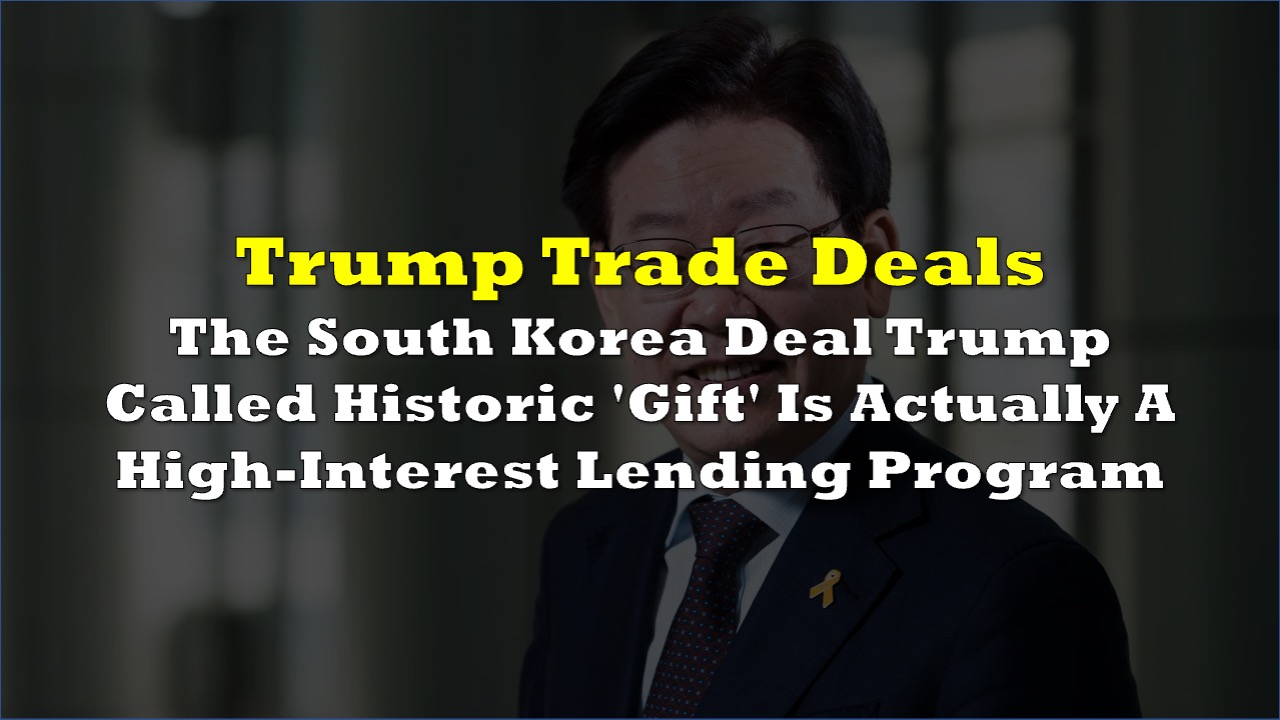

The $350 billion that President Donald Trump announced South Korea would “give to the United States” as part of last week’s trade agreement is structured primarily as high-interest loans rather than the direct payment Trump publicly described, according to details emerging from the negotiations.
South Korean officials have confirmed that “loans and guarantees would account for a majority of the fund, while direct investments would represent a small portion,” following a pattern established in Trump’s recent deal with Japan where officials revealed 98% of a similar pledge involved loans and guarantees that benefit the lending country.
Trump announced the South Korea agreement on July 30, saying the country would “give to the United States $350 Billion Dollars for Investments owned and controlled by the United States, and selected by myself.” The deal reduced tariffs on South Korean goods from a threatened 25% to 15%.
 Sponsored · Altamira Gold Corp.
The agreement also includes $100 billion in South Korean purchases of US liquefied natural gas and other energy products, with $150 billion specifically earmarked for shipbuilding projects under what officials called the “Make American Shipbuilding Great Again” initiative.
South Korea’s President Lee Jae-myung, who took office in June after his predecessor was removed for declaring martial law, called the agreement crucial for eliminating trade uncertainties. Lee is scheduled to visit the White House within two weeks to finalize additional details.
The deal came as South Korea, the US’s sixth-largest trading partner, faced economic pressure from Trump’s tariff threats. The country’s exports declined 0.03% in the first half of 2025, with exports accounting for more than 40% of its GDP.
But the financial structure mirrors Trump’s “massive” deal with Japan, where officials later clarified that Tokyo would earn money through the arrangement rather than simply handing over funds.
 Sponsored · Selkirk Copper Mines
Japan’s chief trade negotiator revealed Saturday that only 1% to 2% of that country’s $550 billion pledge represents actual investment. The remaining 98% consists of loans and loan guarantees that will earn Japan interest payments and fees.
“It’s not that $550 billion in cash will be sent to the US,” negotiator Ryosei Akazawa told Japanese broadcaster NHK, adding that “Japan’s just making money” on the loan portions.
Trump had described the Japanese arrangement as “seed money” and “not a loan or anything, it’s a signing bonus.” When asked about the 90% profit-sharing he touted, Japanese officials clarified that split applies only to the tiny equity portion, not the bulk financing structure.
The arrangements allow both countries to avoid Trump’s threatened 25% tariffs while earning returns on their financial commitments. Japan expects to save approximately $68 billion in tariff costs under its deal, while collecting interest on loans that comprise the vast majority of its pledge.
The revelations have drawn criticism from trade analysts who question whether the arrangements represent the foreign concessions Trump claims to have secured.
“There is a lot less here than meets the eye,” said Brad Setser, a former US Trade Representative advisor, calling the commitments potentially “vaporware.”
Similar deals with the European Union, Indonesia, Vietnam, and the Philippines follow comparable structures, featuring headline investment figures that include significant loan components rather than direct transfers.
Treasury Secretary Scott Bessent defended the approach Wednesday, saying countries earned lower tariff rates because they “were willing to provide this innovative financing mechanism.”
Whether the promised financing will materialize remains unclear, with Japanese officials noting that many details have yet to be formalized in writing.
Information for this story was found via Reuters, and the sources and companies mentioned. The author has no securities or affiliations related to the organizations discussed. Not a recommendation to buy or sell. Always do additional research and consult a professional before purchasing a security. The author holds no licenses.