

SpaceX’s aborted Starship launch did not destroy a rocket, delay a customer mission, or produce a catastrophic failure, yet it erased billions of dollars in market value within hours.
The 13th Starship flight test never left the launch pad Thursday after several Super Heavy Raptor engines failed to ignite, triggering an automatic abort less than one second before liftoff, Reuters reported.
By the end of after-hours trading, SpaceX shares had fallen roughly 4%, extending a slide that had already pushed the stock below its $135 IPO price for the first time since last month’s listing, according to MarketWatch.
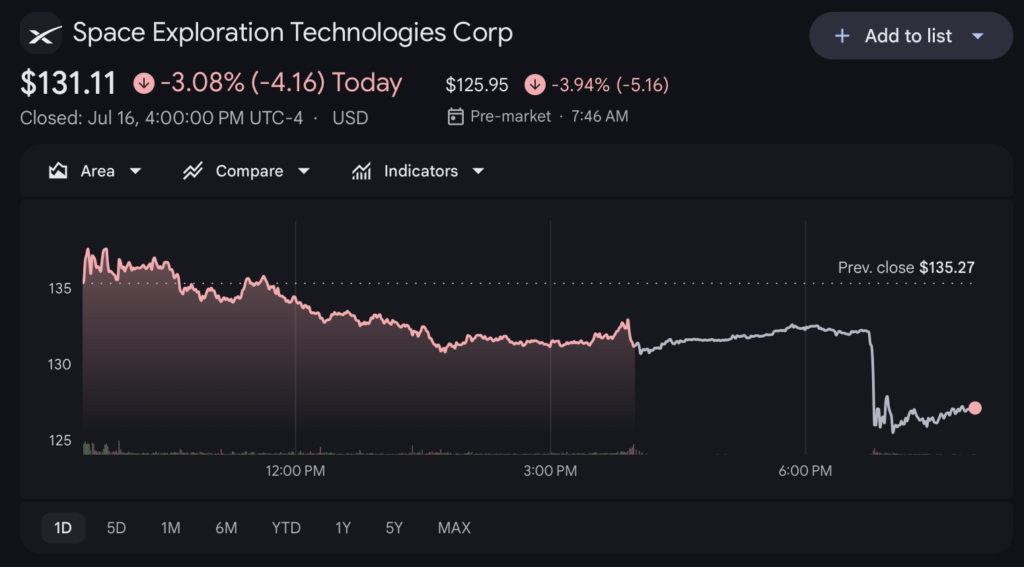
The fact is launch scrubs are common during rocket development, particularly for experimental heavy-lift vehicles. Before SpaceX went public, an aborted test would primarily affect engineering schedules.
 Sponsored · Selkirk Copper Mines
Now, investors view those same events as signals about execution risk.
The latest scrub occurred after engine ignition began but before the rocket was released from the launch mount. SpaceX’s automated safety systems halted the countdown when some of the booster’s 33 Raptor engines failed to start, preventing an off-nominal launch, AP News reported.
CEO Elon Musk later said two Raptor engines will be replaced before another launch attempt, which he expects could occur early next week.
The market’s response was notable because the launch itself did not fail. The vehicle remained intact, no payload was lost, and the safety systems performed as designed. Operationally, the setback amounted to additional inspections, hardware replacement, and another countdown in the coming days.
Financially, however, investors reacted as though Starship’s development timeline had become more uncertain.
That distinction matters because much of SpaceX’s long-term growth thesis depends on Starship dramatically reducing launch costs while enabling larger Starlink deployments, commercial cargo missions, NASA lunar contracts, and future deep-space operations. Musk himself claimed SpaceX would be “worth more than the rest of Earth if we accomplish our goals.”
Every delay therefore affects not only engineering milestones but also assumptions embedded in the company’s valuation.
The planned mission was more than another test flight. SpaceX intended to launch 20 next-generation Starlink satellites capable of testing new communications capabilities while collecting data on Starship’s upgraded heat shield during reentry. Neither the booster nor the spacecraft was intended to be recovered.
Starship also remains central to NASA’s Artemis program, where a modified version of the spacecraft is expected to serve as the Human Landing System for future lunar missions.
Successive flight tests are therefore important not only for SpaceX’s commercial ambitions but also for government programs that depend on the vehicle reaching operational maturity.
SpaceX shares had already fallen below their IPO price before Thursday’s launch window opened, reflecting cooling enthusiasm after the company’s record-breaking public debut. The aborted countdown became another data point reinforcing investor concerns that execution will determine whether the company can sustain its premium valuation.
The irony is that the systems designed to prevent a launch accident functioned exactly as intended.