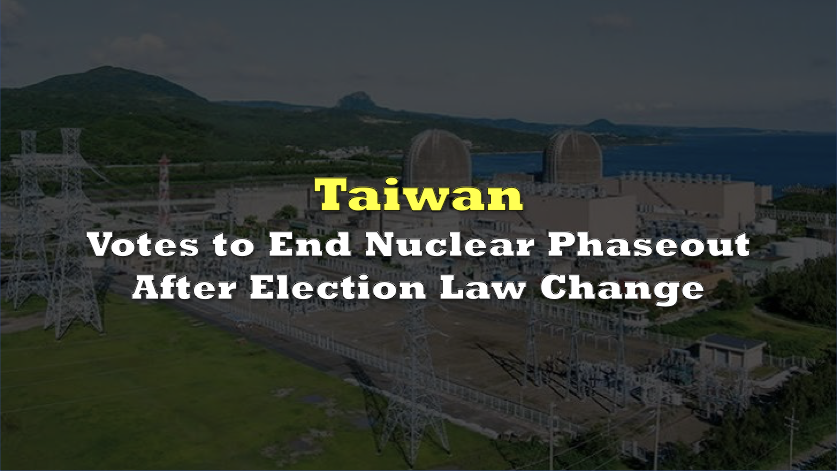

Taiwanese voters backed a reversal of the country’s nuclear phaseout on Saturday, with a change to electoral scheduling helping deliver a successful referendum despite a considerably smaller proportion of affirmative votes than in a failed nuclear power referendum last year.
The latest proposal received 7,434,677 affirmative votes against 4,557,768 opposing votes, according to Central Election Commission figures reported by United Daily News.
Affirmative votes accounted for 61.99% of valid ballots, compared with 74.17% in an August 2025 referendum on extending operations at the Maanshan Nuclear Power Plant.
 Sponsored · Selkirk Copper Mines
The difference was voter participation. Turnout more than doubled to 62.79% from 29.53% last year, while the number of affirmative votes increased by 71.3%. The number of opposing votes also more than tripled.
Under Taiwan’s Referendum Act, a proposal requires both a majority of valid votes and affirmative ballots representing at least 25% of all eligible voters.
Last year’s proposal fell short of the second requirement, receiving support from just 21.70% of eligible voters. Saturday’s measure secured 37.17%, exceeding the required threshold by more than 2.4 million votes.
Three months after the failed 2025 referendum, Taiwan’s legislature voted 56–44 to amend the Referendum Act, restoring the practice of holding referendums alongside nationwide elections when their schedules coincide.
 Sponsored · Silver47 Exploration Inc.
The amendment, promulgated on December 3, 2025, allowed Saturday’s nuclear policy referendum to take place alongside elections for local government officials.
The opposition Kuomintang, backed by the Taiwan People’s Party, secured legislative approval for the broader nuclear policy question in August.
Unlike last year’s reactor-specific proposal, Saturday’s referendum sought public approval for using nuclear power to support economic development and abandoning the government’s nuclear-free energy policy.
KMT Chairwoman Cheng Li-wun called for a comprehensive restart of nuclear power following the result, linking nuclear generation to Taiwan’s competitiveness in artificial intelligence and its carbon reduction objectives, Central News Agency reported.
President Lai Ching-te had already signaled greater openness to nuclear energy in March, citing growing electricity requirements from AI development, decarbonization commitments, and geopolitical risks.
Taiwan’s Nuclear Safety Commission completed its initial review of the Maanshan restart plan on September 24, two months before Saturday’s vote.
State-owned Taiwan Power Company must still complete safety assessments covering equipment aging, radiation, and earthquake resistance before submitting its findings for further regulatory review.
Taiwan’s Cabinet said Saturday that it respected the referendum outcome but maintained its requirements for reactor safety, nuclear waste management, and public consensus.
The referendum also leaves provisions establishing a nuclear-free objective in Taiwan’s Basic Environment Act and Climate Change Response Act intact.
While voters have authorized a change in energy policy, the referendum neither specifies which reactors should return to service nor establishes a deadline for restoring nuclear electricity generation.