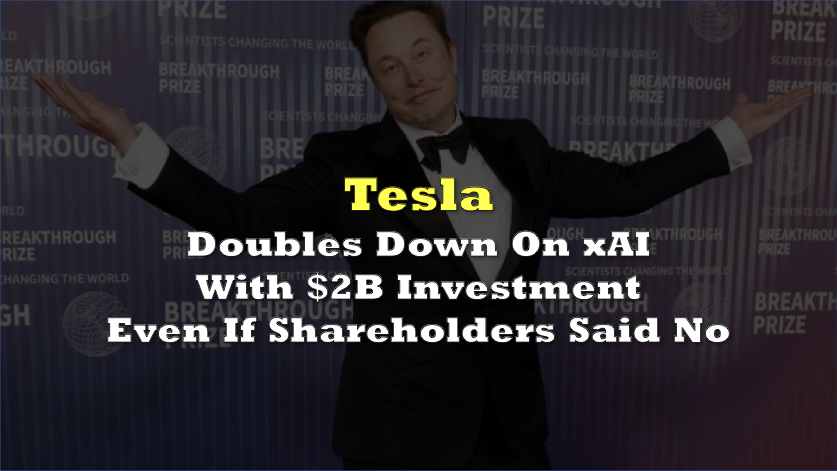

Tesla (NASDAQ: TSLA) this week said it agreed to invest about $2 billion in Elon Musk’s artificial intelligence startup xAI, aligning the automaker more tightly with an autonomy and robotics narrative that underpins a roughly $1.5 trillion valuation.
The automaker disclosed it entered into an agreement to invest approximately $2 billion to acquire shares of xAI as part of the latter’s publicly disclosed financing round. The investment was made on market terms consistent with those previously agreed to by other investors in the round, and is expected to close in Q1 2026 subject to customary regulatory conditions.
The companies also entered into a framework agreement tied to the investment that builds on an existing relationship and sets a process for evaluating potential AI collaborations, with Tesla positioning the investment and framework as a means to enhance its ability to develop and deploy AI products and services into the physical world at scale under Master Plan Part IV.
This comes after shareholders did not approve a non-binding proposal to authorize Tesla to invest in xAI at a November 2025 annual meeting, because Tesla’s bylaws generally treat abstentions as votes against: there were 1.06 billion shares for it, 916.3 million shares against, and 473.1 million shares abstained, leading Tesla to report the proposal “was not approved.”
Tesla Board: "Do you guys want us to invest in xAI, Daddy's overvalued AI company?"
— 𝕋𝕒𝕧𝕚 (@tavi_chocochip) January 28, 2026
Shareholders: "Nah, not really…"
Tesla Board: "Ok then… well, anyway, we just invested $2B, you're welcome!" pic.twitter.com/0ACr94ksFE
Tesla paired the xAI investment disclosure with a reiteration that Cybercab robotaxi production plans remain on track for this year, while describing a broader build program that includes Cybercabs, humanoid robots, Semi trucks, and Roadster sports cars.
That expansion path is set to raise Tesla’s capital expenditures above $20 billion this year, CFO Vaibhav Taneja said, more than double the $8.5 billion in 2025, a step-up that helped pare an initial after-hours share move of about 3.5% to roughly 1.8%.
There should be a few immediate lawsuits about this self-dealing. This was the one item $TSLA shareholders voted against. https://t.co/WBISEq37Sv
— Suspected Saboteur (@ShortingIsFun) January 28, 2026
The company’s core EV business remains as the bulk of its current revenue, but 2025 revenue fell about 3% to roughly $94.83 billion, the first annual revenue decline since going public, with a separate company-statement indicating annual revenue fell 2.9% in 2025.
Quarterly profitability mixed tighter earnings with weaker net income: adjusted EPS was $0.50 in the fourth quarter versus $0.45 expected, while net income fell 61% to $840 million. Automotive gross margin excluding regulatory credits rose to 17.9% from 13.6% a year earlier, above a roughly 14.3% expectation.
Energy generation and storage stood out as a growth driver, with segment revenue up 25.5% to a record $3.84 billion in the December quarter, beating estimates of $3.46 billion amid sustained demand for grid-scale batteries that support renewable power and stabilize electricity networks.
On strategy and product mix, Musk told analysts Tesla would stop selling Model S sedans and Model X SUVs, with factory space redirected to robots. Cybercabs meanwhile will be added to a robotaxi service currently relying on Model Y vehicles running a version of Full Self-Driving and will also be available for consumers to buy.
Information for this story was found via Reuters and the sources and companies mentioned. The author has no securities or affiliations related to the organizations discussed. Not a recommendation to buy or sell. Always do additional research and consult a professional before purchasing a security. The author holds no licenses.