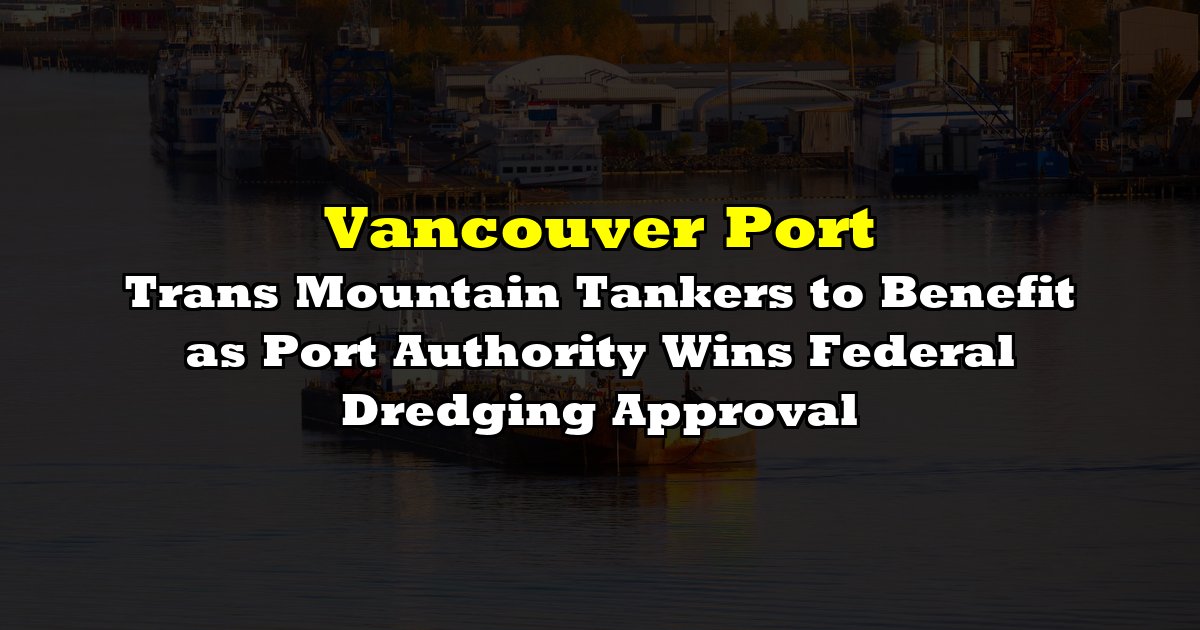

Aframax-class tankers departing Trans Mountain’s Westridge Marine Terminal have been limited to loading roughly 80 per cent of capacity due to draft restrictions in Burrard Inlet’s Second Narrows. That constraint is now set to be addressed. The Vancouver Fraser Port Authority has obtained all necessary federal permits, among them a federal authorization under the Fisheries Act issued by Fisheries and Oceans Canada, to proceed with dredging the navigation channel beneath the Ironworkers Memorial Bridge.
Work is scheduled to begin in September and will target the channel’s northern and southern flanks east of the Ironworkers Memorial Bridge. The project will also involve removing segments of two decommissioned Metro Vancouver waterlines and installing new navigation aids near the Columbia Containers terminal on the inlet’s south shore.
The port authority has not provided a completion timeline.
The dredging will not change the types of vessels using the waterway. Aframax tankers, which measure up to 250 metres in length with a draft of up to 16 metres, will remain the largest class allowed. The goal is simply to let those ships depart with fuller loads. B.C. Energy Minister Adrian Dix made a similar point last year, saying the project would mean “less traffic at the port and better utilization.”
 Sponsored · Selkirk Copper Mines
Most of the dredging will reach about 1.3 metres below the sea floor, with a maximum depth of six metres, removing approximately 25,000 cubic metres of material. That volume represents less than one per cent of what the port authority excavates each year from the Fraser River as part of routine maintenance.
The project is not without opposition. The Sierra Club has warned that disturbing the inlet’s toxic sediments could reverse years of ecological recovery, with eelgrass, herring, salmon, seals, and whales all at risk. The port authority acknowledges a low risk of contaminated sediment disturbance but says dredging contractors will be required to monitor water turbidity and pause work when needed.
The federal Fisheries Act authorization carries more than 100 legally binding conditions, and all in-water work will be confined to the mid-August through end-of-February window identified by the Fisheries Department as lowest-risk for fish habitat.
The idea was first floated by Prime Minister Mark Carney in spring 2025, tied to a broader ambition of doubling Canada’s export volumes to markets outside the United States within ten years, a goal that has grown more pressing amid sustained trade friction with Washington.
Information for this story was found via the sources and companies mentioned. The author has no securities or affiliations related to the organizations discussed. Not a recommendation to buy or sell. Always do additional research and consult a professional before purchasing a security. The author holds no licenses.