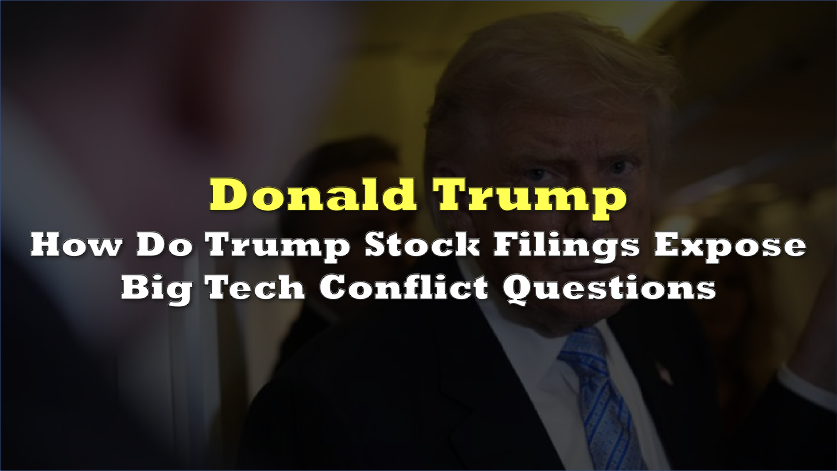

President Donald Trump’s stock disclosures have turned Big Tech exposure into a White House ethics problem as they show presidential money moving through companies sitting directly under presidential power.
The most explosive slice is a Yahoo Finance tally, circulated through market trackers, showing Trump made 94 trades tied to the “Magnificent Seven” in the first quarter of 2026. The trades were reportedly valued between $50 million and $70 million, split across 64 purchases and 30 sales involving the group of technology giants that dominate US equity indexes.
That group is not just another stock basket. The names ranged from cloud and chip companies such as Microsoft, Oracle, Broadcom, Nvidia and Amazon to platform stocks including Meta and Apple, plus banks including Goldman Sachs and Bank of America. These firms sit in the center of AI policy, antitrust enforcement, cloud procurement, trade fights, content regulation, autonomous-driving rules, and federal technology spending.
 Sponsored · Selkirk Copper Mines
Reuters reported that two Office of Government Ethics filings showed at least $220 million in Trump-linked first-quarter transactions, with the total potentially reaching about $750 million because disclosure forms use broad value bands instead of exact dollar amounts. The filings included transactions tied to major companies such as Microsoft, Meta, Oracle, Broadcom, Nvidia, Apple, Amazon, Bank of America, and Goldman Sachs, along with municipal bonds and index funds.
The Financial Times placed the range at $211 million to $687 million, underscoring the problem with the disclosure system itself: even when the filings are public, the public still gets a foggy number.
The disclosure smoke
The filings offer enough detail to raise questions, but not enough to settle them.
They do not show exact execution prices. They do not show realized gains or losses. They do not always identify the precise instrument in a way that lets the public cleanly separate stock, bonds, funds, or other securities. They also do not answer whether a trade was part of a pre-set account strategy, a portfolio rebalance, or a discretionary manager’s independent call.
 Sponsored · Cambria Gold Mines
That opacity matters more when the account belongs to a president. A delayed tariff decision can move Apple. An AI export rule can move Nvidia. Pentagon and federal cloud spending can move Microsoft, Amazon, and Oracle. Antitrust enforcement can move Meta, Alphabet, Apple, and Amazon. EV policy and China rhetoric can move Tesla.
Nothing in the disclosures establishes an illegal trade. But that is a low bar for a presidency. The more serious issue is whether the current ethics regime can handle a president whose disclosed financial activity touches companies that are both market leaders and policy subjects.
The Trump Organization has argued that there is no direct-control problem. A spokesperson told Reuters that Trump’s investments are held in discretionary accounts managed by third-party financial institutions, and that Trump, his family, and the Trump Organization do not select, direct, or approve individual investments.
That defense answers one question narrowly: who clicked the trade button. However, it does not erase the larger political question of whether family-controlled wealth, broad portfolio knowledge, and presidential market power can coexist without creating a standing conflict cloud.
$200 fine
The Washington Post reported that Trump was months late in disclosing tens of millions of dollars in stock trades and was fined $200. The report said the late disclosures included Microsoft and Amazon transactions.
That number is almost comically small beside the disclosed trading range. A $200 penalty attached to transactions worth tens of millions of dollars is the kind of mismatch that turns a compliance issue into a political weapon. Federal rules require covered officials to report qualifying transactions above $1,000 within set deadlines.
When the official is the president, delayed visibility means the public may learn about major market exposure only after the policy window has already moved.
The Trump Organization’s third-party-management explanation may reduce the appearance of day-to-day trading control, but it does not create the clean separation associated with a true blind trust. In the Reuters report, the assets are reportedly still held through a trust overseen by his children
That distinction is the core of the controversy. A blind trust is designed to block knowledge and control. A family-linked structure with discretionary managers may block specific trading instructions, but it does not necessarily block awareness of the portfolio’s broad interests after disclosures are filed.
For ordinary investors, that difference is technical. For a president, it is everything.
The issue is not that Trump owns exposure to major US companies. The issue is that the same office making decisions over AI, trade, competition, tax, procurement, and industrial policy is now tied through public filings to market activity in the companies most sensitive to those decisions.
That makes the filings politically dangerous even if they never become legally damning.
Information for this briefing was found via the sources and the companies mentioned. The author has no securities or affiliations related to this organization. Not a recommendation to buy or sell. Always do additional research and consult a professional before purchasing a security. The author holds no licenses.