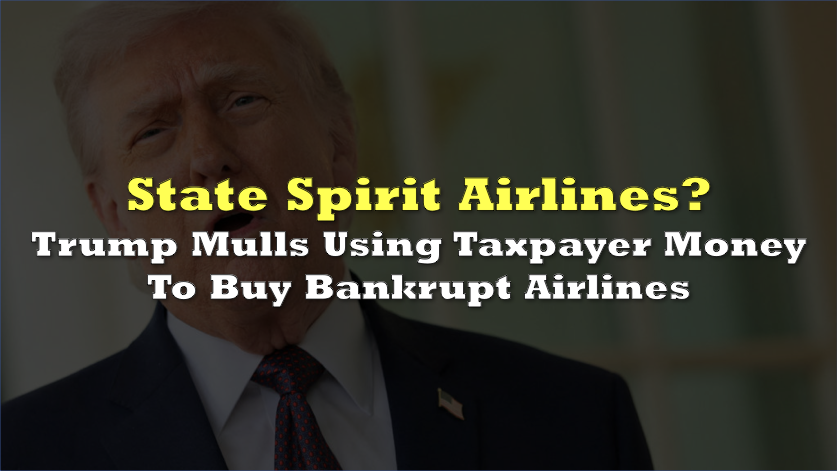

President Donald Trump is weighing a taxpayer-funded takeover of Spirit Airlines as the bankrupt ultra-low-cost carrier negotiates a federal financing package that could reach $500 million and give the government a major ownership stake.
Speaking at the Oval Office on Thursday, Trump said the administration may go beyond a bailout and buy the airline outright if the price is low enough.
“We’re thinking about doing it, helping them out and meaning bailing them out or buying it. I think we just buy it,” he said. “We’d be getting it virtually debt free. They have some good aircraft, some good assets, and when the price of oil goes down, we’ll sell it for a profit.”
 Sponsored · Selkirk Copper Mines
The remarks followed a New York bankruptcy court hearing where Spirit’s lawyer, Marshall Huebner of Davis Polk, said the airline was in advanced talks with the US government on financing that could support its restructuring. The carrier’s cash crisis could become critical within a week, while the contemplated package could involve a $500 million government-backed bailout and warrants that may give Washington up to a 90% stake.
Spirit Aviation Holdings traded at $1.11 after falling $0.39, or 26.0%, following Trump’s comments. Earlier reporting said the stock had surged more than 160% on Wednesday after news of the rescue talks, though shares remained near penny-stock levels at around $1.55.
Trump said the core motivation was preserving jobs and competition, saying “we’re looking if we could get it for the right price, I’d do it to save jobs,” he said.
“I’d love to be able to save an airline,” Trump said. “You know, I like having a lot of airlines. So it’s competitive.”
 Sponsored · Altamira Gold Corp.
Spirit CEO Dave Davis welcomed the remarks, saying the company was “grateful for President Trump’s support” and wanted a solution that protects jobs, preserves competition, and keeps affordable fares available. The Spirit pilots’ union also backed a rescue, with Capt. Ryan P. Muller saying, “When Spirit enters a market, fares go down.”
Spirit has filed for Chapter 11 twice since late 2024, first in November 2024 and again in August 2025. The airline emerged from its first bankruptcy in March 2025, then refiled less than a year later after continuing cash pressure and restructuring problems.
The airline has been hit by years of losses, rising operating costs, changing consumer preferences, an engine recall, and failed merger attempts. Reuters reported that high jet fuel costs tied to the US/Israel conflict with Iran added about $100 million in losses, while The Verge reported the fuel spike added about $360 million to expenses.
Spirit’s fleet remains one of its most valuable pieces. CBS reported that as of the end of last year, Spirit owned 48 planes, leased 83 more, owned 18 spare engines, and leased 16 spare engines, all tied to the Airbus A320 family. The airline has since announced plans to cut its fleet to 76 to 80 planes by Q3 2026 as part of restructuring.
Trump also pointed to Spirit’s airport slots, calling them “pretty valuable.” Slots are scheduled takeoff and landing times at constrained airports, meaning they can become valuable assets even when an airline’s operating business is distressed.
Sen. Ted Cruz called the bailout idea a “terrible idea,” while Sen. Tom Cotton wrote that if Spirit’s creditors or other investors do not think they can run it profitably after two bankruptcies in under two years, he doubts the US government can either.
Transportation Secretary Sean Duffy also framed the issue as a viability test rather than a jobs-only decision.
“The question will be, can we do anything to save Spirit and make it viable, or would we be putting good money into a company that inevitably is gonna be liquidated?” he said.
The White House has tried to connect Spirit’s predicament to the blocked JetBlue Airways acquisition. That $3.8 billion merger was challenged by the Biden-era Justice Department in 2023, then blocked in January 2024 by US District Judge William Young in Massachusetts. JetBlue and Spirit terminated the deal in March 2024.
Information for this briefing was found via the sources and companies mentioned. The author has no securities or affiliations related to this organization. Not a recommendation to buy or sell. Always do additional research and consult a professional before purchasing a security. The author holds no licenses.