President Donald Trump on Friday turned the Supreme Court decision that struck down his emergency tariffs into a threat of something potentially broader: cutting off trade with countries that run surpluses with the US unless the Federal Reserve lowers interest rates.
“LOWER THE RATE OR I’LL STOP TRADING WITH COUNTRIES WITH WHICH WE HAVE A DEFICIT,” Trump wrote on Truth Social. He also described ending trade as “better than tariffs” and argued that high US rates leave the country at an unfair competitive disadvantage.
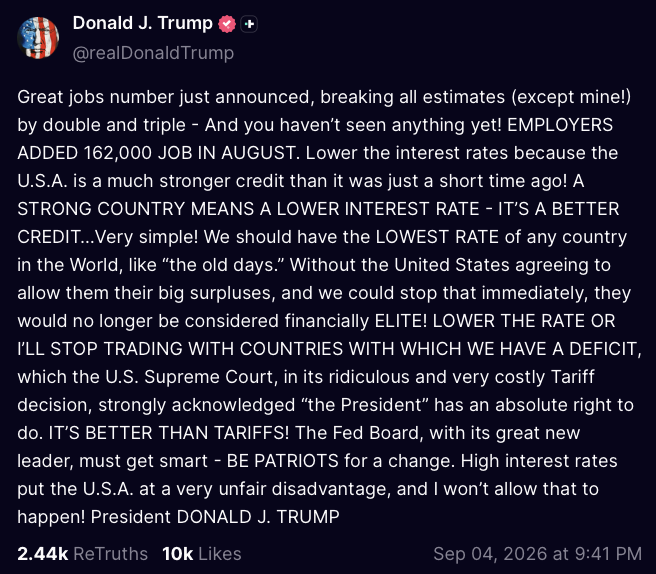
The threat came immediately after a surprisingly strong August jobs report moved markets in the opposite direction. The Bureau of Labor Statistics said nonfarm payrolls increased by 162,000, versus 56,000 expected in a Reuters poll, while unemployment held at 4.1%. The dollar index rose 0.37% following the release, while traders increased bets on a potential Fed rate hike this month.
 Sponsored · Selkirk Copper Mines
The Fed held its benchmark target range at 3.50% to 3.75% on July 29. Three policymakers dissented in favor of a quarter-point increase, while the committee said inflation remained elevated relative to its 2% goal.
Its next meeting is scheduled for September 15 and 16.
Trump also invoked February’s Supreme Court ruling, claiming the justices had acknowledged an “absolute right” for the president to stop trade.
The decision itself is narrower. The Court held that the International Emergency Economic Powers Act does not authorize tariffs. It noted that IEEPA permits a president to prohibit importation after identifying an “unusual and extraordinary threat” originating substantially outside the US and declaring a national emergency. The ruling did not describe that authority as absolute.
The threat also follows a sharp widening of the US trade gap. The Bureau of Economic Analysis reported Thursday that the goods and services deficit jumped 24.4% from June to $88.6 billion in July.
Monthly goods deficits included $27.5 billion with Mexico, $23.3 billion with Vietnam, $18.1 billion with Taiwan, and $15.2 billion with China.