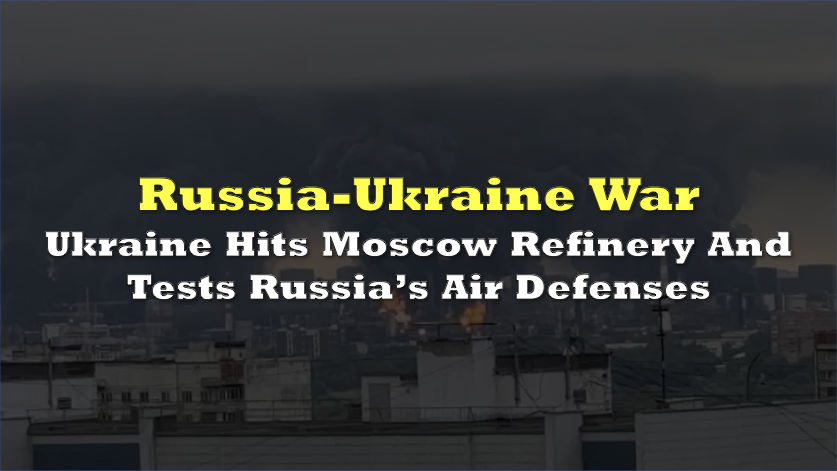

Ukraine’s latest strike on Moscow has turned the Russian capital’s refinery network into a test of repair capacity, fuel rerouting, and air-defense economics. The attack hit the Moscow Oil Refinery, a Gazprom Neft-operated facility that serves the capital region and has now been struck twice in the same week.
Russian officials said hundreds of Ukrainian drones were intercepted across several regions overnight, while Moscow-area airports halted or delayed flights and local authorities reported injuries from the attack and falling debris.
According to Reuters, which cited industry sources, damage from the two June attacks appears to have touched both of the plant’s main crude-processing paths. Those sources said the June 18 attack damaged the Euro+ refining complex, while an earlier June 16 strike damaged CDU-6. Reuters reported that Euro+ accounts for about 47% of the plant’s crude-distillation capacity, while CDU-6 accounts for about 53%.
 Sponsored · Cambria Gold Mines
Gazprom Neft had not publicly commented on the reported extent of the damage in the said reports. That makes the strike more than a psychological blow against Moscow. If the reported damage is sustained, Ukraine has shown it can put pressure on a capital-region fuel plant by targeting the units that convert crude into usable products, not merely tanks or exposed perimeter equipment.
Russia’s Defence Ministry said, per Al Jazeera’s report, that air defenses shot down 555 Ukrainian drones across multiple regions, including almost 200 headed toward Moscow.
AP reported that more than 500 flights were disrupted across Moscow-area airports. Russian authorities also reported injuries in the Moscow region, with totals varying slightly across outlets. Multiple outlets put the injured at 16 to 17 people.
Those disruptions matter because the Moscow refinery is not a remote export asset. It is a domestic fuel facility tied to the capital region, processing about 230,000 barrels per day in 2024 and produced 11.6 million metric tons of oil products, including gasoline, diesel, and bitumen.
 Sponsored · Selkirk Copper Mines
President Volodymyr Zelenskyy confirmed Ukraine’s long-range campaign and linked it to pressure on Russia to end the war. Reuters reported that he warned Moscow would face consequences if Russian attacks on Ukraine continue, including his line that “Moscow will burn.”
Ukraine has increasingly used drones against Russian refineries, oil depots, and energy-linked infrastructure. Reuters has tracked strikes in 2026 against multiple Russian energy sites, including facilities in Yaroslavl, Tuapse, Perm, Ryazan, Syzran, Novokuibyshevsk, Ufa, and Kirishi.
Kyiv’s logic is straightforward: Russia’s energy infrastructure helps finance and sustain the war. But the Moscow strike adds another layer. It forces Russia to spend defensive attention not only on border areas, occupied territory, export routes, and military sites, but also on infrastructure close to the political center.
The cost imbalance is the point. A refinery does not need to be permanently destroyed to become expensive. It only needs to be hit often enough to require shutdowns, inspections, replacement parts, rerouted product flows, and protection from the next wave.
But for Moscow, the metric that matters may no longer be drones destroyed. It is barrels protected.
Information for this story was found via the sources and companies mentioned. The author has no securities or affiliations related to the organizations discussed. Not a recommendation to buy or sell. Always do additional research and consult a professional before purchasing a security. The author holds no licenses.