
Now that it has nearly been a year since the Covid-19 pandemic decimated US financial markets and simultaneously sparked the worst recession since the Second World War, it appears that an economic recovery may finally be underway, prompting the Federal Reserve to pull back some of its support.
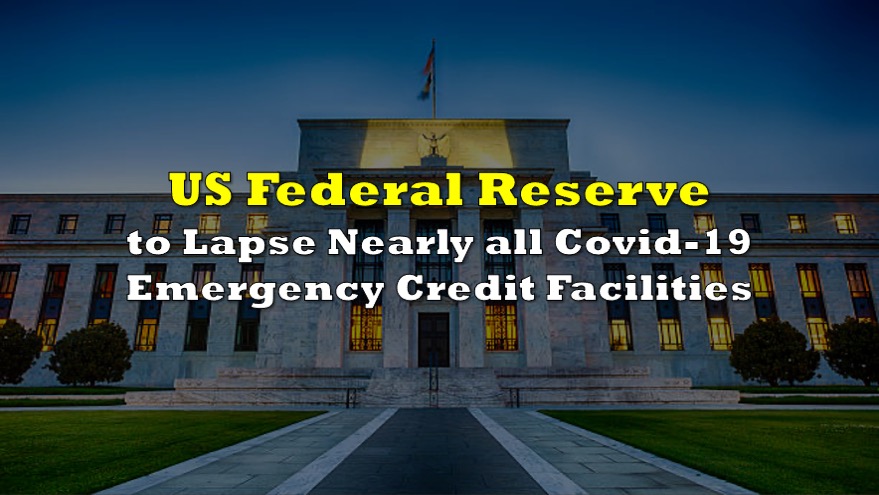
On Monday, the Federal Reserve announced it will let three of its emergency lending programs lapse as scheduled at the end of March, including the Money Market Mutual Fund Liquidity Facility, the Commercial Paper Funding Facility, and the Primary Dealer Credit Facility. The lending programs were unveiled in March of last year in response to the sudden and steep market collapse that left investors with very little liquidity. However, with markets now stabilized, the central bank plans to pull back some of its support, citing low usage.
The three credit facilities were part of a broader plan to inject stability into a financial system that was left in ruins following the onset of the pandemic. The emergency facilities were introduced under unprecedented powers that granted the Federal Reserve a torrent of unlimited asset-buying, as well as slashing interest rates to near-zero. Although the latter two schemes are unlikely to subside anytime soon, the more directed credit facilities have been the subject of previous controversy, and as a result— only a small uptake has been recorded throughout the pandemic.
 Sponsored · Cambria Gold Mines
The three lending facilities in particular gained notable headlines when former Treasury secretary Steven Mnuchin rejected the central bank’s calls to renew emergency lending past the December 31 expiration, amid ongoing pressure from Republican lawmakers. The Federal Reserve feared that an early pullback would result in increased volatility at a time when financial markets were still fragile. However, as the market recovery continued to gain momentum, investors and companies gained access to liquidity via other means, such as private markets.
This resulted in a significantly smaller level of usage relative to the credit facility’s earmarked funds. As the Financial Times reports, only 3.5%, or $90.9 billion of the Federal Reserve’s minimum $2.6 trillion backstop has been used as of March 3 2021. With the expiration of the three facilities at the end of the month, there will be only one program left remaining: the Paycheck Protection Program Liquidity Facility, which the Fed announced would be renewed until June.

Information for this briefing was found via the Financial Times. The author has no securities or affiliations related to this organization. Not a recommendation to buy or sell. Always do additional research and consult a professional before purchasing a security. The author holds no licenses.