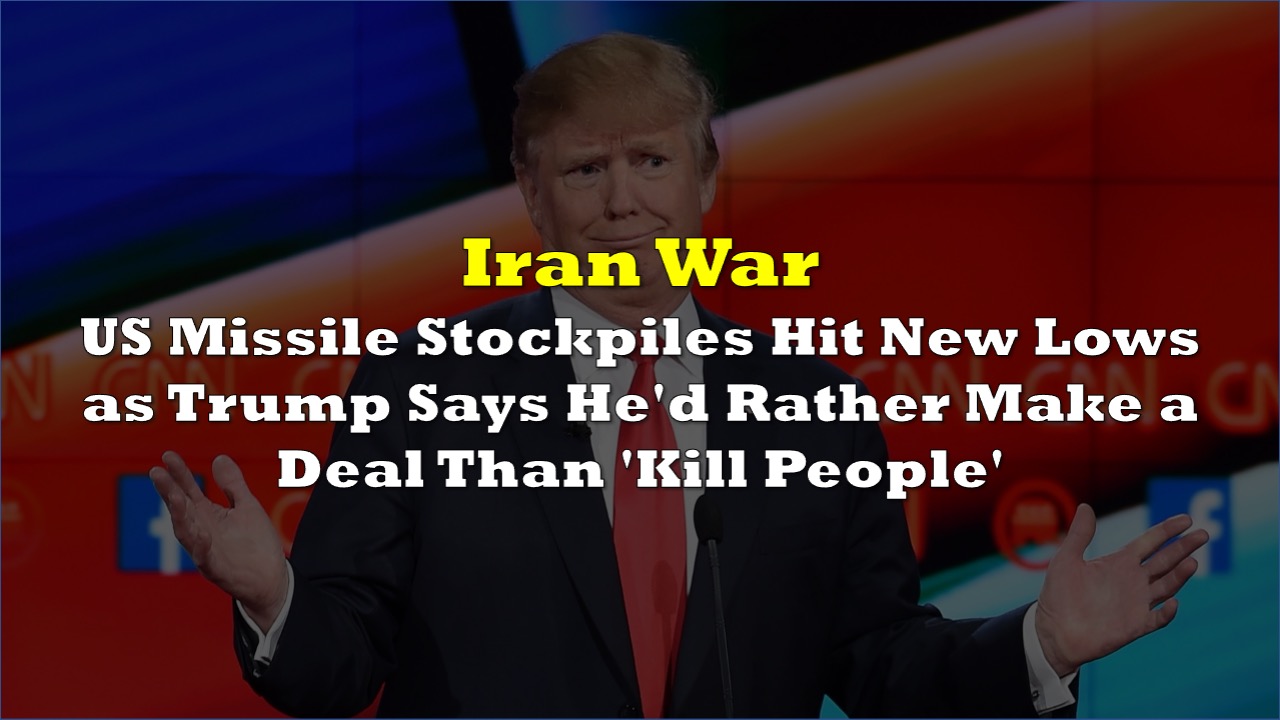

The US has used up “virtually all” of its stockpile of Army Tactical Missile Systems and Precision Strike Missiles during five months of war with Iran, Reuters reported Tuesday, with CNN separately reporting that the US has also expended roughly 80% of THAAD interceptors and about half of its Patriot stock.
That report came three days after Trump called off a planned weekend offensive. He first addressed the decision publicly Wednesday, telling a Las Vegas crowd he’d called off what he described as the biggest attack since World War II after Iran and other Middle Eastern countries, by his account, asked him to hold off, saying he’d rather make a deal “because I don’t want to kill people.” Iranian state media gave no indication Tehran actually made that request.
Several outlets have reported military advisers raised stockpile concerns with Trump in the days beforehand. A US official told Reuters the president instead acted on Gulf pressure, and Trump has repeatedly rejected the shortage narrative outright, telling Reuters the US has “far more munitions than anyone in the world.”
Pentagon spokesperson Sean Parnell has sent reporters a nearly identical statement on the topic since April, insisting the military “has everything it needs.” Joint Chiefs Chairman Gen. Dan Caine has struck a different tone in private and before Congress, warning senators the Pentagon will “not get the munitions” it needs without additional funding, and separately raised stockpile concerns with Trump directly before a late-July pause in strikes.
 Sponsored · Cambria Gold Mines
In April: Iran War Has Burned Through a Third of US Missile Stockpiles, Analysis Finds
The shortage itself isn’t new, only deeper — an April CSIS analysis found the war had already cut THAAD stocks by more than half, Patriot by roughly 50%, and Precision Strike Missiles by at least 45%. Those figures have since climbed toward today’s near-total drawdown.
Exact current numbers are classified and vary by source — CSIS put Patriot depletion at about 65% in late July, while other reporting puts it closer to three-quarters. Not every category faces the same squeeze. The US is producing lower-cost munitions like artillery shells at record levels; it’s specifically the exquisite, million-dollar-plus long-range systems running short.
The financial toll is just as contested. Hegseth told the Senate Appropriations Committee in July the war has cost $37.5 billion so far, up from a $29 billion Pentagon estimate in May that Sen. Patty Murray called “suspiciously low.”
Independent analysts at Moody Analytics put the real figure at more than $132 billion, and sources told CBS News the official estimate excludes costs like rebuilding US bases that Iranian strikes have damaged. Pressed separately on whether a new funding request would be enough to finish the job, Caine declined to commit to a number, saying the answer depended in part on Iran’s own actions.
The Pentagon has asked Congress for $67 billion specifically to cover war costs, on top of the $1.5 trillion defense budget it’s separately requesting for next fiscal year.
Trump has threatened major escalation and then pulled back several times since Operation Epic Fury began February 28, most notably in April, when a threat to let “a whole civilization” die gave way to a two-week ceasefire hours later.
Previously: Trump Agrees To Continue Talks With Iran Then Declares Ceasefire Over
That April ceasefire, tied to reopening the Strait of Hormuz, collapsed by mid-July, and the US reimposed its naval blockade on Iran in response. That thread has since moved forward — Trump said Tuesday a broader announcement on the strait could come within days, and Iran and Oman agreed Wednesday, CBS News reported, on a transit arrangement that could feed into it.
The bigger worry inside the Pentagon isn’t Iran. Analysts and some officials say the drawdown leaves the US with a thinner cushion for a future conflict with China or Russia, and could delay weapons deliveries — including the ATACMS Ukraine has sought for years — as production struggles to keep pace with demand.