

Populist leaders are losing political power faster than their broader movements are losing electoral support, complicating a narrative of global rejection following a series of election defeats in 2026.
Democrats’ takeover of both chambers of the US Congress on November 3 followed major setbacks for nationalist and populist-linked political establishments in Hungary, Serbia, and Brazil.
Yet a newly published European index shows that parties classified as populist, authoritarian, or extremist have reached their highest recorded average electoral support.
 Sponsored · Selkirk Copper Mines
The 2026 Authoritarian Populism Index, published by Swedish think tank Timbro and the EPICENTER network on October 21–22, placed combined support for those parties at 32.6% across 31 European democracies.
The figure is approximately three times the level recorded during much of the postwar period. In 26 of the 31 countries, qualifying challenger parties received more than 20% of votes in their latest parliamentary elections.
The contrast raises a distinction between removing political leaders and reversing the electoral movements that put them in office.
Populist leaders on the fall
In the US, Democrats captured the House of Representatives and Senate in the November 3 midterms, taking control of Congress for the remaining two years of President Donald Trump’s term.
 Sponsored · Cambria Gold Mines
By November 4, Democrats had secured at least 54 Senate seats and gained at least 30 House seats, Reuters reported.
READ: Which Records Did the 2026 US Midterm Elections Break?
The result changes Trump’s ability to advance legislation and exposes his administration to congressional investigations, although it does not remove him from the presidency.
Economic dissatisfaction was a significant factor in the election. The Associated Press Voter Poll found that roughly eight in ten voters considered inflation a moderate or severe financial hardship.
Concerns about government corruption and the cost of living also figured prominently in voters’ decisions.
The results followed Hungary’s April 12 parliamentary election, in which Péter Magyar’s Tisza party ended Viktor Orbán’s 16-year government.
According to Hungary’s National Election Office, Tisza secured 141 of 199 parliamentary seats with 53.18% of the party-list vote. Orbán’s Fidesz-KDNP coalition finished with 52 seats and 38.61%.
In Serbia, an anti-corruption student movement defeated the political establishment associated with longtime President Aleksandar Vučić in the October 25 parliamentary election.
The Student List secured 53.01% of the vote and 140 of 250 parliamentary seats, according to final results reported by ANSA on November 2.
Brazil delivered another setback to a prominent right-wing political movement when President Luiz Inácio Lula da Silva defeated Flávio Bolsonaro in the October 25 presidential runoff.
Lula received 51.79% of valid votes, compared with Bolsonaro’s 48.21%, a margin of approximately 4.43 million votes, according to Brazil’s Chamber of Deputies.
Sweden’s September parliamentary election also showed declining support for a major right-wing populist party. The Sweden Democrats fell from 20.54% in 2022 to 17.48% in 2026, losing 11 parliamentary seats.
European challenger parties reach record support
The European data present a different picture when electoral support is measured independently of whether a party remains in office.
According to the Authoritarian Populism Index, average support for radical-right challenger parties reached 21.3% in 2025 and remained close to that peak in 2026.
The index found that radical-right support increased in the latest parliamentary election in 20 of the 31 countries studied.
By summer 2026, parties classified as challengers were participating in 11 national governments covered by the index. Their presence illustrates how movements once positioned outside mainstream politics have become established participants in governing coalitions.
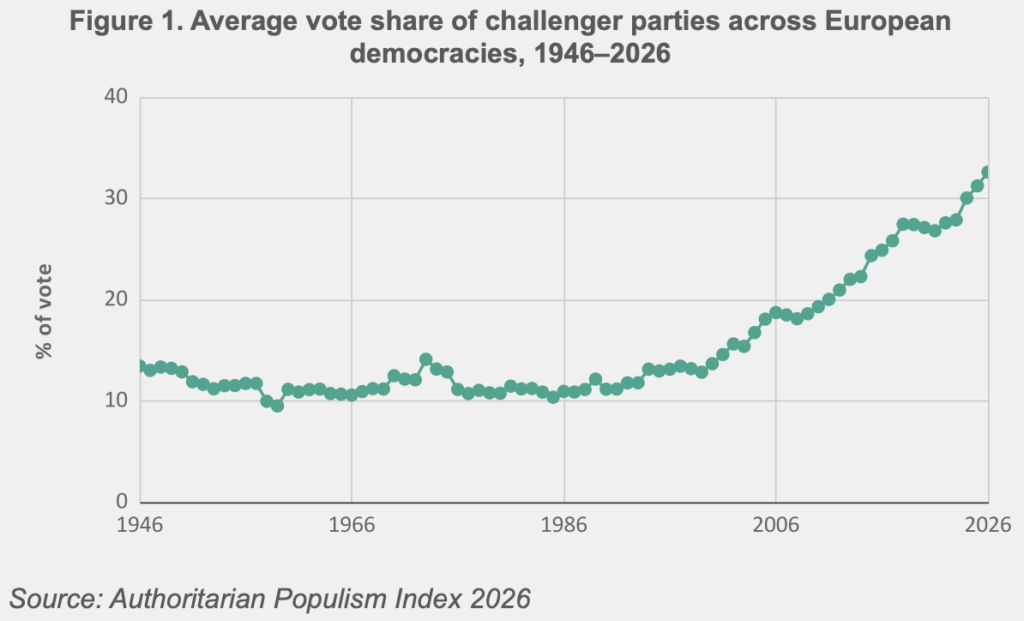
Those findings also carry methodological limitations. The 32.6% figure is calculated using the most recent parliamentary election result available in each country. A country that last voted in 2022 can therefore contribute that result to the 2026 average.
The index also groups different political traditions, including radical-left and radical-right parties, under a broader classification. Its definitions are not directly comparable with every movement described as populist outside Europe.
Nevertheless, the research documents sustained electoral demand for parties challenging established political institutions even as several prominent incumbents have lost office.
That pattern is visible outside Europe as well. In Colombia, conservative political outsider Abelardo de la Espriella, who received Trump’s endorsement, defeated left-wing candidate Iván Cepeda in the June 21 presidential runoff. Colombia’s electoral authorities subsequently certified his victory with 12.96 million votes against Cepeda’s 12.71 million.
Japan’s February 8 parliamentary election also demonstrated the continuing appeal of some right-wing challengers. Sanseito expanded from two seats to 15, while the governing Liberal Democratic Party secured 315 seats in the 465-member lower house, according to the Inter-Parliamentary Union.
A study published in the journal Public Choice on August 25 provides another explanation for why prominent populist movements can lose elections without necessarily experiencing an ideological collapse.
Researchers Andreas Bergh and Anders Kärnä examined populist and mainstream parties across 32 European countries between 1980 and 2023. Their study estimated that participation in government was associated with an average subsequent electoral penalty of approximately 4.5 to 5 percentage points.
Crucially, the researchers found that the penalty was broadly similar for populist and mainstream parties.
The study challenges the assumption that a populist party’s loss of electoral support necessarily demonstrates that its ideology has become less appealing. Governing can impose political costs across party types, including among organizations that originally built their appeal by challenging those in power.
The research does not establish what caused the individual 2026 election outcomes as its dataset ends in 2023.
Still, the distinction has immediate consequences for interpreting the political changes. In the US, Democrats’ control of Congress will constrain Trump’s legislative power without directly determining the size or durability of his electoral coalition.
In Hungary and Serbia, newly victorious political movements must now govern after campaigning against established political leadership. Their subsequent performance will provide another measure of how electoral support responds to a transition from opposition to government.
The European index measures votes and participation in government, but not the degree to which challenger parties influence policy. Its findings therefore leave three separate questions for the post-election period: whether established populist leaders can regain office, whether their parties retain electoral support, and whether their political priorities continue shaping government decisions after electoral defeats.