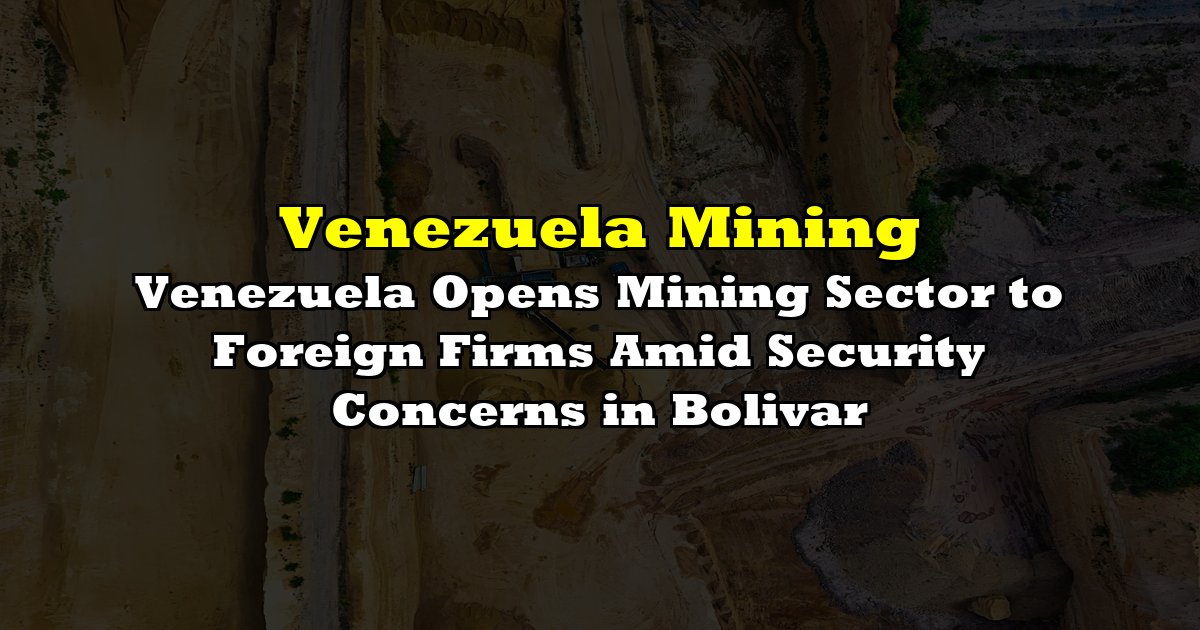

Venezuela’s National Assembly has unanimously approved a new mining law, opening the country’s vast gold and strategic mineral reserves to foreign and private investment with concessions lasting up to 30 years. Backed by the Trump administration, the reform aims to inject capital into a battered economy, but deep-seated security issues in the southeastern Bolivar state threaten to derail progress.
The legislation, championed by Acting President Delcy Rodriguez since her ascent in January 2026 following a U.S.-led operation to remove Nicolas Maduro, offers a stable regulatory framework with provisions for international arbitration and extensions of concessions by two additional 10-year periods. It imposes a royalty tax of up to 13% on gross production value and a 6% tax on primary mining activities, while the Central Bank of Venezuela will manage gold sales.
U.S. Interior Secretary Doug Burgum, during a March visit, endorsed the law, highlighting Rodriguez’s commitment to ensuring security for investors.
 Sponsored · Silver47 Exploration Inc.
Yet, on the ground in Bolivar’s Orinoco Mining Arc, a region designated for strategic mineral development, the reality is starkly different. Armed groups, including Colombia’s National Liberation Army, former FARC members, and local criminal organizations like Tren de Guayana and 3R, dominate the largely illegal mining industry. “The syndicates control the mines. They’re the ones who set the rules and enforce the law,” said Ines Garcia, a 51-year-old informal miner from El Callao municipality, describing a climate of violence and fear.
Local miners and activists paint a grim picture of entrenched corruption and complicity. Residents allege that criminals supply machinery, fuel, and weapons with government permission, while the military’s Operation Roraima, launched in 2023 to combat illegal mining, has failed to dismantle these networks. A UN Human Rights Council report from 2022 further detailed accusations of military involvement in killings, disappearances, and worker exploitation in the region.
Foreign interest is already stirring despite these hurdles. TSX Venture-listed Gold Reserve (TSXV: GRZ), part of Burgum’s delegation, saw its shares surge 103% in early January, fueled by optimism over reclaiming its Brisas mine—holding roughly 10 million ounces of gold worth $44.4 billion—seized by the government in 2009. The company has a 30-day U.S. license to negotiate with Rodriguez’s administration.
Swiss trader Trafigura is also active, partnering with state-owned Minerven on a responsible sourcing program under a U.S. Treasury license. Meanwhile, Rodriguez reported that 120 potential energy investors, mostly from the U.S., have visited since she took office.
Environmental and social concerns add another layer of complexity. Sixteen local NGOs warned in a late March open letter that the law could mask severe environmental degradation and human rights violations under a “veneer of legality,” pointing to historical military corruption in mining areas. “You have to put the term ‘benefit’ in quotation marks—who benefits?” asked Italo Pizarro, an activist from Sifontes municipality, highlighting risks to Indigenous communities.
A veteran Bolivar geologist with over 40 years of experience cautioned that displacing tens of thousands of informal miners and entrenched criminal networks will be far from straightforward. With Venezuela owing billions to firms like Crystallex and Rusoro Mining from past nationalizations, the path to stabilizing the sector remains fraught.
The stakes are high as Rodriguez seeks to diversify an oil-dependent economy plagued by hyperinflation and sanctions. Gold Reserve’s potential return to the Brisas project alone could unlock billions in value—if security and governance challenges in Bolivar can be addressed by the end of 2026.
Information for this story was found via the sources and companies mentioned. The author has no securities or affiliations related to the organizations discussed. Not a recommendation to buy or sell. Always do additional research and consult a professional before purchasing a security. The author holds no licenses.