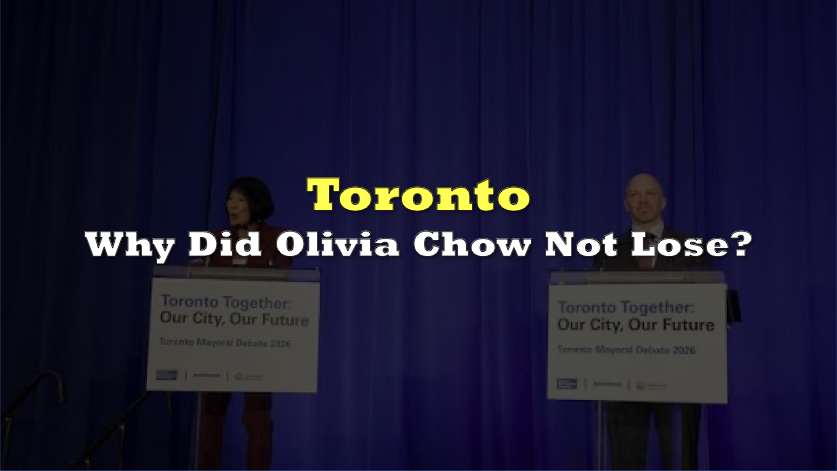

Brad Bradford’s campaign to replace Toronto Mayor Olivia Chow failed to carry even the council ward he had represented for eight years, exposing the gap between widespread dissatisfaction with City Hall and voters’ willingness to replace its leadership.
In Beaches–East York, where Bradford won re-election as a councillor with 54.7% of the vote in 2022, Chow secured 65.4% in Monday’s mayoral election. Bradford received just 31.0%, according to unofficial results.
The local defeat reflected a broader result across Toronto, where Chow won another term despite polling that showed significant frustration over affordability, housing, taxation, and the city’s direction.
 Sponsored · Cambria Gold Mines
Chow received 532,201 votes, or 54.16%, compared with Bradford’s 404,013 votes, or 41.11%. Her margin reached 128,188 votes, with all 1,431 polls reporting as of early October 27.
The election delivered Chow her first full four-year term after she initially became mayor through the June 2023 by-election following John Tory’s resignation.
In 2023, Chow won with 269,372 votes, representing roughly 37% of ballots cast. This year, her total nearly doubled, while her vote share increased by approximately 17 percentage points.
Toronto recorded approximately 982,660 mayoral votes in the unofficial count, compared with 725,333 ballots cast in the 2023 by-election. That represents an increase of roughly 35% and the city’s largest municipal election vote total since 2014.
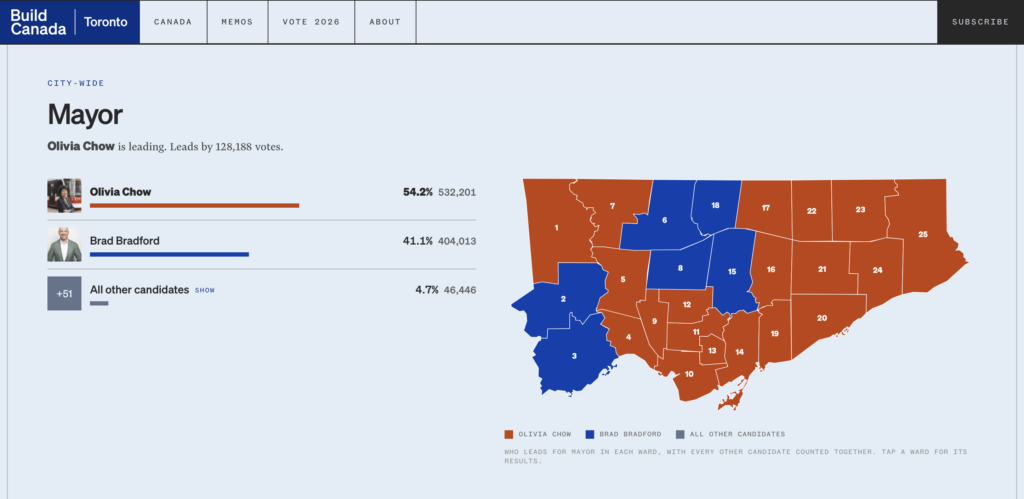
Bradford’s own ward rejected his mayoral bid
The Beaches–East York result provides one of the clearest illustrations of Bradford’s difficulty translating his council experience into citywide support.
 Sponsored · Selkirk Copper Mines
Bradford received 14,577 votes in the ward, against Chow’s 30,798, a difference of 16,221.
Four years earlier, Bradford won his council seat with 15,169 votes. His mayoral campaign therefore attracted 592 fewer votes in the ward than his 2022 councillor campaign, despite substantially more ballots being cast in the area in 2026.
Bradford campaigned on a one-year property tax freeze, a reduction in land transfer taxes on homes below $1.1 million, increased policing, and measures to improve transit reliability.
He also proposed hiring 1,000 additional police officers over four years and refunding transit fares when TTC trips were delayed by more than 15 minutes.
The proposals positioned Bradford as an alternative to Chow’s approach of maintaining public services while investing in housing, transportation, and affordability programs.
However, the ward’s results show that his established local political presence did not translate into majority support for his mayoral candidacy.
Voter dissatisfaction not enough for an opposition majority
Polling before the election had identified potentially significant weaknesses in Chow’s support. A Pallas Data survey conducted October 24 found that 48% of respondents were dissatisfied with Chow’s performance, compared with 40% who were satisfied. Only 19% expressed satisfaction with Toronto City Council.
Yet Chow maintained a 53% to 43% lead over Bradford among decided and leaning voters in the same survey. The poll sampled 608 eligible Toronto voters, with a reported margin of error of four percentage points.
Another survey commissioned by Build Canada and conducted October 11–16 found that 60% of respondents wanted a major change in direction at City Hall, while 61% believed residents were receiving poor value for their property taxes and fees.
The survey actually placed Bradford ahead of Chow by four points among decided voters and leaners.
But the broader polling picture was not uniformly negative for Chow. Liaison Strategies’ October 24–25 survey found 51% approving of Chow and 43% disapproving, while Bradford’s favourability stood at 40%, against 49% unfavourable.
The differences indicate that dissatisfaction with the mayor, perceptions of City Hall, and support for a challenger were distinct measures. They did not necessarily move together.
Housing tenure was another dividing line. A Forum Research survey conducted October 25 found Chow leading Bradford by 67% to 29% among renters. Among homeowners, Bradford led 51% to 46%.
Chow also recorded stronger support among younger voters in the survey, while Bradford performed better among middle-aged respondents and in parts of suburban Toronto.
Toronto’s $18.9B budget remains the central test
The election also represented a choice between competing approaches to financing city services.
Toronto’s 2026 operating budget totalled $18.9 billion, alongside a $63.1 billion, 10-year capital plan. The budget introduced a combined 2.2% residential property tax and City Building Fund levy increase while maintaining a third consecutive TTC fare freeze.
It also funded monthly transit fare capping after 47 paid trips, expanded student nutrition services, and continued rental housing incentives.
The city identified $788 million in efficiencies, reductions, and offsets to help address financial pressures. Its operating budget also benefited from $1.23 billion in support under the Ontario–Toronto New Deal.
Chow campaigned on extending transit affordability measures, including free TTC rides after 10 paid trips per week, and expanding school lunch programs. Bradford’s competing proposals emphasized tax restraint, policing, and transportation performance.
Both faced the same underlying fiscal constraints. Toronto continues to confront pressure from emergency services, transit operations, inflation, and limited municipal revenue sources.
Those pressures remain significant regardless of the election result. Chow’s victory does not establish that residents are satisfied with Toronto’s affordability or municipal finances. Pre-election surveys showed considerable concern on both issues.
But the result establishes that the desire for changes at City Hall did not translate into sufficient electoral support for Bradford, even in the ward where he had previously won a majority as councillor.
With turnout substantially higher than in 2023, Chow secured a majority of votes rather than relying on the divided field that first brought her to office.
Her next term, however, will test whether that expanded electoral mandate can translate into progress on the same municipal affordability, housing, and service pressures that shaped the campaign.