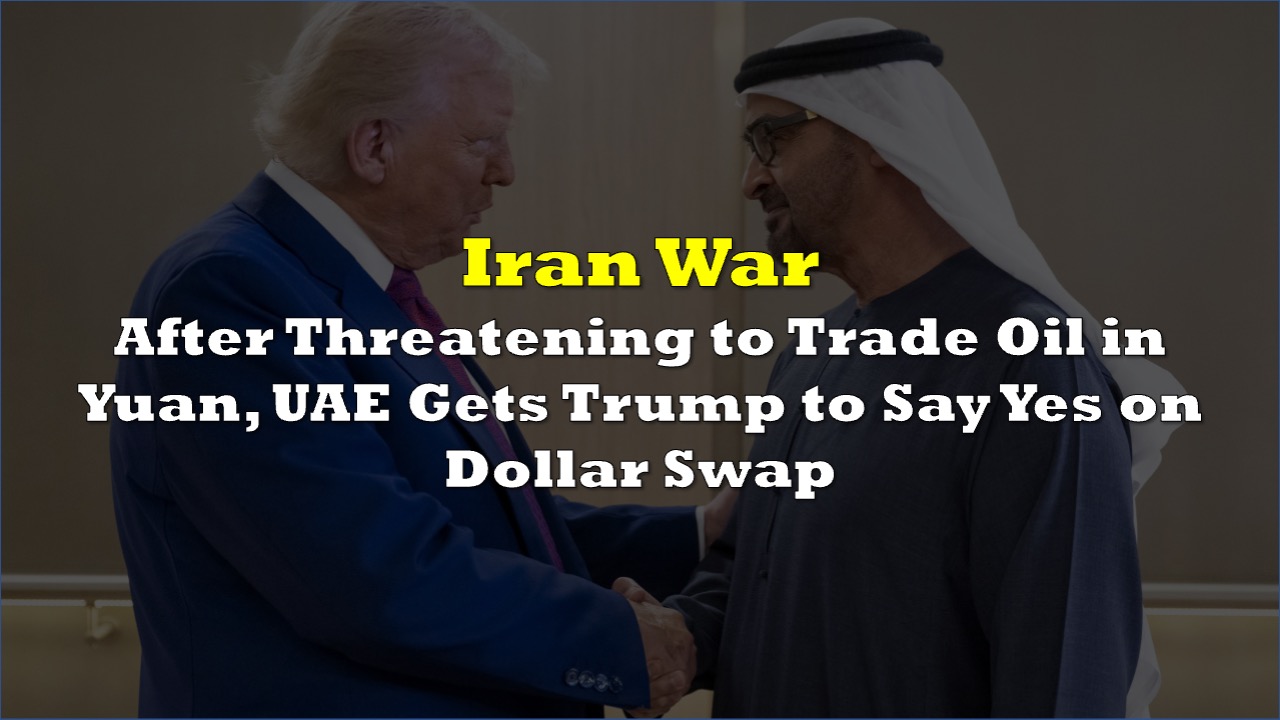

President Donald Trump confirmed on Tuesday he is open to providing the United Arab Emirates with a dollar liquidity lifeline, telling CNBC’s Squawk Box: “If I could help them, I would. They’re very good for this country.”
The remarks are the most direct presidential endorsement yet of a currency swap arrangement first reported by the Wall Street Journal and raised by UAE Central Bank Governor Khaled Balama with Treasury Secretary Scott Bessent at last week’s World Bank and IMF meetings in Washington.
Trump acknowledged the UAE’s damage — “UAE got hit with 1,400 missiles. They were hit the hardest of the group, actually,” — then added: “I’m surprised because they are really rich.”
A White House official told CNBC the swap remains “something we’re thinking about considering.” Abu Dhabi has yet to file a formal request, and the White House has not begun drafting specifics.
The UAE pushed back publicly. Its Washington embassy said “any suggestion that the UAE requires external financial backing misreads the facts,” citing more than $2 trillion in sovereign investment assets, $300 billion in central bank reserves, and $1.5 trillion in banking deposits.
 Sponsored · PTX Metals Inc.
Jason Tuvey of Capital Economics told the Boston Globe the swap may be less about emergency need and more about bolstering investor confidence if the war drags on.
Brad Setser, a senior fellow at the Council on Foreign Relations and former Treasury official, read it differently. Writing Tuesday, he noted the request likely followed a significant drawdown in the UAE’s $285 billion in central bank reserves during March and early April — suggesting the pressure is real.
He added that Gulf states that once recycled petrodollars back into the global financial system have flipped into net absorbers of dollar liquidity, and that Saudi Arabia — whose current account break-even oil price has climbed to roughly $100 per barrel — will likely also need to borrow dollars to weather the Hormuz closure.
And all goes beyond optics. Trump’s family has extensive financial ties to the UAE. Jared Kushner’s firm Affinity Partners received approximately $200 million from the UAE sovereign wealth fund in 2023, followed by a $1.5 billion investment from Abu Dhabi-based Lunate.
The UAE invested $2 billion in World Liberty Financial, the cryptocurrency venture run by Trump’s sons Eric and Donald Jr. The Trump Organization is developing a luxury hotel in Dubai. Trump claimed on Tuesday that he secured a $1 trillion investment commitment from the UAE during a visit last year.
Also read: Justin Sun Says Trump’s DeFi Project Built a Secret Backdoor to Freeze Investor Funds
A currency swap would let the UAE Central Bank draw dollars against dirhams at the prevailing exchange rate — providing hard-currency liquidity without requiring US taxpayer transfers, though politically difficult to distinguish from a bailout in an election year.
The Fed holds standing swap lines with five central banks: the European Central Bank, the Bank of Canada, the Bank of England, the Bank of Japan, and the Swiss National Bank. Extending one to the UAE during an active war would mark a significant departure.
The UAE is a founding member of mBridge — the multi-central bank digital currency platform that settled more than $55 billion outside the SWIFT network by late 2025 — and has already completed its first yuan-denominated LNG trade with China. Whether Washington acts or stalls, Abu Dhabi has options.
Information for this story was found via the sources and companies mentioned. The author has no securities or affiliations related to the organizations discussed. Not a recommendation to buy or sell. Always do additional research and consult a professional before purchasing a security. The author holds no licenses.