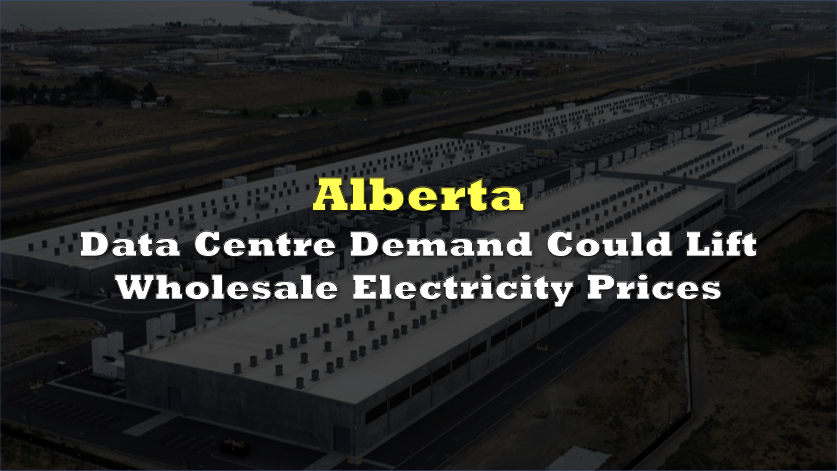

Alberta’s first hyperscale artificial intelligence project has exposed a timing gap in the province’s strategy for protecting electricity customers from the costs of data-centre expansion.
Meta Platforms is expected to begin receiving 250 megawatts from Capital Power’s existing Alberta fleet during the second half of 2028. The dedicated 932-megawatt Greenlight generation facility intended to support the development is not scheduled to enter service until the second half of 2030.
That creates an approximately two-year period in which new data-centre demand is scheduled to arrive before its principal new power plant.
 Sponsored · Selkirk Copper Mines
Meta has said it will fully fund the generation and grid infrastructure associated with its Sturgeon County development. Alberta’s government has also promised that data centres, rather than existing customers, will pay for the transmission upgrades they cause.
Capital Power’s Dey told analysts during the company’s April 29 earnings call that Alberta’s forward market was underestimating the effect of data centres, economic growth, and slower construction of new generation.
Dey said he could not determine whether prices would reach $80 or $90 per megawatt-hour in the first quarter of 2028. He expressed greater confidence that Alberta was moving toward a tighter market and higher prices over the following three years.
Alberta’s pool price averaged $32.15 per megawatt-hour during the first quarter of 2026, down 19% from one year earlier and 25% from the preceding quarter. February averaged only $22.39, while January and March averaged $39.44 and $33.68, respectively.
 Sponsored · Altamira Gold Corp.
Against the quarterly average, an $80 to $90 price would represent an increase of approximately 149% to 180%. It would approach a tripling only when compared with Alberta’s weakest recent months.
The forward curve was pricing a smaller increase. The Market Surveillance Administrator reported a 2028 forward price of $59.07 per megawatt-hour as of March 31. TC Energy Corporation’s June market update placed the indicative 2028 contract at $61.51.
Dey’s $80 to $90 scenario was therefore about 30% to 52% above available 2028 forward indications. It represented Capital Power management’s assessment of upside risk, not a consensus forecast that prices would triple.
Alberta’s data-centre policy focuses on cost causation. Hyperscalers are expected to finance the transmission infrastructure required to connect their projects and are encouraged to bring their own generation.
Adding large, permanent customers could also spread existing transmission and distribution costs across more electricity consumption.
Capital Power has estimated that adding 1.5 gigawatts of demand could reduce an average residential customer’s bill by approximately $6 per month through lower allocated network charges. That figure does not account for a potentially higher wholesale energy component.
The two effects can move in opposite directions. A household could receive a smaller share of fixed transmission costs while paying more for the electricity commodity itself.
Alberta’s first-quarter market data illustrate how quickly wholesale prices can accelerate when spare supply becomes scarce. During hours when the available supply cushion fell between 250 and 500 megawatts, the pool price averaged approximately $618 per megawatt-hour. Those conditions were limited, but they demonstrate the nonlinear price effect of a tightening system.
Meta’s initial 250-megawatt requirement is small compared with Alberta’s entire system. It is potentially material during the relatively few hours when the grid has little unused capacity.
Alberta has attracted far more data-centre interest than its power system can currently accommodate. The Alberta Electric System Operator previously disclosed more than 16 gigawatts of firm data-centre connection applications, compared with a provincial peak demand slightly above 12 gigawatts. Its interim process limited initial allocations to 1.2 gigawatts through 2028. That capacity has now been fully assigned between two projects receiving 970 megawatts and 230 megawatts.
Meta’s planned Alberta campus is expected to begin at approximately one gigawatt and could eventually expand to 1.8 gigawatts. The company valued the initial development at about $13 billion.
The project’s scale is close to Alberta’s entire first-round allocation for large data-centre loads.
The supply response is also becoming slower and more expensive. Dey told analysts that generating facilities that previously required two to three years to construct can now take four to five years. He estimated that construction costs have risen to two or three times their levels from five years ago.
The Meta project distributes commercial benefits across three companies. Capital Power secured an energy-supply agreement lasting more than 10 years for the initial 250 megawatts. The arrangement adds contracted demand while maintaining the company’s exposure to Alberta wholesale prices.
Pembina Pipeline reached a final investment decision on the 932-megawatt Greenlight plant under a long-term tolling arrangement. The contract includes capacity payments and usage-based payments covering fuel, operating, and maintenance costs. Greenlight can eventually be expanded to 1,864 megawatts.
Meta receives a path toward dedicated supply for its campus, which could consume roughly as much electricity as 800,000 homes at its initial scale.
Existing consumers receive no equivalent contractual protection from the wholesale market during the transition.
Alberta’s policy may keep the cost of Meta’s transmission connection and dedicated plant off ordinary ratepayers’ bills. Whether the project ultimately lowers or raises total household electricity costs will depend on whether reduced network charges outweigh higher energy prices.