

Canada’s September labour report depicts a job market where public-sector employment is shrinking, private payrolls are stagnant, and unemployed workers are finding it harder to secure new positions despite a layoff rate near historical norms.
Public-sector employment declined by 70,000 in September, exceeding Canada’s overall net loss of 68,000 jobs. Private-sector employment increased by approximately 24,100, while self-employment fell by 22,500.
Private-sector employee numbers were little changed for a second consecutive month. Only 30.6% of people unemployed in August found work by September, compared with a 36.5% average between 2017 and 2019.
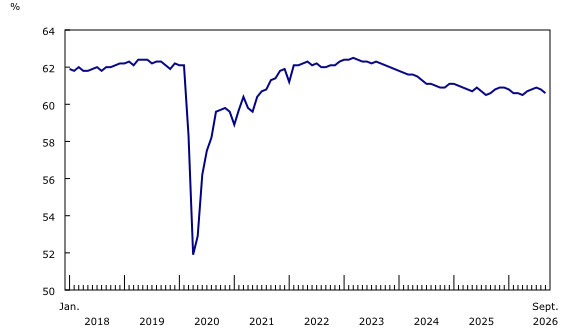
Total employment fell 0.3%, divided between 35,000 full-time and 33,000 part-time positions. The unemployment rate increased to 6.5% from 6.4%, while the employment rate slipped to 60.6%.
 Sponsored · Selkirk Copper Mines
The month’s losses followed a 42,000 decline in August, reversing much of the 181,000 jobs added from April through July.
September marked the fourth consecutive monthly decline in public-sector employment. The sector had 119,000 fewer employees than a year earlier, a 2.6% contraction. Private-sector employment, by contrast, remained 163,000 higher than in September 2025, an increase of 1.2%.
Educational services shed 35,000 jobs, leaving industry employment 67,000 below its year-earlier level. Health care and social assistance lost 23,000 positions, its first monthly decline since December 2022. Manufacturing employment also fell 13,000, partly reversing a 22,000 gain in August.
Employment among workers aged 15 to 24 declined by 48,000. Their unemployment rate remained at 13.0% as the youth labour force contracted by 50,000.
Nationally, the layoff rate stood at 0.7%, close to pre-pandemic levels.
By province, Quebec lost 49,000 jobs in September, extending its cumulative employment decline since January to 130,000, or 2.8%. British Columbia lost 20,000 positions, while Alberta added 23,000, lifting provincial employment 2.9% above its year-earlier level.
The unexpected national decline shifted financial-market expectations. Economists surveyed by Reuters had forecast 9,200 new jobs.
Reuters reported that the Canadian dollar weakened 0.44% to $1.4287 per US dollar, while the two-year government bond yield dropped 9.5 basis points to 2.410% following the release.
Money markets stopped pricing an October Bank of Canada rate increase, Reuters reported, although a December increase remained anticipated.
Statistics Canada also reported average hourly wage growth of 2.3% year over year, up from 2.0% in August.
Despite the two-month decline, total Canadian employment remained 95,000 higher than a year earlier, contrasting with the 119,000 year-over-year decline in public-sector employment.