

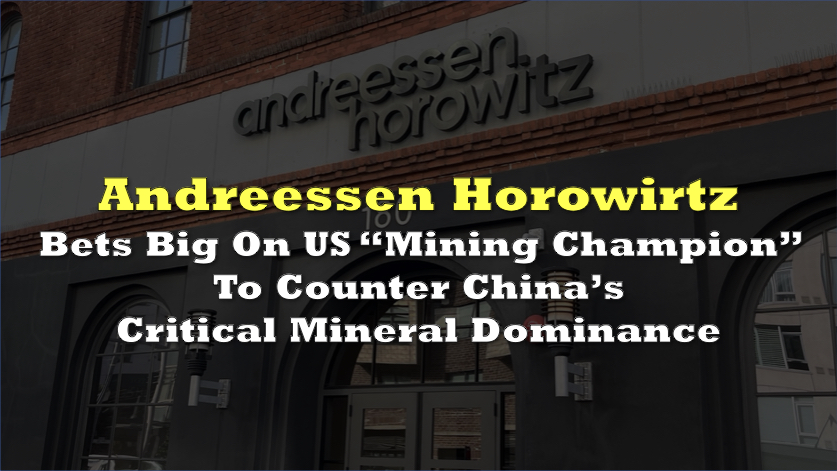

Andreessen Horowitz (a16z) has published what amounts to a venture-capital call to arms. The 5,000-word essay by partners Ryan McEntush and Erin Price-Wright argues that the US cannot meet its industrial or security ambitions without rebuilding an end-to-end domestic supply chain for lithium, rare-earths, nickel, copper, and other critical minerals.
“Critical minerals are the quiet enablers of modern power,” the authors write, warning that China’s dominance in refining and magnet manufacture has become “a linchpin of global industry — one the West is scrambling to avoid.”
What’s new
A16z has backed mining-tech startups before, most visibly KoBold Metals, which uses AI to hunt for copper and battery-grade nickel.
 Sponsored · Selkirk Copper Mines
But until now the firm treated the sector as a curiosity inside its broader “American Dynamism” franchise. The new essay is different: it calls mining “the heart of the business,” demands vertical integration “from exploration through magnet sintering,” and urges Washington to streamline permitting and underwrite early-stage processing plants.
The timing is not accidental. KoBold raised $537 million in January at a $2.96 billion valuation—capital that will fund a full mine build-out rather than another pilot. A16z was a follow-on investor in that round, signaling comfort with decade-long paybacks instead of the usual SaaS-style exits.
Silicon Valley orthodoxy
Since the 2011 “software is eating the world” essay by Marc Andreessen, the firm has cultivated an image of code over concrete. This new stance reframes physical extraction as a “systems-engineering challenge” on par with launching rockets or building data centers.
The essay’s most striking line—“The only credible answer is an American mining champion — vertically-integrated, technology-enabled, and built to win” —reads like a reverse-takeover of the mining sector by Silicon Valley culture.
 Sponsored · Altamira Gold Corp.
The manifesto is also a tacit admission that software alone cannot fix the most acute bottleneck: processing. China refines about 85% of rare-earth oxides, 70% of lithium chemicals, and virtually all battery-grade graphite; the US refines none at scale.
By pressing for colocated mines and refineries, a16z is betting that tighter feedback loops and AI-driven process control can claw back marginal cost even under stricter US environmental rules. Public-market precedents exist—MP Materials is spending $700 million to close that same rare-earth loop in California—but venture capital has been largely absent from the capex-heavy midstream.
The venture math
The private market appetite is growing because energy-transition demand looks non-linear. BloombergNEF estimates global lithium demand will triple by 2030; copper could run a cumulative 20 Mt short by 2035 without new mines.
That optimism collides with Nevada’s Thacker Pass project, mired in three years of litigation over Indigenous rights and groundwater impacts despite White House “critical” status.
Yet green-field projects still average 10–15 years from discovery to first metal. Venture investors that accept this illiquidity are effectively taking a macro-long on both energy security and de-globalisation.
Big investment alone will not speed up the mine-build timeline, so the firm is seeking tailwinds on Capitol Hill: a16z has already spent $650,000 on federal lobbying in 2025, up more than 40% year-on-year. The wishlist in its essay—loan guarantees, offtake agreements, streamlined NEPA reviews—mirrors provisions in the Inflation Reduction Act and recent Defense Production Act allocations.
KoBold’s record-size Series C shows the cheque sizes are now big enough to matter even to legacy miners. Rio Tinto and BHP Group have each partnered with software-heavy juniors in the past 12 months to outsource exploration risk.
“Mining champion”
The question a16z poses is whether a pure-play “mining champion” can keep that edge through to refining and magnet production before incumbents simply buy it.
The writers press Washington to “use grants, loan guarantees, offtake agreements, and tax credits to de-risk early-stage projects.” That aligns with recent Department of Energy awards for battery-grade graphite and the Pentagon’s rare-earth magnet solicitations, but it also gambles on bipartisan follow-through.
A change of administration—or a commodity price slump—could leave vertically integrated startups nursing stranded assets, a fate that already clipped China’s Ganfeng Lithium’s market cap by 75% after lithium prices collapsed last year. Lithium carbonate prices have fallen nearly 80% from their 2022 peak to a four-year low, flattening cash flows across the sector.
For KoBold’s multi-billion-dollar mine plan, a similar downturn in copper or cobalt could wipe out the equity layer unless long-term offtakes or federal floor-price mechanisms materialise.
A16z is betting that a software-native operator can knit exploration, refining, and magnet making into one resilient flywheel—before Beijing’s price war or Nevada’s next injunction starves the venture of cash flow. If the experiment works, it could re-write US industrial strategy and hand Silicon Valley its first hard-asset unicorn. If it fails, the lesson will be blunt: rocks, unlike code, do not bend to blitz-scaling.
Information for this briefing was found via the sources mentioned. The author has no securities or affiliations related to this organization. Not a recommendation to buy or sell. Always do additional research and consult a professional before purchasing a security. The author holds no licenses.


One Response
Gents……….please contact me……my firm has access to Major REE as well as technology for processing ………/we are a Major global mining developmental company prefer private capital over government funding…….Please advise