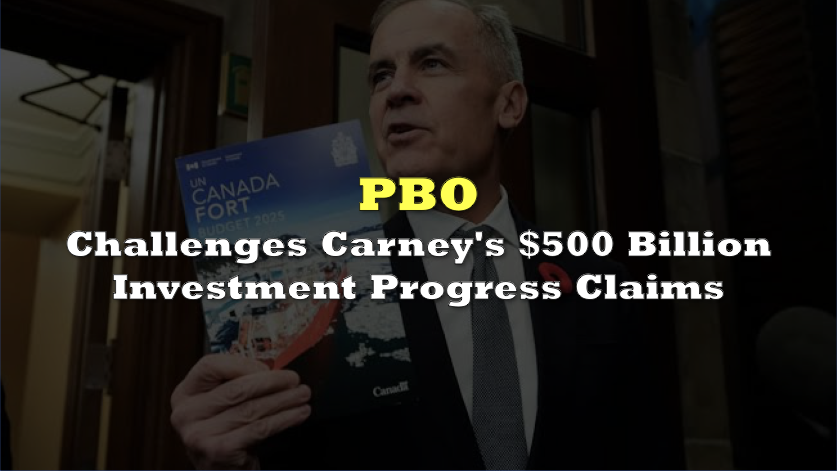

Prime Minister Mark Carney’s government is presenting nearly $500 billion in investment commitments as progress toward a five-year economic target, even though one of the largest pledges included in that total extends over ten years.
The discrepancy has renewed significance following an assessment by PBO, which cautioned that the announced commitments largely represent financing for prospective projects rather than binding commitments to undertake construction.
The government’s target is to catalyze $1 trillion in capital investment over five years, including $500 billion in new private-sector investment. Budget 2026 highlighted the September Canada Investment Summit as tangible progress toward that objective.
 Sponsored · Silver47 Exploration Inc.
However, the commitments involve different financing structures and delivery schedules.
BMO announced on September 11 that it intended to mobilize up to $70 billion over ten years across electricity infrastructure, pipelines, transportation, mining, artificial intelligence computing, defence, and oil and gas.
The federal government subsequently included BMO’s announcement among nearly $325 billion in commitments from Canadian banks at the September 15 summit.
BMO specified that its initiative would involve bank financing, debt capital markets activity, and public equity raising. The announcement did not establish that $70 billion would be directly invested in construction or deployed within five years.
 Sponsored · Selkirk Copper Mines
Two other major commitments follow shorter schedules. TD Bank pledged $150 billion in financing over five years, while Scotiabank committed more than $100 billion over the same period.
BMO’s $70 billion pledge alone represents approximately 14% of the government’s nearly $500 billion headline figure.
In its assessment, the PBO said the investment summit commitments were largely not attached to specific projects.
The watchdog did not dispute that financial institutions announced the amounts. Instead, it distinguished the availability of financing from the capital expenditures required to deliver infrastructure and other productive assets.
Budget 2026 acknowledges that the commitments involve different financial activities and timeframes, warning against treating them as directly comparable or additive.
The government also identified more concrete developments, including Bell Canada’s proposed $52.5 billion Saskatchewan AI infrastructure expansion and approximately $140 million in federal support for Generation Mining’s Marathon critical minerals project.
Separately, the PBO reported that the Major Projects Office now oversees 18 referred projects representing $194 billion in potential capital investments, compared with 15 projects representing $125 billion previously.
However, the office has not published performance scorecards documenting project approval timelines.