

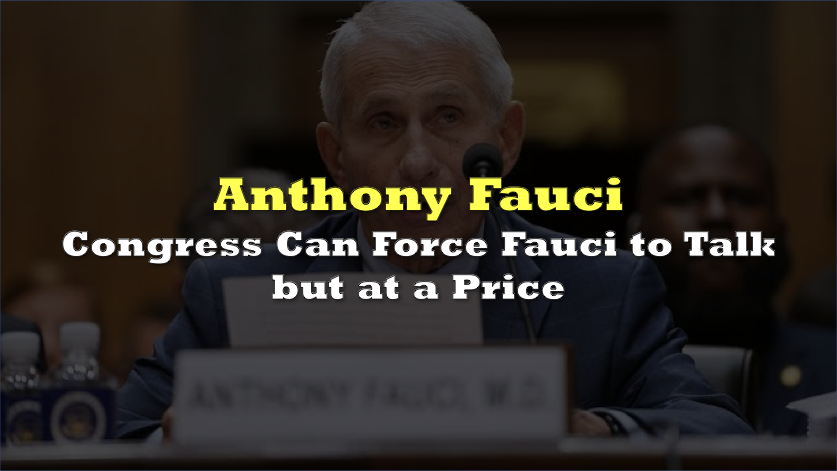

Senator Rand Paul can potentially force Anthony Fauci to answer the questions he refused at Wednesday’s Senate hearing, but doing so would require the Kentucky Republican to secure Democratic votes and grant legal protections that could weaken the prosecution leverage he has spent years trying to build.
A subpoena brought Fauci into the Senate Homeland Security and Governmental Affairs Committee hearing on July 29. It could not, by itself, force him to surrender his constitutional protection against self-incrimination.
“Under the advice of my attorneys, I will invoke my right under the 5th Amendment of the Constitution to refrain from answering your questions,” Fauci said, according to Reuters.
 Sponsored · Selkirk Copper Mines
Paul released 1,141 pages of Fauci’s diary covering December 2019 through December 2022. He alleges that the entries show Fauci privately considered a laboratory origin for COVID-19 while publicly dismissing it, and that Fauci obscured the role of federally funded research in Wuhan.
“You did not tell the American people the full story,” Paul said during the hearing, according to STAT.
Fauci denies covering up the virus’s origins or lying about NIH funding. A representative supplied Reuters with a fact-check arguing that the diary matched Fauci’s public record, including his statements that he remained open to a laboratory-origin theory while viewing natural transmission as better supported by available evidence.
The Associated Press reported that some passages highlighted by Paul reflected uncertainties Fauci had already discussed in interviews or his 2024 memoir. It also noted that a Republican-led House investigation completed in 2024 did not establish wrongdoing by Fauci.
 Sponsored · Cambria Gold Mines
Fauci accused Paul of convening the hearing to produce statements that could support a new prosecution. Paul has accused the former National Institute of Allergy and Infectious Diseases director of misleading Congress about federally funded coronavirus research in Wuhan and helping conceal information about COVID-19’s origins. Fauci denies both allegations.
The hearing therefore ended where the committee’s more consequential decision begins.
The immunity testimony
Under the US Code, a congressional committee can ask a federal district court to order testimony from a witness who has invoked the Fifth Amendment. The request must first receive support from two-thirds of the full committee.
The Homeland Security and Governmental Affairs Committee currently has 15 members, including eight Republicans and seven Democrats. Paul would therefore need 10 votes, requiring support from at least two Democrats even if every Republican backed the request. The calculation turns what appeared to be a confrontation between Paul and Fauci into a test of whether the investigation can attract bipartisan support.
Paul would also need to notify the attorney general at least 10 days before seeking the order. The Justice Department could ask the court to delay its issuance, although the delay could not exceed 20 days. Once the statutory requirements are met, the law directs the district court to issue the order.
Fauci would then have to be recalled, asked the relevant questions, and formally presented with the order. At that point, he could no longer refuse to answer those questions solely by invoking the Fifth Amendment.
However, the price is also contained in the Code. Neither Fauci’s compelled testimony nor information directly or indirectly derived from it could be used against him in a criminal case. The government could still prosecute him using evidence obtained from wholly independent sources, but prosecutors would carry the burden of demonstrating that their case was not tainted by the immunized testimony.
The immunity would not cover perjury, false statements made during the compelled testimony, or refusal to obey the order. Congress could therefore require Fauci to answer without giving him permission to lie.
It would also not amount to blanket protection for every potential offense related to the pandemic. Congressional Research Service guidance describes the protection as use immunity rather than transactional immunity. The distinction preserves the possibility of prosecution while restricting the evidence available to prosecutors.
That restriction can be substantial. During the Iran-Contra investigation, Congress granted Oliver North immunity to secure his testimony. A federal appeals court later required extensive scrutiny of whether witnesses and prosecutors had been influenced by North’s nationally televised statements, demonstrating how congressional disclosure can contaminate a parallel criminal case even when investigators attempt to separate the two.
The Congressional Research Service calls immunity a strategic choice between obtaining information for Congress and preserving the government’s ability to prosecute. In practical terms, lawmakers must decide which objective matters more.
Research policy
The hearing came one day after the Trump administration introduced a government-wide policy prohibiting federal support for research it classifies as dangerous gain-of-function work. The Department of Health and Human Services said the policy also creates independent review requirements for certain high-risk research and restricts funding in jurisdictions with insufficient oversight.
The policy decision did not resolve the factual dispute at the center of Paul’s inquiry. The FBI and CIA have assessed that a laboratory incident was likely, although the CIA expressed low confidence. Four other intelligence agencies and the National Intelligence Council have favored natural transmission.
Former President Joe Biden granted Fauci a full and unconditional pardon covering federal offenses committed from January 1, 2014, through January 19, 2025, when those offenses arose from his government service.
The pardon covers Fauci’s tenure at NIAID, his membership in the White House coronavirus task forces, and his service as chief medical adviser. It does not cover statements or other conduct occurring during the July 2026 hearing.
That gap helps explain why Fauci’s attorneys advised him not to answer. Paul and Health Secretary Robert F. Kennedy Jr. had publicly suggested that new testimony could create exposure for perjury or false statements despite Biden’s pardon. Fauci said Paul’s calls for prosecution gave him reason to believe the hearing was intended to create a new criminal case.
An immunity order would alter that calculation. It would force Fauci to answer while preventing the government from using those compelled answers as a roadmap for prosecuting him, except when the alleged offense involved the testimony itself.
Paul warned that Fauci’s refusal would have consequences, Axios reported. The committee has not publicly indicated whether those consequences will include seeking an immunity order.



One Response
Talk about fishing for nothing in an empty pool. They will stoop at nothing to prove their conspiracy theories and get back at their perceived enemies. Let me guess, the Pillow Guy is behind this one?
Of course he was open to the idea it might have come from the Lab. Any sensible thinking human would be. But the more likely transmission was natural. That was the final finding and conclusion. Try to move on already. Never seen anything like this revenge vendetta. The need to be right when they are so very stuck in a single idea. Cons = rigid we are always right thinking.