
British Columbia’s overlapping Indigenous land claims are the product of a 150-year treaty vacuum that governments are only now trying to fill, and the result is a province where roughly 80% of the land is still subject to Indigenous claims and major territories overlap.
After the Colony of Vancouver Island was established in 1849, governor James Douglas signed 14 treaties with First Nations between 1850 and 1854 to secure land for fur trapping, mining, and other colonial activity. Those Douglas Treaties could have become the framework for broader settlement across the province.
Instead, treaty-making largely stopped after the Hudson’s Bay Company refused to keep funding negotiations, leaving British Columbia with virtually no further treaties for the next 150 years.
That break is what made BC different from much of the rest of Canada. While Ontario and the Prairie provinces negotiated treaties with most First Nations, BC continued to settle non-treaty lands as immigration accelerated.
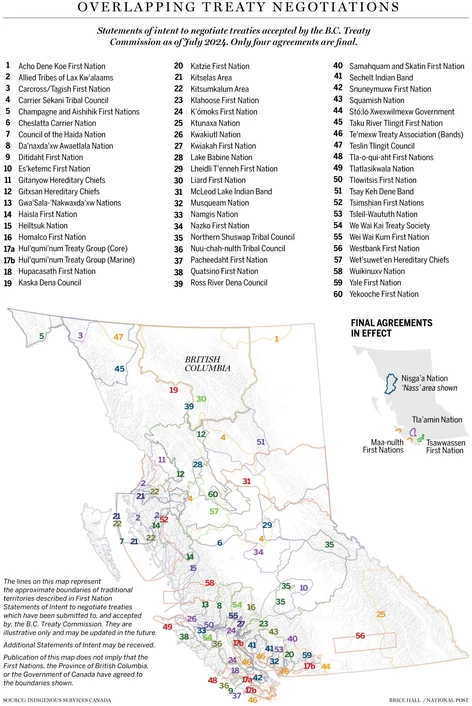
The BC Treaty Commission map shows 60 statements of intent to negotiate treaties accepted as of July 2024, but only four final agreements in effect. Decades of negotiation produced a large queue of asserted territories, many of them overlapping, while only a small number reached final legal settlement.
The issue erupted again after Ottawa’s agreement with the Musqueam Indian Band, first announced on Feb. 20. The federal government officially recognized Musqueam “rights and title” over more than 500,000 hectares in southern BC, including much of Metro Vancouver.
Private property concerns intensified because the Musqueam agreement landed after a landmark BC Supreme Court ruling last summer. In that decision, Justice Barbara Young ruled that Cowichan claims to certain lands in Richmond and along the Fraser River should override the Crown’s granting of some fee-simple titles.
That ruling amplified fears that unresolved title claims are no longer only a Crown-versus-First Nation issue but could reach into private ownership structures previously assumed secure.
The Musqueam file also exposed the depth of First Nation-to-First Nation conflict. The Squamish Nation said it had not been consulted and vowed to challenge Musqueam claims that overlap its own. Tsawwassen First Nation said Musqueam claims appear to overlap with its traditional territory around Brunswick Point, with Kwikwetlem and Tsleil-Waututh also asserting conflicting claims.
That is why the modern fix has become almost as contentious as the historical neglect. BC adopted UNDRIP legislation in 2019, and Ottawa followed with Bill C-15 two years later. In the Musqueam agreement, the federal government asserted that UNDRIP now represents the “minimum standards” in interpreting Canadian law.
Supporters frame that as necessary correction. Critics argue it is producing a widening legal mismatch between Indigenous title recognition and the operating assumptions of Canadian sovereignty, resource law, and property law.
That conflict sharpened in December 2025, when the BC Court of Appeal found the province’s UNDRIP legislation inconsistent with its mineral rights laws. The ruling effectively challenged the legal basis on which large parts of BC’s natural resource economy have operated.
Premier David Eby has already said the province will amend the law in the spring, warning that the court decision invites “further and endless litigation” and produces “less certainty, not more.”
READ: Eby Blasts “Dramatic, Overreaching, And Unhelpful” Court Rulings
There are examples of negotiated clarity, but they are limited and not conflict-free. In May 2000, the Nisga’a Nation signed the first treaty with an individual First Nation in more than 100 years, gaining explicit self-government rights. The Nisga’a have since partnered with a Houston-based energy company on a liquefied natural gas project through their territory.
But even that model has not eliminated territorial friction, with some in the nearby Gitanyow First Nation opposing the project because of overlapping land claims.
The core problem is therefore cumulative, not episodic.
Information for this story was found via National Post and the sources and companies mentioned. The author has no securities or affiliations related to the organizations discussed. Not a recommendation to buy or sell. Always do additional research and consult a professional before purchasing a security. The author holds no licenses.