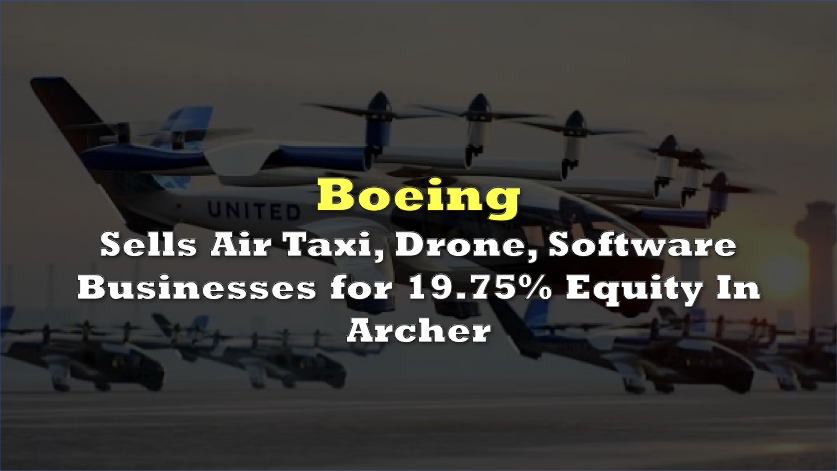

Boeing is transferring three aerospace technology businesses to Archer Aviation without taking a fixed cash purchase price, instead converting Wisk Aero, Insitu, and SkyGrid into a large equity position and a package of rights that keep Boeing financially and technologically tied to what happens next.
Archer announced Monday that it will acquire all three businesses from Boeing. The structure puts autonomous passenger aircraft, military drones, and digital airspace management under the same public company while allowing Boeing to relinquish direct ownership without walking away from the underlying technology.
Under Archer’s SEC-filed purchase agreement, Boeing will receive newly issued Class A shares equal to 19.75% of Archer’s shares outstanding immediately before closing, subject to adjustments tied to the acquired businesses’ cash, debt, and transaction expenses.
 Sponsored · Cambria Gold Mines
Using Archer’s delayed $5.59 quote Monday morning, the stake shares would represent about $850 million of equity value.
Boeing will also receive two Archer warrants, with each sized using $100 million divided by Archer’s five-day volume-weighted average share price immediately before closing. The first carries a $13.00 exercise price, while the second carries a $17.88 exercise price.
The aerospace giant separately committed to purchase as much as $55 million of Archer shares if Archer launches a qualifying equity offering generating at least $400 million in gross proceeds. That agreement remains available until the later of March 31, 2027, or three months after the acquisition closes, subject to its other conditions.
A side agreement also gives Boeing the right to designate one candidate for Archer’s board while it maintains a specified minimum shareholding. Archer is required to appoint Boeing’s initial designee following closing, subject to the agreement’s eligibility conditions.
 Sponsored · Selkirk Copper Mines
Most importantly, Boeing is not surrendering Wisk’s autonomy technology outright. The companies are entering a technology-sharing arrangement that will preserve Boeing’s access to Wisk’s core autonomous-flight technology for current and future commercial and defense aircraft. Boeing said the arrangement allows it to concentrate investment on its core businesses while continuing to benefit from technologies developed inside the businesses being sold.
Revenue and R&D
For Archer, the transaction reaches beyond adding another eVTOL development program. Wisk has developed six generations of eVTOL aircraft and completed more than 1,700 flight tests. SkyGrid develops automated airspace-management technology.
Insitu builds unmanned aircraft systems used for intelligence, surveillance, and reconnaissance and has fielded more than 3,500 systems across customers in 35 countries, according to the companies. Archer said Insitu generates more than $200 million in annual revenue and is profitable.
Archer and Wisk also arrive at the transaction with an unusual history. Wisk sued Archer in 2021 over alleged trade-secret theft and patent infringement. Archer countersued and the companies settled the litigation in August 2023, Reuters reported, when Boeing invested in Archer and Wisk became Archer’s designated autonomy technology partner for future aircraft variants.
The deal can also come as unusual because Archer is still a relatively young, loss-making aerospace company. Archer was founded in 2018 and generated just $1.6 million of revenue in Q1 2026.
Investors initially treated the transaction as a major positive for Archer. Shares gained 21% in premarket trading then later cooled down to $5.59, up about 6.7%, after reaching $6.98 earlier.
The companies expect the acquisition to close by the end of 2026, subject to regulatory and customary conditions.